What Is An MOT?
An MOT is a compulsory annual test of whether a road vehicle meets minimum road safety and environmental standards. As of November 2026, GOV.UK describes it in exactly those terms. It applies to most cars, motorcycles, vans and similar vehicles once they pass a set age.
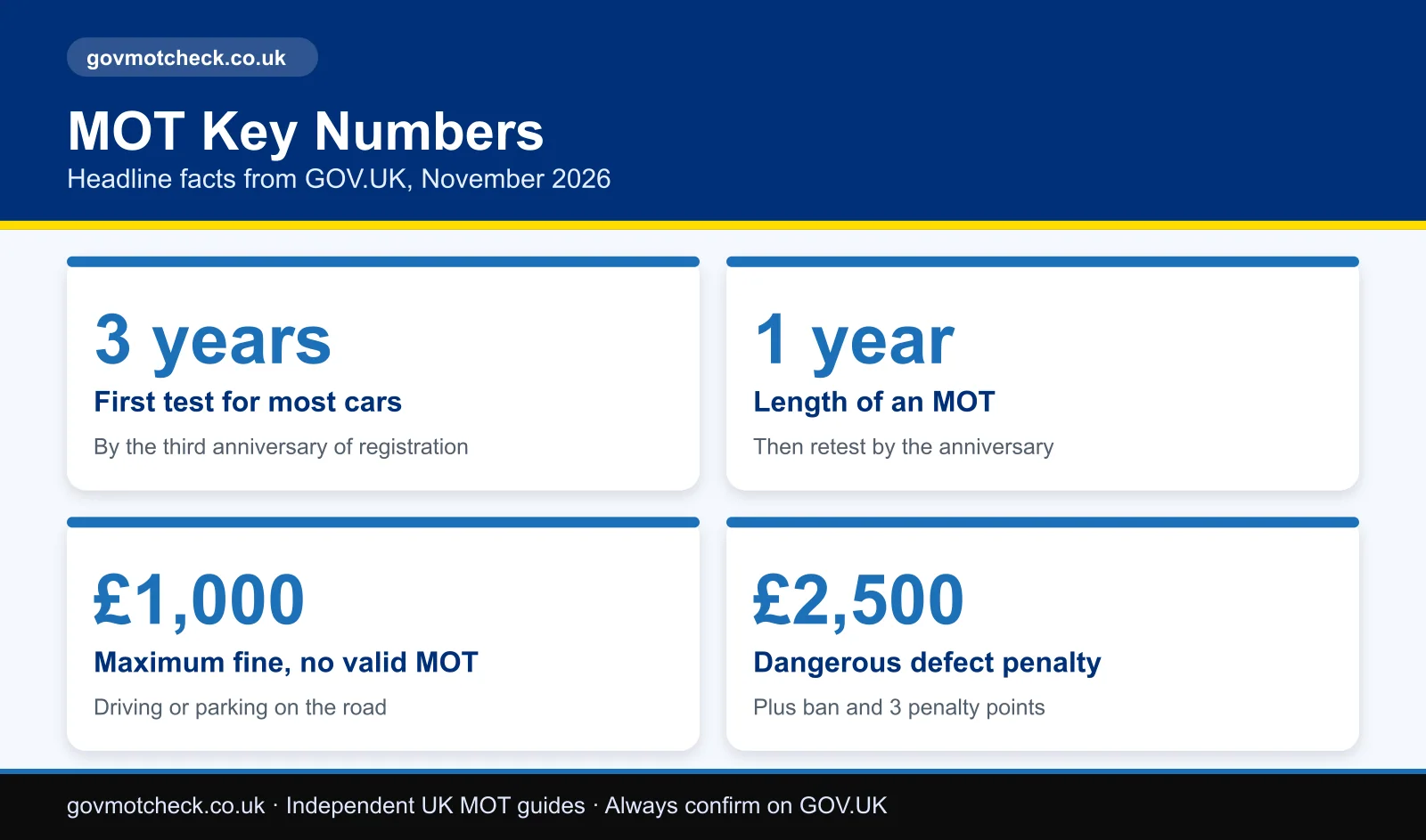
The test is a snapshot. A vehicle that passes on a Tuesday morning was judged roadworthy against a published standard at that moment. The certificate says nothing about how it will behave in six months.
Understanding that single idea clears up most of the confusion drivers have about the test. It explains:
- Why a car can fail on a tiny fault: the standard is a strict checklist, not a judgement of overall condition.
- Why a fresh pass is no guarantee: the result only describes the day of the test.
- Why advisories matter: they flag wear that may become a fail later.
Important
An MOT is a legal snapshot of roadworthiness on the day, not a promise that the vehicle is reliable or well maintained.
What Does MOT Stand For?
MOT stands for Ministry of Transport. That was the name of the government department that created the test in 1960. The department has been renamed and reorganised many times since, but the three letters stuck. Today the test is run by the Driver and Vehicle Standards Agency (DVSA).
People also write it as M.O.T. or "MoT". All mean the same thing. In everyday speech, "taking the car for its MOT" is shorthand for the whole process of the test and the certificate.
Note
If you search for "mot meaning" or "mot stands for", the answer is always the same: Ministry of Transport.
Is An MOT The Same As A Roadworthiness Test?
Yes, in practice. An MOT is the British roadworthiness test for light vehicles. Other countries use different names, such as the "TÜV" in Germany or "contrôle technique" in France. The purpose is similar:
- Check that vehicles on public roads are not dangerous.
- Check that they are not excessively polluting.
What Does A Pass Actually Mean?
A pass means the vehicle met the minimum legal standard on the day of the test. It does not mean the vehicle is in perfect condition, correctly serviced or worth buying.
It also does not mean the vehicle is free from "advisory" notes, which are things the tester wants you to watch.
A pass means
The vehicle met the minimum legal standard on the day of the test.
A pass does not mean
- The vehicle is in perfect condition
- It has been correctly serviced
- It is worth buying
Warning
Do not treat a fresh certificate as proof that a used car is in good mechanical health. Buyers who rely on it alone can face expensive surprises.
MOT Meaning At A Glance
The quickest way to grasp the MOT is to see its main facts side by side. The table below summarises the essentials, based on GOV.UK guidance as of November 2026.
| Question | Short answer |
|---|---|
| What does MOT stand for? | Ministry of Transport |
| What is it for? | Checking road safety and environmental standards |
| How often? | Once a year after the first test is due |
| First test for most cars | By the third anniversary of registration |
| How long does a pass last? | One year |
| Who runs it in Great Britain? | DVSA, through approved test stations |
| What if I drive without one? | A fine of up to £1,000 is possible |
| Is the engine tested? | The condition of the engine, clutch and gearbox is not covered |
Pro Tip
Screenshot or bookmark this table if you only need the headline answers. The rest of the guide expands each row.
Why The "At A Glance" View Matters
Most searches for the meaning of MOT want a fast answer, then a way to find out more. Each row above is expanded later in this guide.
The neighbouring pages cover the topics this one deliberately leaves out:
- Booking and cost: how to book an MOT and what it costs.
- Rules and penalties: the rules and penalties for driving without one.
Where The MOT Name Comes From
The name is a historical accident that became permanent. The Ministry of Transport was set up in 1919 and later merged into other departments. Yet the roadworthiness test kept the original ministry's initials.
The Ministry Of Transport Connection
When the test began in September 1960, Minister of Transport Ernest Marples introduced it using powers in the Road Traffic Act 1956. The certificate was issued under the Ministry's authority. People naturally called it the "Ministry of Transport test", then the "MOT".
Why The Name Survived Reorganisation
The Ministry of Transport no longer exists under that name. Responsibility sits today with the Department for Transport, with DVSA running testing in Great Britain.
The initials survived because they had become a brand in their own right. They were printed on garage signs, forms and advertising for decades.
Note
The garage you visit does not work for the Department for Transport. It is a private business authorised by DVSA to carry out tests.
Is "MoT" Or "MOT" Correct?
Both appear in print. GOV.UK writes "MOT" in capitals, and this guide follows that. The lower-case "o" version is an older style seen on signs and in older books.
The History Of The MOT: 1960 To The Present
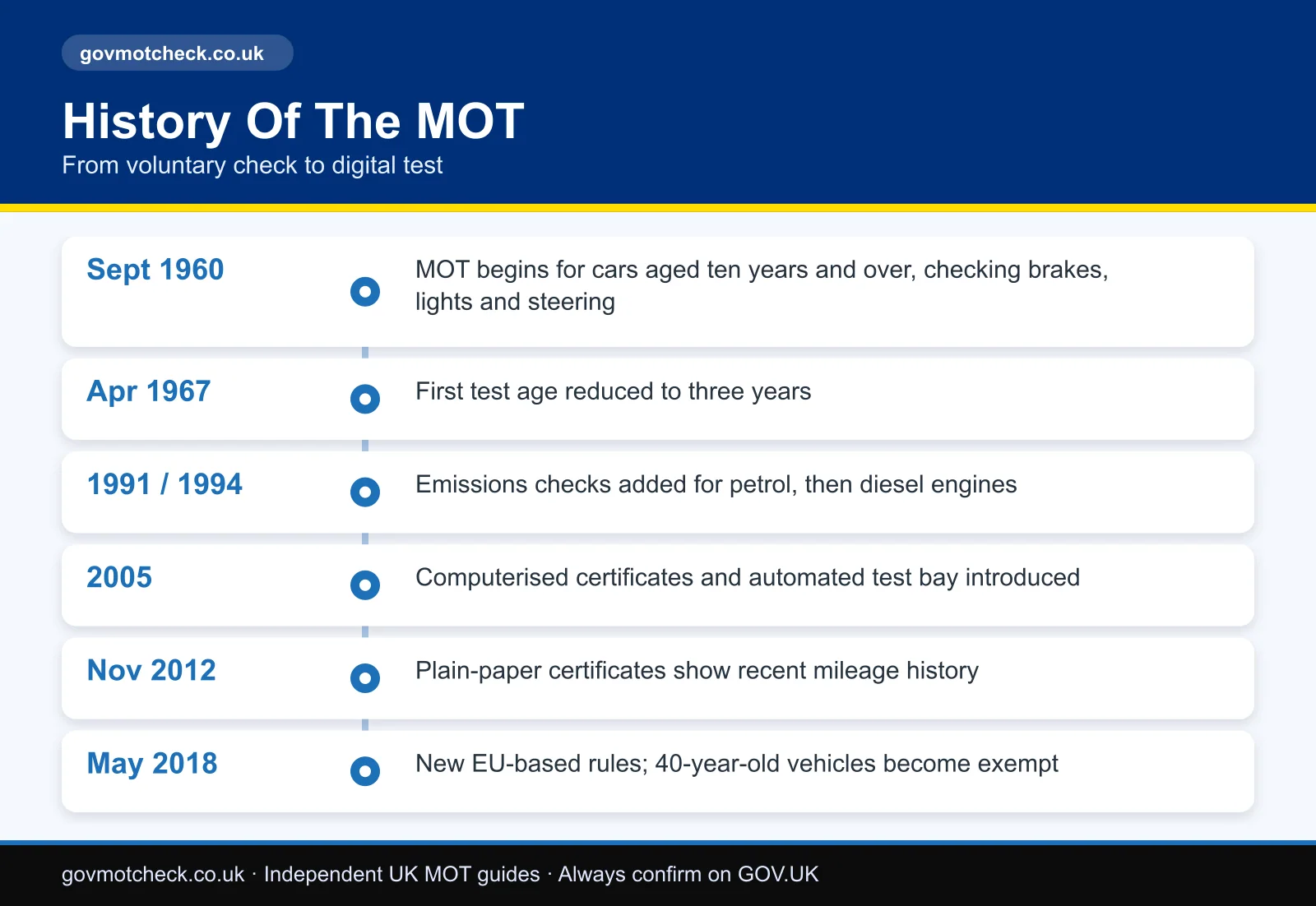
The MOT has changed from a voluntary check of three systems on ten-year-old cars to a computer-driven annual test of dozens of components. The timeline below picks out the main dates.
Dates come from published histories of the test and from GOV.UK. Check official sources if you need a legal citation.
Pro Tip
If you only remember three dates, make them 1960 (first test), 1967 (three-year test age) and 2018 (modern defect grades and the 40-year exemption).
The First MOT In 1960
The test was introduced on 12 September 1960 on a voluntary basis. It originally checked:
- Brakes
- Lights
- Steering
It applied to cars ten years old or more, then annually after that. The voluntary period ended on 15 February 1961, when the test became compulsory for vehicles of that age.
Falling Test Age Through The 1960s
A high failure rate in the early years led the government to reduce the age at which cars needed a test. From the end of 1961 the age came down to seven years. In April 1967 it was reduced to three years, the figure that still applies to most cars today.
Note
The first-test age fell from ten years, to seven, to the three years that applies to most cars now. A younger car is therefore tested much sooner than it was in 1960.
Commercial Vehicles And The Tax Disc
In 1962 the first commercial vehicle test was created. A valid certificate also became a requirement for getting a tax disc.
That link between roadworthiness and vehicle tax is still visible today. GOV.UK says you cannot renew vehicle tax without a valid MOT unless the vehicle is declared off the road. The details of this relationship are covered on the MOT and tax check page.
Note
The link between vehicle tax and a valid MOT is still in force today, even though it began with the tax disc.
How The MOT Test Grew Over The Decades
The scope of the test has widened gradually. New items were added as vehicle technology, safety expectations and environmental policy developed.
Tyres, Wipers And Structure
A tyre check arrived in 1968. By 1977 the test also covered:
- Wipers and washers
- Indicators and brake lights
- The horn
- The exhaust system
- The body structure and chassis
A stricter tyre tread depth requirement followed in 1992 for most vehicles.
Emissions Testing
Emissions checks for petrol engines were added in 1991, and for diesel engines in 1994. These checks are the main reason GOV.UK describes the test as covering "environmental" as well as safety standards.
Important
Emissions are part of the pass or fail decision, which is why a lit engine warning light or visible smoke can matter even when the car drives well.
Modern Systems And Electronics
Checks on anti-lock braking, rear wheel bearings, rear wheel steering and rear seat belts were added in 1991.
In 2012, checks were added for:
- Secondary restraint systems such as airbags
- The battery and wiring
- Electronic stability control
- Speedometers
- Steering locks
These additions show how the test follows what manufacturers fit to cars.
The 2005 To 2018 Modernisation
The test moved from paper to computer in stages. By the late 2010s, every test result was entered directly into a central database.
Computerisation In 2005
A computerised system for issuing certificates was introduced in 2005, alongside the Automated Test Bay. This meant results began to be recorded centrally rather than only on paper at the garage.
Plain-Paper Certificates And Mileage History
In 2012, plain-paper certificates replaced the older pre-printed ones in Great Britain. From 18 November 2012, certificates began to show recent mileage history. That is one reason the MOT record is so useful when you check an MOT history before buying.
Pro Tip
Mileage on the record is one of the quickest ways to spot a clocked car. Look for readings that rise steadily year on year.
The 2018 Changes
On 20 May 2018, testing in England, Scotland and Wales was changed to comply with EU Directive 2014/45. Two changes stand out:
- 40-year exemption: vehicles first registered at least 40 years earlier became exempt from testing.
- Defect grading: faults were graded into the dangerous, major and minor categories still used today.
Who Runs The MOT Today?
Responsibility is shared between several bodies, and the split differs between Great Britain and Northern Ireland.
DVSA: The Test Regulator
The Driver and Vehicle Standards Agency (DVSA) does four main jobs:
- Sets the testing standards.
- Publishes the inspection manuals.
- Authorises test stations and testers.
- Manages the MOT testing service in Great Britain.
DVLA: The Vehicle Record Keeper
The Driver and Vehicle Licensing Agency (DVLA) keeps the vehicle register and handles vehicle tax (Vehicle Excise Duty, or VED). It uses the MOT record to check whether a vehicle can be taxed, which is why the two systems are closely linked.
Note
DVSA tests and regulates. DVLA registers and taxes. Keeping the two apart helps when you are working out who to contact.
DVA In Northern Ireland
Northern Ireland has its own scheme run by the Driver and Vehicle Agency (DVA). GOV.UK states that Northern Ireland has different rules and processes for vehicles registered there. If you live there, read the Northern Ireland MOT guide rather than relying on figures for Great Britain.
MOT In Great Britain And Northern Ireland
The headline idea is the same in both places: a regular check of roadworthiness. The details differ, so treat each scheme as its own system.
Different Agencies, Different Processes
Great Britain
Tests happen at DVSA-authorised stations, and the results go into the national MOT history database.
Northern Ireland
The DVA runs testing, with its own centres and booking process.
Moving A Vehicle Between The Two
GOV.UK says that if your last MOT was in Northern Ireland and your next test is in Great Britain, the renewal date is based on the Great Britain test. If you are moving a vehicle, check both agencies' guidance before the move.
Warning
Do not assume a Northern Ireland certificate or date carries over unchanged. Check both agencies' guidance before the move so you do not drive without a valid test.
Read the Northern Ireland guide
Who Needs An MOT?
Most vehicles used on public roads in Great Britain need an MOT once they reach the relevant age, including cars, vans, motorcycles, and many larger passenger vehicles. The requirement attaches to the vehicle, not the driver.
Cars, Vans And Motorcycles
A privately owned car is the standard case. The rule also covers light commercial vehicles such as small vans, and motorcycles. Class details are in the classes overview later in this guide. Bikes, vans and electric vehicles are covered fully in the guide to MOT rules for motorcycles, vans and EVs.
Does A Leased Or Company Vehicle Need One?
Yes. The legal duty is about the vehicle, so a lease car, a company car and a fleet van all need valid MOTs.
Usually the registered keeper is responsible for arranging it, but your lease or company terms may allocate the task. Check your agreement.
Pro Tip
If you drive a company car, ask the fleet manager in writing who books the MOT and who pays for repairs.
Do You Need An MOT To Sell A Car?
You are not required to have a valid MOT merely to sell a car. However, a car without one cannot lawfully be driven on the road except to a pre-arranged test or repair.
Buyers also tend to treat a long MOT as a selling point, so a fresh certificate can help a sale.
Which Vehicles Do Not Need An MOT?
Some categories of vehicle are exempt. GOV.UK lists:
- Electric goods vehicles registered before 1 March 2015.
- Tractors.
- Some historic vehicles.
- Any type listed on the MOT exemption form (V112).
Note
Exemption depends on the vehicle type and its history. Check the current GOV.UK list for your exact vehicle.
The 40-Year Rule In Brief
Vehicles first registered at least 40 years ago can qualify as historic if they have not been substantially changed. The owner must declare this. This guide only mentions it for context, and the full conditions are on the MOT rules and exemptions page.
Lorries, Buses And Trailers
GOV.UK says lorries, buses and trailers do not need an MOT but do need an annual test instead. This is a separate regime run for heavy vehicles, with its own manuals.
When Is The First MOT Due?
GOV.UK says your vehicle must be tested by the third anniversary of its registration. After that, it must be tested by the anniversary of its last MOT, once it is over three years old.
Important
The three years run from the date of registration, not from the date you bought the vehicle.
The Three-Year Rule For Most Cars
The first test is not due on the three-year anniversary of the car being bought. It runs from registration. For worked date examples and the early-test window, see the MOT due date guide.
Worked example
A car first registered on 10 June 2023 would need its first MOT by 10 June 2026.
Vehicles That Need A Test At One Year
Most cars
First test by the third anniversary of registration.
Taxis, ambulances and similar
Some vehicles must be tested at one year old. Check the current GOV.UK table.
Some vehicles must be tested at one year old. According to the GOV.UK fees table, these include:
- Ambulances
- Taxis
- Private passenger vehicles with nine or more passenger seats
- Playbuses
The table is category-specific, so check the current GOV.UK table for your exact vehicle.
How Long Does An MOT Certificate Last?
An MOT lasts for one year. GOV.UK states you can see the expiry date in the MOT history service or on your certificate.
Testing Early Without Losing Time
You can have the test done up to a month minus a day before expiry and keep the same renewal date. Test any earlier and the new certificate runs a year from the pass date instead.
Worked example
If the MOT expires on 15 May, the earliest date that preserves it is 16 April. A pass on 14 April would make the new expiry 13 April the following year.
Pro Tip
Set a calendar reminder for about six weeks before expiry so you have time to book and repair.
What Happens When It Runs Out?
You cannot drive or park the vehicle on the road with an expired MOT, with two exceptions:
- Driving it to or from a repair.
- Driving it to a pre-arranged MOT test.
Penalties and insurance consequences are set out in the guide to the rules.
Warning
Driving without a valid MOT can lead to a fine of up to £1,000, and it may affect your insurance.
What Does An MOT Check?
An MOT checks the parts of a vehicle that matter most for road safety and emissions, working through a fixed set of areas defined in the DVSA inspection manual. GOV.UK says "important parts on your vehicle will be checked to make sure they meet the legal standards".
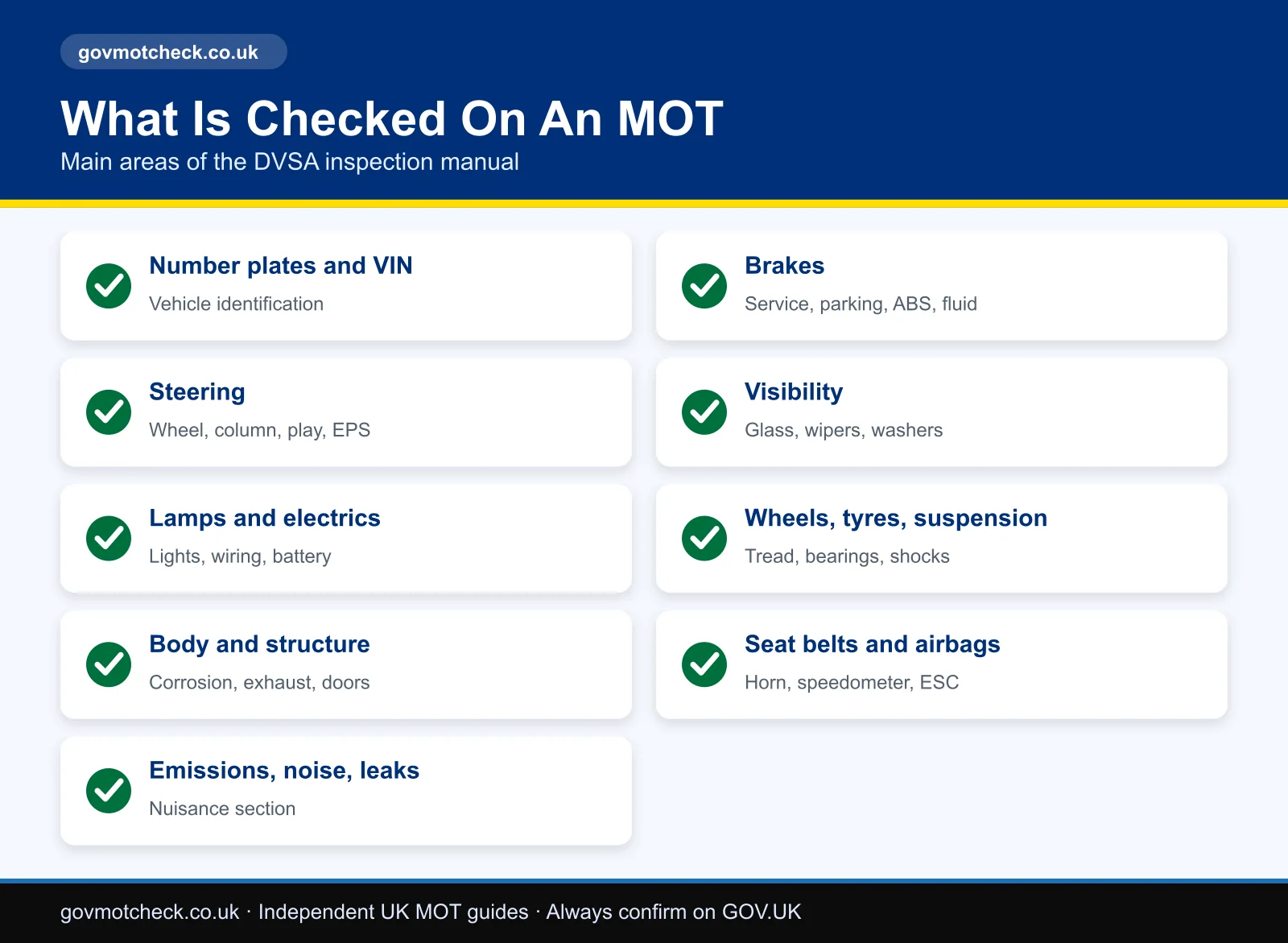
The official manual for cars, private buses and light commercial vehicles (classes 3, 4, 5 and 7) is organised into numbered sections. Using the manual's own structure is the clearest way to answer "what is checked on an MOT" without missing anything.
Pro Tip
Skim the section headings on this page before your test. They follow the same order the tester uses.
What Is Checked On An MOT, In One List
At a minimum, the test covers:
- Vehicle identification: number plates and the VIN.
- Brakes and steering.
- Visibility: glass, wipers and washers.
- Lamps and electrical equipment.
- Axles, wheels, tyres and suspension.
- Body and structure.
- Other equipment such as seat belts and the horn.
- Nuisance items such as emissions and noise.
The sections below take each in turn.
Safety systems
- Brakes and steering
- Lamps and electrical equipment
- Seat belts and airbags
Identification and environment
- Number plates and the VIN
- Visibility: glass, wipers and washers
- Emissions and noise
Where The Checklist Comes From
The checks are not decided by individual garages. They come from the DVSA MOT inspection manual, which as of November 2026 was last updated on 14 October 2026 and was first published on 20 May 2018.
Every authorised tester works to the same document, which is why a fail at one station should be a fail at another.
Note
The manual is updated from time to time, so the exact wording of a rule can change. Check GOV.UK for the current version.
The MOT Inspection Manual Sections
The manual has sections numbered 0 to 10 plus three appendices. The table below maps each to what it covers, using the descriptions on the GOV.UK manual page.
| Section | Title | Examples of what it covers |
|---|---|---|
| 0 | Identification of the vehicle | Number plates, vehicle identification number (VIN) |
| 1 | Brakes | Condition and operation, parking brake, ABS, brake fluid |
| 2 | Steering | Wheel, column, steering play, electronic power steering |
| 3 | Visibility | Field of vision, glass, wipers, washers |
| 4 | Lamps, reflectors and electrical equipment | Headlamps, indicators, stop lamps, wiring, battery |
| 5 | Axles, wheels, tyres and suspension | Wheel bearings, tyres, springs, shock absorbers |
| 6 | Body, structure and attachments | Structure, exhaust system, doors, seats |
| 7 | Other equipment | Seat belts, airbags, horn, speedometer, ESC |
| 8 | Nuisance | Noise, exhaust emissions, engine warning light, leaks |
| 9 | Supplementary tests for buses and coaches | Doors, emergency exits, grab handles, steps |
| 10 | Seat belt installation checks | Larger, older passenger vehicles |
The Appendices
The three appendices support the main sections:
- Appendix A: structural integrity and corrosion.
- Appendix B: tyre load index tables.
- Appendix C: seat belt fitment tables.
Testers use these to judge borderline cases, for example whether corrosion near a structural point is serious enough to fail.
Why The Manual Matters To Drivers
You can read the same manual the testers use. It is the best source if a result seems odd, and it is cited when reviewing disputes.
If you need the next step after a fail, the guide to MOT failures and advisories explains how defects are graded and fixed.
Pro Tip
If you disagree with a defect, note the manual section it relates to before you speak to the garage. It makes the conversation much more precise.
Vehicle Identification Checks
The test begins by confirming the vehicle is what its documents and plates say it is. Section 0 of the manual covers number plates and the vehicle identification number.
Number Plates
Plates must be present, secure, legible and correctly formatted. A cracked plate, unusual spacing or non-standard characters can all cause problems. The tester also checks that the plate matches the registration the test is booked under.
Warning
A damaged or badly spaced plate is an easy thing to overlook, but it can cost you a fail. Check it in good light before you go.
VIN And Identification
The VIN is a unique identifier stamped on the vehicle. A VIN that is missing, illegible or inconsistent can be a reason for refusing the test, according to the manual's list of refusal reasons.
Brakes
Brakes are one of the largest areas of the test. The manual covers the condition and operation of:
- The service brake
- The secondary brake
- The parking brake
- ABS (anti-lock braking system), EBS and brake fluid
How Brakes Are Measured
Testers normally use a roller brake tester, which measures the braking force at each wheel and checks for imbalance between the two sides of an axle. The manual recommends doing the brake performance test after the rest of the inspection, to reduce risk from defects not yet found.
What Commonly Goes Wrong
Typical findings include:
- Worn or corroded discs.
- Seized calipers.
- Leaking brake pipes.
- Low fluid.
- A parking brake that does not hold.
Detailed fixes belong on the failures page, but the principle is simple: brakes must stop the car evenly and reliably.
Important
If the car pulls to one side under braking or the handbrake feels weak, get it checked before the test rather than hoping it passes.
Steering
The steering section covers the mechanical condition of the steering system, the wheel and column, steering play, and electronic power steering (EPS).
Play And Wear
The tester checks for excessive movement in joints, rack ends and the column. Steering that is loose or stiff, or a column that is insecure, can fail the test.
Electric Power Steering Warnings
Cars with electronic power steering may show a dashboard warning if the system has a fault. The manual includes EPS checks, so a lit steering warning is something testers take seriously.
Note
A steering warning light is not just a nuisance. Have it diagnosed before the test, not after a fail.
Visibility
Visibility checks make sure the driver can see properly. They cover:
- Field of vision
- Bonnet catches
- Glass condition
- View to the rear
- Windscreen wipers and washers
Windscreen Damage
Likely to fail
A chip or crack in the driver's line of sight, a split wiper blade, or an empty washer bottle.
Easy to prevent
Replace tired wiper blades and top up the screen wash before the test.
Chips or cracks in the driver's line of sight can fail. The manual sets rules about where damage is acceptable and its size, so a small chip at the edge may pass while the same chip in front of the driver may not.
Wipers And Washers
Wipers must clear the screen effectively and washers must work. A split blade or an empty washer bottle that does not spray is a common, cheap-to-fix failure.
Pro Tip
Replace tired wiper blades and top up the screen wash before the test. It costs little and removes an easy fail.
Lamps, Reflectors And Electrical Equipment
Section 4 covers:
- Headlamps and position lamps
- Daytime running lamps
- Stop lamps, indicators and hazard lamps
- Fog lamps and reversing lamps
- Warning lights (tell-tales)
- The trailer electrical socket
- Electrical wiring and the battery
Bulbs, Aim And Condition
The tester checks that each lamp works, is the right colour, and is securely fitted. Headlamp aim is also measured with approved equipment, so a bulb that lights but points too high can still cause a fail.
Warning Lights On The Dashboard
Tell-tales such as the ABS and airbag lights must work as designed and should not show a fault. A warning that stays lit generally points to a defect the tester will record.
Warning
A dashboard warning light that stays on after you start the engine is likely to be recorded as a defect.
Axles, Wheels, Tyres And Suspension
Section 5 covers axles, wheel bearings, wheels and tyres, the tyre pressure monitoring system (TPMS) and suspension components such as springs, shock absorbers, arms and joints.
Tyres
Testers check condition, size, type, load and speed rating, and tread depth. The following can all cause a fail:
- Cuts
- Bulges
- Exposed cords
- Mismatched types on one axle
Tread depth is judged against the legal minimum, and the manual includes tyre load index tables in Appendix B.
Pro Tip
Walk round the car and look at the inner sidewalls as well as the outer ones. Damage often hides where you do not usually look.
Suspension And Wheel Bearings
Corroded springs, leaking shock absorbers, worn bushes and play in wheel bearings are checked by hand and by lifting the car. These items can feel subtle when driving, which is one reason an MOT catches things owners miss.
Body, Structure And Attachments
Section 6 deals with structure and attachments, including the exhaust system and bumpers, and the body and interior, including doors, catches, seats and the floor.
Corrosion And Structural Integrity
Rust is judged by where it is, not just how much there is. Corrosion near a load-bearing area such as a suspension mounting or seat belt anchorage is treated much more seriously than surface rust on a panel. Appendix A of the manual sets the detailed rules.
Important
A small patch of rust on a structural point can matter more than a large patch on a door panel.
Exhaust System And Bumpers
The exhaust must be secure, free from serious leaks and not likely to fall off. Bumpers and body panels must not have sharp edges likely to injure pedestrians. Doors must open and latch properly.
Seat Belts, Airbags And Other Equipment
Section 7 covers:
- Seat belts and restraint systems
- Airbags
- Anti-theft devices
- The horn
- The speedometer
- Any speed limiter
- Electronic stability control (ESC)
Seat Belts
Belts are checked for condition, security, operation and locking. They must latch, retract and show no serious damage to the webbing. The test also checks that each seat belt that should be fitted is present.
Pro Tip
Pull each belt out fully and let it retract. Fraying or a belt that sticks is easy to spot and worth fixing early.
Horn, Speedometer And Stability Control
The horn must work and be suitable. The speedometer must be fitted and working. ESC is checked on cars where it is a required fitment, typically via the warning lamp.
Noise, Emissions And Leaks
Section 8, "Nuisance", covers noise, exhaust emissions, the engine malfunction indicator lamp (often called the engine management light) and fluid leaks.
Exhaust Emissions
Petrol cars
Emissions are measured with a gas analyser.
Diesel cars
Emissions are measured with a smoke meter, and the manual includes DPF checks.
Emissions are measured with a gas analyser on petrol cars and a smoke meter on diesels. The test compares readings with limits that depend on the vehicle's age and fuel type. A lit engine management light can fail the test regardless of the readings.
Warning
Do not clear a warning light just before the test and hope for the best. If the fault is real, it can still cause a fail.
Diesel Particulate Filters
On diesel cars, the manual contains checks for the diesel particulate filter (DPF) and visible smoke. Smoke of a certain colour or density can lead to a fail, and substantial avoidable smoke is a reason for a tester to refuse the test.
Leaks
Fluid leaks that are serious enough to be a hazard, such as fuel or heavy oil dripping onto the road, can cause a fail.
How Electric And Hybrid Vehicles Are Tested
Electric and hybrid vehicles take the same test as petrol and diesel ones, with adjustments. They do not have exhaust emissions to measure, but all other safety checks still apply.
High-Voltage Components
The manual advises testers to avoid touching high-voltage components and their wiring, which is typically orange. The test is a visual and functional one, and testers do not dismantle high-voltage systems.
Note
Electric cars still need brakes, tyres, lights, steering and seat belts to meet the same standards as any other car.
EV Weight And Brakes
Because electric cars are heavy and often use regenerative braking, brake and tyre wear can show up differently. For class-specific points, see the dedicated motorcycle, van and EV MOT guide.
What An MOT Does Not Cover
An MOT does not check everything on a car. It sets a minimum legal standard for specific systems, then stops. Knowing the gaps protects you from false confidence.
Engine, Clutch And Gearbox
What the MOT checks
Road safety and environmental standards, including brakes, steering, lights, tyres and emissions.
What it does not cover
The condition of the engine, clutch or gearbox, and routine servicing.
GOV.UK states plainly that the MOT "does not cover the condition of the engine, clutch or gearbox". A car can pass with a worn clutch or a rough engine, provided emissions and safety checks are met.
Important
A pass says nothing about the engine, clutch or gearbox. Budget for those separately.
Other Things Outside The Test
There is no road test as part of the statutory MOT. The manual says a road test is permitted only to check inspection results. The test is also carried out without dismantling, so items that cannot be reached are not fully inspected.
Service Items
The test does not replace servicing. These are service matters, not MOT matters:
- Oil levels
- Filters
- Spark plugs
- Cambelts
- Coolant condition
- Air conditioning
- General mechanical health of the engine
The MOT versus service comparison later in this guide explains the difference in detail.
What Does The MOT Not Tell You About A Used Car?
An MOT history is valuable, but it is not a full inspection of a used car. It confirms roadworthiness at past dates and records mileage, failures and advisories.
Mileage And Defect Trends
Mileage readings at each test help you spot a suspicious drop. Repeated advisories for the same item, such as corrosion, suggest an issue that has been developing for years. The MOT history check guide shows how to read these records.
Pro Tip
Open the history in one tab and the advert in another. Compare the mileage and the dates line by line.
What You Still Need To Check
A pass cannot tell you about:
- Previous accident repairs that look sound.
- Finance or ownership problems.
- Engine wear.
Combine the record with a test drive and, for higher-value cars, an independent inspection.
Special Cases The Manual Covers
The inspection manual includes detailed rules for unusual vehicles. These explain why some tests take longer or follow different steps.
Historic And Modified Vehicles
Historic vehicles over 40 years old that have not been substantially changed may be exempt, though owners can still ask for a test. Extensively modified vehicles, such as a rally car, may be exempt from some "missing where fitted as standard" defects, but minor modifications do not qualify.
Note
Do not assume your modified car counts as "extensively modified". The manual says minor modifications do not qualify, so ask the test station if you are unsure.
Narrow-Track Vehicles
Narrow-track vehicles may be inspected on hard standing if the headlamp aim test can still be done on approved equipment. Where a roller brake test is not possible, a decelerometer test is required.
Disabled Drivers' Controls
Controls that are additional to standard ones and do not affect standard equipment are not testable, though the tester should report defects in them to the owner.
How Is An MOT Test Carried Out?
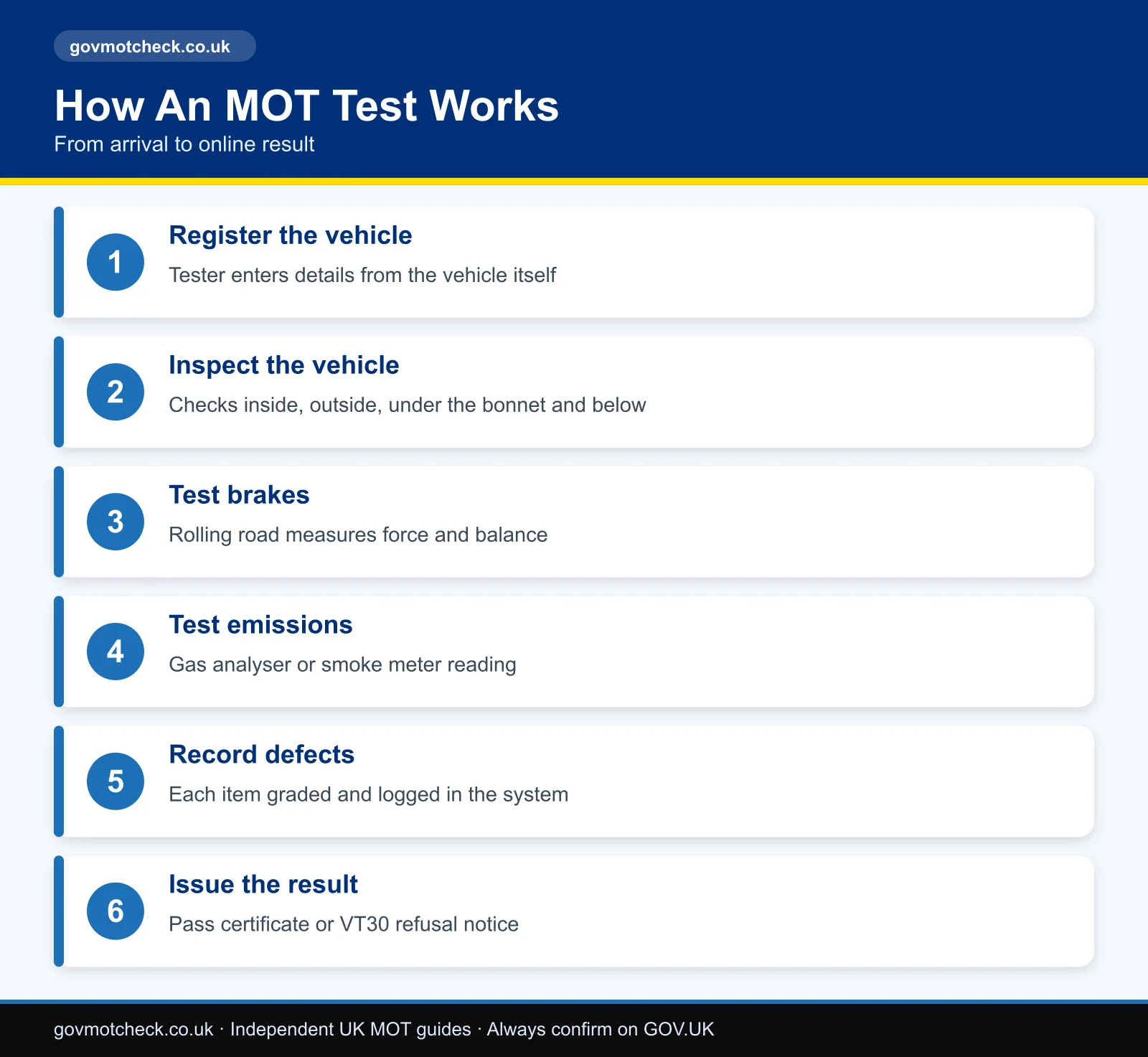
An MOT is carried out by a DVSA-authorised tester at an approved test station, who works through the inspection manual using specialist equipment and records every result on the national MOT testing service. The process is the same shape for most cars.
Pro Tip
Knowing the four steps below helps you ask better questions at the garage and understand what the tester is doing.
Step 1: Registering The Vehicle
Before inspecting anything, the tester registers the vehicle on the MOT testing service. The manual says vehicle details must come from the vehicle itself, not from the V5C registration certificate, a job card or a previous record. The V5C is the logbook issued by the DVLA.
Step 2: The Inspection
The tester checks the vehicle from several positions:
- Standing at the side
- Inside the cabin
- Under the bonnet
- From below, on a ramp or in a pit
The manual says the tester must carry out the test personally, using approved equipment, without avoidable distraction.
What the tester does
Registers the vehicle, inspects it, runs the brake and emissions tests, and records every defect.
What the tester does not do
Take a road test as part of the statutory MOT, or repair faults and then pass the car.
Step 3: The Brake And Emissions Tests
Brake performance is measured on rollers, and the emissions test is done with a probe in the exhaust or a smoke meter. The manual notes the emissions test may be done first if the engine is warm, while the brake test is better done last.
Step 4: Recording The Result
Every defect is selected from a component-based menu in the testing service, and the tester chooses the right severity. The result then goes into the national MOT database, which is what you see when you check the history online.
Note
Because the result goes straight into the central database, the garage cannot quietly change it afterwards.
Does The Tester Drive The Car?
The tester may move the car in the bay, but the statutory MOT does not include a road test. The manual permits a road test only to check findings from the inspection, and only if the tester is licensed to drive the vehicle and satisfied it is safe.
Why There Is No Road Test
The MOT is built around static and rolling-road measurements that can be repeated on any day. Road tests would introduce variables such as traffic, weather and driving style.
What This Means For Noises And Rattles
A noise that only occurs at speed may not be reproduced in a test bay. If you are worried about a knock or vibration, tell the tester when you hand the car over, though they can only record defects that fall within the test.
Pro Tip
Write down when a noise happens, such as over bumps or when turning, and give the note to the tester or garage reception.
How Long Does An MOT Take?
A typical car MOT takes less than an hour of test time, though GOV.UK does not publish an official duration and the total depends on your test centre. Treat any figure as a guide and ask when you book.
How Long Does An MOT Take For A Car?
Many centres quote about 45 minutes to an hour of actual testing for a standard car, but that is an industry norm rather than an official figure.
The test itself is not timed by the regulator. The time reflects the number of checks, how easy the car is to inspect and how busy the station is.
Note
There is no official MOT duration, so treat any quoted time as an estimate from the garage.
How Long Does An MOT And Service Take?
If you combine an MOT with a service, expect it to take considerably longer, often half a day or more, because the service work is separate from the test. The garage will usually tell you a collection time when you book. Whether to combine them is covered in the MOT versus service section below.
What Affects The Length Of A Test?
Several things make a test longer or shorter:
- The vehicle type: larger vehicles and vans take more time than small cars.
- Defects found: a failed item may need to be re-examined and recorded in detail.
- Access: heavily modified or dirty vehicles can slow the process.
- Queues: a busy centre may have a waiting list before the test even begins.
- Retests: if you repair on the spot, a partial retest adds time.
Pro Tip
Book an early-morning slot and ask for the likely collection time. It is the simplest way to avoid a wasted day.
How Long Does An MOT Take To Show Online?
The result is entered into the testing service when the test finishes, and it normally appears in the MOT history shortly afterwards. If it has not appeared after a day or so, ask the test centre to confirm it has been submitted. The MOT certificate guide explains what to do if a record is missing.
What Should You Bring To An MOT?
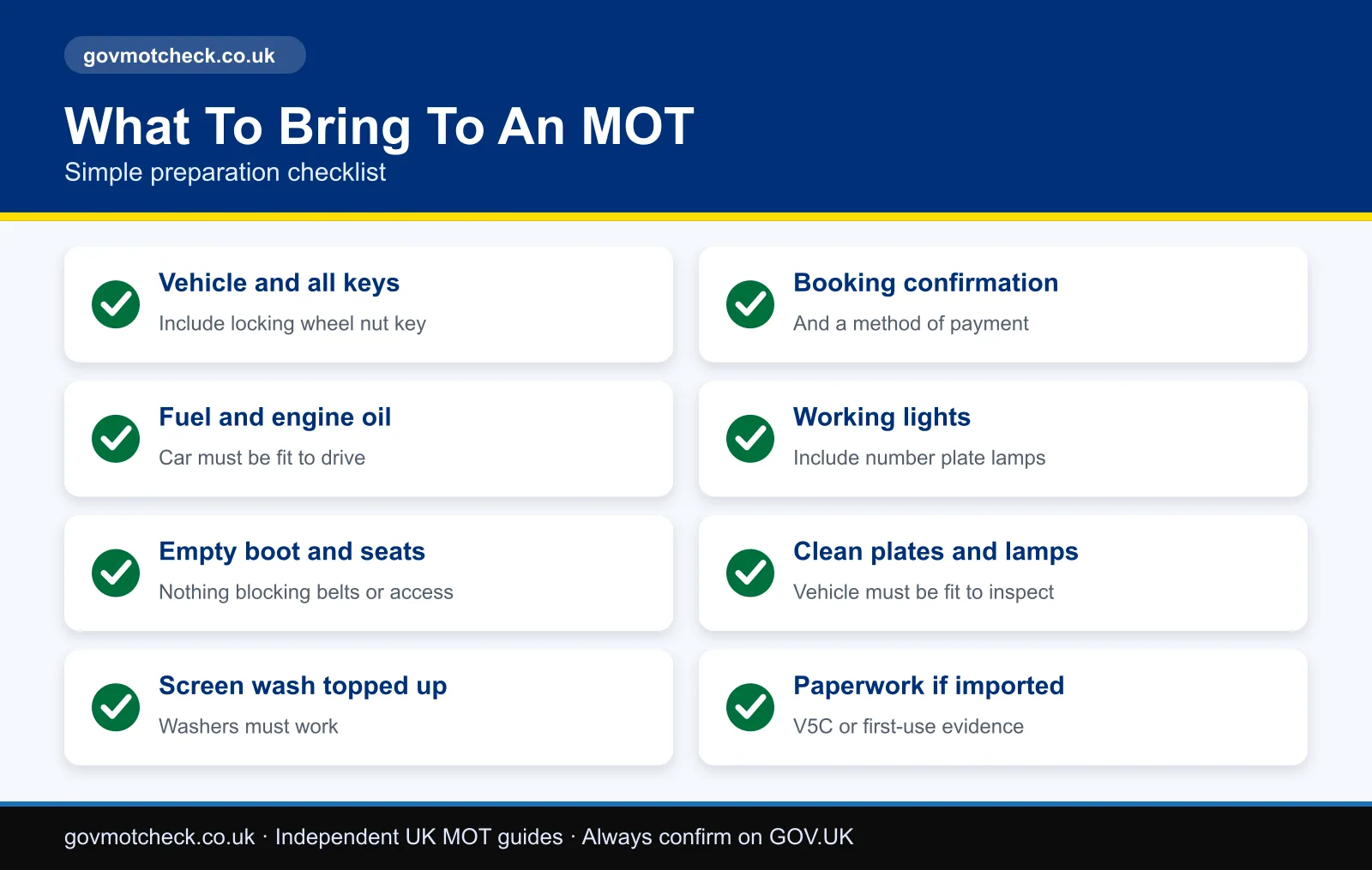
You need to bring the vehicle, its keys and any locking wheel nut key. You do not normally need the V5C or an old certificate, because the tester takes vehicle details from the vehicle and the MOT database.
| Item | Needed? |
|---|---|
| Vehicle and keys | Yes |
| Locking wheel nut key | Yes, if fitted |
| V5C logbook | Usually not; take it if first-use date is unclear |
| Booking confirmation | Sensible |
| Fuel and oil in the car | Yes |
Important
Do not forget the locking wheel nut key. Testers need to remove wheels in some circumstances, and a missing key can hold up the test.
Documents
GOV.UK's pages on the test do not list required documents, and the manual says details must come from the vehicle rather than the V5C. Some older or unusual vehicles can be an exception.
The manual lists failure to produce the V5C or other evidence of first use as a reason a tester may refuse a test in certain cases, for example where the first-use date is unclear. Take any paperwork you have if your vehicle:
- Has a private plate.
- Was imported.
- Has no clear history.
Locking Wheel Nut Key And Other Keys
If the car has locking wheel nuts, bring the key. Testers need to remove wheels in some circumstances. Also bring any key needed to open a locked glovebox, boot or fuel flap if those areas need to be accessed.
Payment And Booking Details
Bring your booking confirmation and a method of payment. Fees are set by centres up to a maximum fee for each vehicle class, and the specifics are on the booking and cost page.
Pro Tip
Keep the booking confirmation on your phone in case you are stopped on the way to the test.
How To Prepare Your Car For An MOT
You can avoid many failures with a ten-minute check. Preparation does not change the standard, but it can stop a fail over something trivial.
A Quick Pre-Test Walk-Around
Before the test
- Check every light, including number plate lamps
- Top up fuel, oil and screen wash
- Clear the boot of heavy loads
Common mistakes
- Arriving with a warning light on
- Forgetting the locking wheel nut key
- Bringing a very dirty car
Work through this quick list:
- Lights: check every light works, including number plate lamps and brake lights, which a helper can watch while you press the pedal.
- Horn: make sure it sounds.
- Wipers and washers: check they clear and spray.
- Tyres: look for obvious damage.
Worked example
Ask a friend to stand behind the car while you press the brake pedal, then repeat with indicators and reverse. Any bulb that does not light is a cheap fix before the test.
Fluids And Fuel
Make sure there is enough fuel and engine oil for the test. The manual lists a vehicle not fit to be driven, for example due to lack of fuel or oil, as a reason for a tester to refuse the test. Top up the screen wash too.
Warning
Arriving with an empty tank or low oil can mean the test is refused before it starts.
Empty The Car
The manual lists a load or items that would prevent a proper test as a reason to refuse. Remove:
- Heavy loads.
- Roof boxes that obstruct inspection.
- Clutter that blocks seat belts or access to the boot.
A boot that is full of luggage may need emptying if items obstruct the tester.
Clean Enough To Inspect
A vehicle that is too dirty for examination is another reason for refusal in the manual. It does not need to be spotless, but the underside, number plates and lamps should be visible.
Can You Watch Your MOT?
Yes. GOV.UK says you can watch from a viewing area but you cannot interrupt the tester. This is useful for understanding any failure.
Why Watching Is Useful
Seeing a worn tyre or a leaking shock absorber with your own eyes makes it easier to judge a repair estimate. If a tester shows you a defect, you can ask where it is and what the manual requires.
Pro Tip
Ask the tester to point out any failed item afterwards, once the test is finished, and take a photo if allowed.
What Not To Do
Do not talk to the tester during the test or ask them to ignore a fault. Testers must follow the manual, and being distracted can lead to errors.
How MOT Defects Are Categorised
Every fault the tester records is graded dangerous, major, minor or advisory. The first two cause a fail; the last two do not.
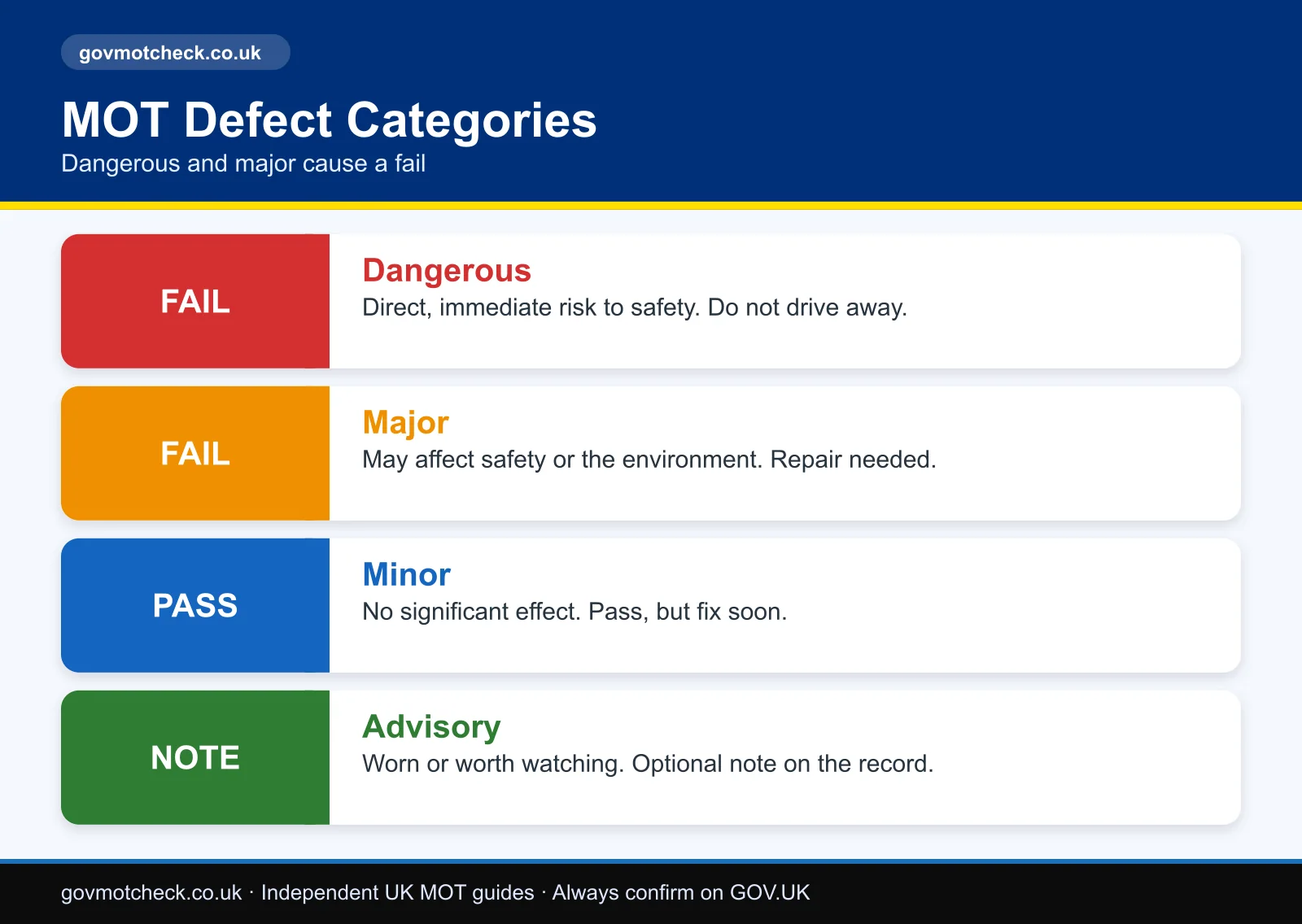
The table below sets the four categories side by side.
| Category | Result | What it means |
|---|---|---|
| Dangerous | Fail | Direct and immediate risk; do not drive away |
| Major | Fail | May prejudice safety or the environment |
| Minor | Pass | No significant effect; fix soon |
| Advisory | Pass | Worn or worth watching; optional note |
Important
Only dangerous and major defects cause a fail. Minor and advisory items still appear on the record.
Dangerous Defects
Dangerous or major: fail
A dangerous defect blocks you from driving the vehicle away. A major defect may prejudice safety or the environment.
Minor or advisory: pass
The vehicle passes. Fix these soon, as they still appear on the record.
A dangerous defect is a direct and immediate risk to road safety or a significant environmental impact. GOV.UK says it blocks you from driving the vehicle away.
Driving a vehicle that failed for a dangerous problem can lead to a fine of up to £2,500, a driving ban and 3 penalty points.
Warning
Do not drive a vehicle away after a dangerous defect. The penalties are a fine of up to £2,500, a driving ban and 3 penalty points.
Major Defects
A major defect may prejudice safety, affect the environment, put other road users at risk, or involve other significant non-compliances. It causes a fail.
You may be able to drive the vehicle away if your current MOT is still valid and no dangerous problems were listed, but it must still meet the minimum roadworthiness standards.
Minor Defects
A minor defect has no significant effect on safety or the environment. A vehicle with only minor defects passes and receives a certificate. It is sensible to fix them soon.
Advisories
Advisories are notes of items that are worn, close to failing or worth watching. They are optional for the tester, and they appear on the record. See the full guide to failures and advisories for how to read them and what to do next.
Note
An advisory is not a fail, but it is the tester telling you what is likely to need work soon.
What Happens After The MOT Test?
You will either receive a pass with a certificate or a fail with a refusal notice. Both are recorded on the national database.
If The Vehicle Passes
The result is recorded, and you may receive a list of minor or advisory problems. You can check the result online in the MOT history service or ask the test centre for a printed certificate. See the guide to the MOT certificate for what the document shows.
If The Vehicle Fails
If it passes
Check the result online or ask for a printed certificate, and note any minor or advisory items.
If it fails
Ask for the VT30, and repair the vehicle before it goes back on the road unless you can legally drive it away.
A fail is recorded with the dangerous or major defects listed. GOV.UK says to ask the test centre for a "refusal of an MOT test certificate", known as form VT30. You can also check the result online.
Pro Tip
Ask for the VT30 before you leave the garage and keep it with your repair quotes.
Driving After A Fail
You can drive away only if your current MOT is still valid and no dangerous problems were listed. If not, you must repair the vehicle before it goes back on the road. Drive carefully to a repairer where permitted.
Retests
After repair the vehicle may need a retest. The manual says testers must re-examine:
- Previously failed items.
- Items affected by repairs.
- Any advised or minor items.
The rules on free and part-fee retests are on the failures page.
Where MOT Records Are Stored
MOT results in Great Britain are held on a central DVSA database, the MOT testing service. That is where GOV.UK's MOT history service gets its information.
Online History
Anyone can look up a vehicle's MOT history using its registration number. The history lists:
- Past tests and results.
- Mileage readings.
- Failures and advisories.
The MOT history check guide explains how to read it.
Why The Database Matters
Because records are central, a garage cannot easily alter a result later, and buyers can verify a seller's claims. If you believe a record is wrong, GOV.UK points to a separate reporting process for mistakes.
Note
If a record looks wrong, report it through the process GOV.UK describes rather than asking the garage to change it.
Who Can Carry Out An MOT?
MOTs can only be carried out by authorised testers at authorised test stations. A garage cannot test unless it is approved by DVSA.
Test Stations
Authorised stations display a blue sign with three white triangles. Stations are approved for specific vehicle classes, so a station that tests cars may not test large vans or buses.
Pro Tip
Look for the blue sign, and confirm your vehicle class is covered before you book.
Testers
Testers are individually authorised and must hold the right qualifications and meet standards. The DVSA can discipline testers who do not follow the manual, and it publishes a testing guide that covers authorisation and discipline.
Independent Versus Franchise Garages
The standard is the same at every station, whether it is a small independent garage, a fast-fit chain or a main dealer. Differences lie in price, waiting times and the repairs they offer, which are covered on the booking page.
What Equipment Is Used In An MOT?
MOT stations use approved, calibrated equipment so results are consistent across the country.
Brake Roller Testers And Headlamp Aim Testers
A roller brake tester measures braking efficiency and balance. A headlamp beam tester checks aim and intensity. The manual requires these to be approved items.
Emissions Analysers And Play Detectors
A gas analyser measures exhaust pollutants on petrol vehicles, and a smoke meter measures diesel opacity. Play detectors are used to find movement in suspension and steering joints when the wheels are lifted.
Photographs And Anti-Fraud Measures
In 2025, DVSA published a post about combating fraud, including a trial requiring testers to upload photos of the vehicle in the test bay. These measures aim to make sure tested vehicles are genuinely tested.
Reasons A Tester Can Refuse To Test
The tester must refuse in some circumstances. These are set out in the manual and are worth knowing before you arrive.
Common Refusal Reasons
According to the manual, a test must be refused or abandoned if, for example, the vehicle:
- Is too dirty for examination.
- Is not fit to be driven because of lack of fuel or oil.
- Carries a load that prevents a proper test.
- Emits substantial avoidable smoke.
- Has no identifiable registration or VIN.
A tester must also refuse if an advance fee requested is not paid.
Important
Most refusal reasons are avoidable. Fuel, oil, a clean and empty car and visible plates cover the common ones.
What Happens To Your Fee
Whether you pay for a refused or abandoned test depends on the centre. Ask when you book, and see the booking guide for what to ask.
Pro Tip
Ask the garage about its refused-test and cancellation policy at the time you book, and get the answer in writing.
What Is The Difference Between An MOT And A Service?
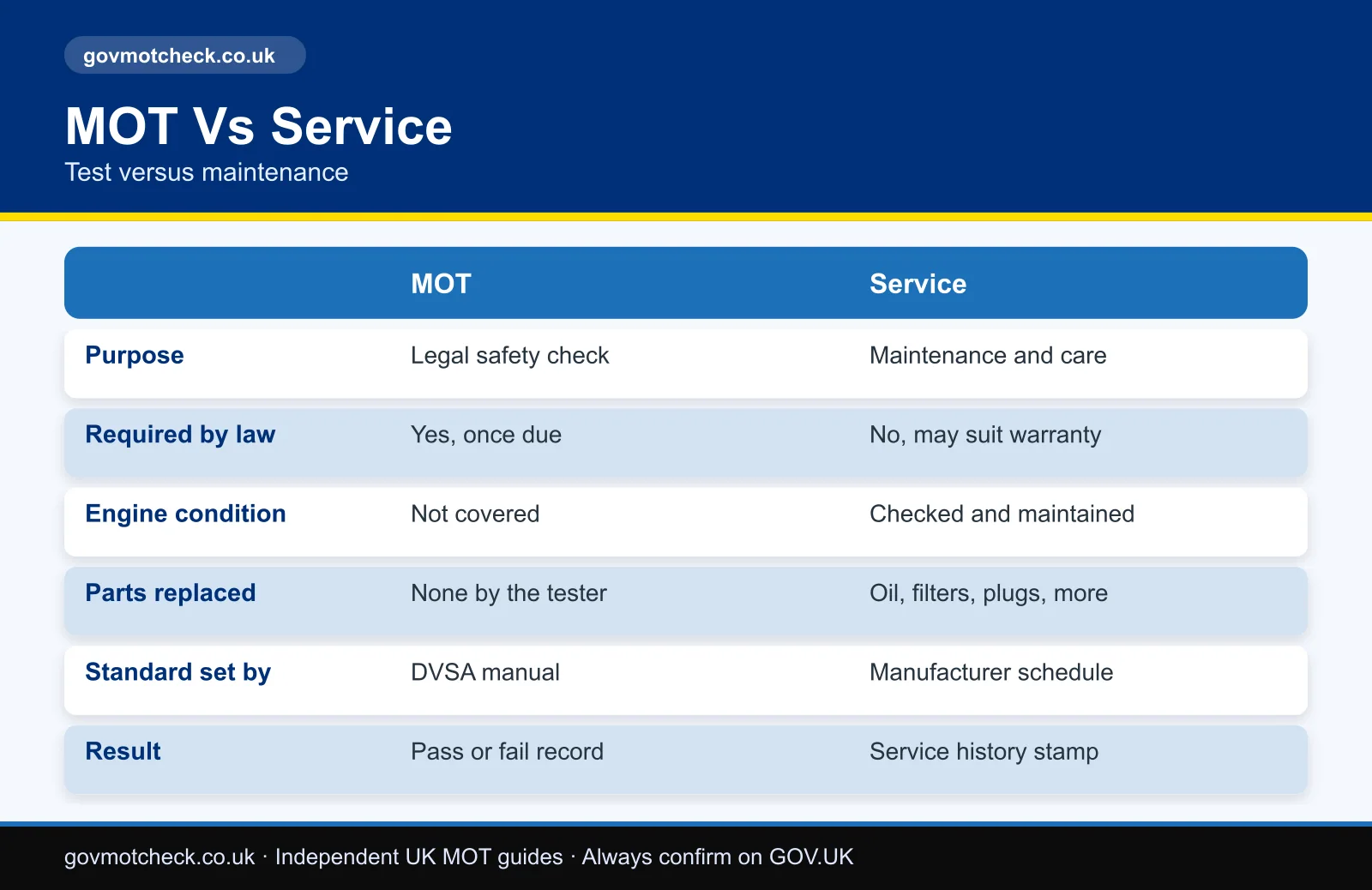
An MOT is a legal inspection of whether a vehicle meets minimum road safety and environmental standards on one day, while a service is maintenance that keeps the vehicle running well. One is a test; the other is work.
Important
An MOT is not a service. The tester inspects and records; nobody repairs or maintains the car as part of the test.
MOT Versus Service In Plain Terms
An MOT looks at safety-critical systems and emissions, and the tester does not repair anything. A service replaces consumables such as oil and filters, checks fluid levels and adjusts or renews wearing parts according to the manufacturer's schedule.
MOT
A legal inspection on one day. The tester records defects and does not repair anything.
Service
Maintenance to the manufacturer's schedule, replacing consumables and wearing parts.
Who Sets The Standard For Each
The MOT standard is set by law and the DVSA, so it is identical everywhere. A service follows the vehicle manufacturer's recommended schedule, and its scope varies between interim, full and manufacturer-specific services.
| Feature | MOT | Service |
|---|---|---|
| Legal requirement | Yes | No |
| Checks engine condition | No | Yes |
| Replaces parts | No | Yes |
| Frequency | Yearly after first test | Per manufacturer schedule |
Why People Confuse Them
Garages often sell "MOT and service" bundles, and both are annual rituals for many drivers. A fresh MOT certificate may make a car seem recently looked after, but it says nothing about oil, belts or engine condition.
Note
Searching "mot vs service" or "difference between mot and service" always leads to the same answer: the MOT is a legal check, the service is maintenance.
Do You Need A Service If You Pass An MOT?
A pass does not replace a service. Since the test does not cover the condition of the engine, clutch or gearbox, a car can pass while overdue for an oil change or timing belt.
What A Service Catches That An MOT Does Not
These are typical service items:
- Engine oil and filter changes.
- Spark plugs.
- Air filters.
- Cambelt or chain condition.
- Coolant and brake fluid age.
- Battery health.
Neglecting them can create expensive failures that no MOT would flag.
Warning
A car with a clean MOT can still break down. Skipping servicing because the car passed is a common and costly mistake.
Warranty And Resale Value
Many new-car warranties depend on following the manufacturer's service schedule, so a service history can matter as much as the MOT. A full service history also supports resale value. Check your warranty terms for what is required.
Should You Do The MOT Or The Service First?
There is no legal order. In practice many owners book the service first, so that any worn parts found are replaced before the test, though doing both on the same visit is common.
Service first
Worn parts such as bulbs or wipers are replaced before the test, which may avoid a fail and a retest.
MOT first
Best if the MOT is about to expire. The test may reveal faults to fix during the service.
Arguments For Servicing First
A service may fix things the MOT would fail, such as a blown bulb, worn wiper blades or low fluid levels. That can avoid a failure and a retest.
Arguments For The MOT First
If your MOT is about to expire, the MOT is the time-critical task. The test may also reveal faults you want to fix during the service, saving a second visit. You can test up to a month minus a day before expiry and keep the same renewal date, as explained in the MOT due date guide.
Pro Tip
If the MOT expires soon, book the test first and ask the garage to quote for any repairs it finds.
Doing Both On The Same Day
Booking both at once is convenient and some garages discount the combination. Check that the quote is clear about which parts are included and whether repairs found during the MOT are charged separately.
MOT Vehicle Classes Explained
The MOT system groups vehicles into classes, based on type and weight. The class decides:
- Which stations can test the vehicle.
- Which checks apply.
- The maximum fee.
Class details in this section come from the DVSA inspection manual and the GOV.UK fees page.
Why Classes Exist
A motorbike, a family car and a mini-bus have different structures, brakes and safety equipment, so one checklist does not suit all. Separate classes allow the right equipment and training for each.
Classes At A Glance
| Class | Typical vehicles |
|---|---|
| 1 | Motorcycles up to 200cc (sidecar combinations are listed separately) |
| 2 | Motorcycles over 200cc |
| 3 | Three-wheeled vehicles up to 450kg unladen weight, excluding motorcycle combinations |
| 4 | Cars, taxis, minibuses and motor caravans up to 12 seats, goods vehicles up to 3,000kg, three-wheelers over 450kg, quadricycles |
| 5 | Private passenger vehicles and motor caravans with 13 or more seats |
| 7 | Goods vehicles from 3,001kg to 3,500kg design gross weight |
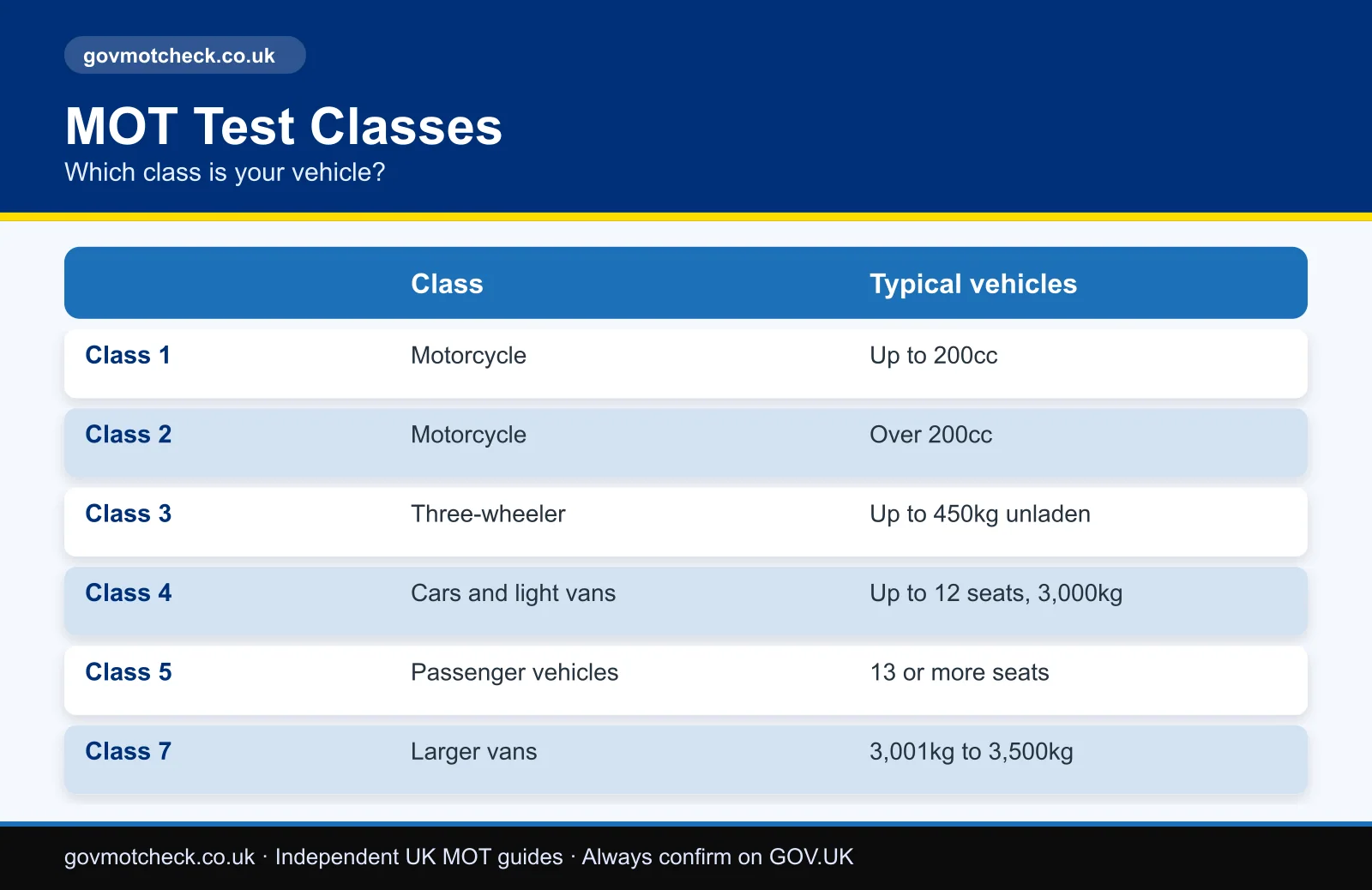
Check The Right Class For Your Vehicle
The class is based on the vehicle's weights and seats, not what you use it for. The registration documents and the GOV.UK fees page show how your vehicle is classified. If you are unsure, ask the test centre before booking.
Pro Tip
Have your registration number ready when you phone the garage. It lets them confirm the class straight away.
Class 4: Cars And Light Vehicles
Class 4 is the most common MOT class, covering private cars, taxis, minibuses, motor caravans and ambulances up to 12 seats, and goods vehicles up to 3,000kg design gross weight.
What Falls Into Class 4
According to the DVSA manual, Class 4 includes:
- Cars and taxis (M1).
- Motor caravans and dual-purpose vehicles.
- Small goods vehicles (N1 up to 3,000kg).
- American pickups up to 6,500kg design gross weight.
- Heavy quadricycles (L7e) and light quadricycles (L6e).
Large Class 4
The manual refers to "Large Class 4" for Class 4 vehicles with a design gross weight over 2,500kg. These may need a test station with suitably sized equipment.
Note
If your vehicle is heavy for a Class 4, ask whether the station can test it before you book.
Motorcycles And Mopeds: Classes 1 And 2
Motorcycles are tested in separate classes with their own manual. The split is by engine size: Class 1 up to 200cc and Class 2 above 200cc.
What Bike Tests Look At
The motorcycle test covers:
- Frame and forks
- Steering and brakes
- Lights and tyres
- Exhaust
- Chain or belt
- Other safety items
Full details are in the guide to MOT rules for motorcycles, vans and EVs.
Bike Ages And Fees
First-test ages and maximum fees differ by motorcycle type, and the GOV.UK fees table lists the specific categories. Because the table is revised from time to time, check it on the day rather than relying on a figure copied into a guide.
Larger Vehicles: Classes 5 And 7
Class 5 covers passenger vehicles with 13 or more seats, and Class 7 covers goods vehicles between 3,001kg and 3,500kg design gross weight. Both use the same manual as cars for much of the inspection.
Class 5 And Its Sub-Classes
The manual refers to Class 5L (up to 5,000kg, tested at some Class 7 stations) and Class 5A stations for vehicles needing a seat belt installation check. Passenger vehicles with more than 8 seats first used before 1 October 2001 need that extra check.
Class 7 Vans
Larger vans from 3,001kg to 3,500kg are Class 7. The manual also mentions zero-emission N2 vehicles of 3,501kg to 4,250kg in that class. Owners of heavier vehicles should confirm the class with the test station.
Using An MOT History When Buying A Used Car
The MOT history is one of the cheapest and most useful checks when buying a car. It is free to view online for any registration in Great Britain.
What To Look For
Look for these signs:
- Steady mileage increases between tests.
- A record of passes with few advisories.
- Any pattern of repeat failures.
A recent major failure followed by a pass the same day suggests a repair was made.
Red Flags
Good signs
- Steady mileage increases
- A record of passes with few advisories
Red flags
- Gaps in annual tests
- Sudden mileage drops
- Repeated corrosion advisories
These are worth questioning:
- Gaps in annual tests.
- Sudden mileage drops.
- Repeated corrosion advisories.
If a seller will not let you check the record, treat that as a warning. For the full method, use the MOT history check guide.
Warning
A seller who refuses to give you the registration number, or discourages you from checking the history, is a serious red flag.
Check Tax As Well
A car needs both a valid MOT and tax. A seller cannot transfer tax to you, and a car with an expired MOT cannot be taxed. See the MOT and tax check page.
MOT, Insurance And Tax In One Paragraph
An MOT is separate from insurance and vehicle tax, but the three are linked in practice. Without a valid MOT, you cannot tax a vehicle unless you declare it off the road with a Statutory Off Road Notification (SORN).
Why Insurers Care
Insurers may not honour a claim if the vehicle was being driven without a valid MOT when the incident happened, depending on policy terms. Check your policy wording.
Important
Driving without a valid MOT can put your insurance cover at risk. Read your policy so you know where you stand.
Where To Read More
Penalties and legal consequences are covered on the rules and exemptions page. This guide keeps to what the test is and how it works.
Fleet And Business Owners
Businesses with several vehicles need a system to track MOT expiries, because the legal duty applies to each vehicle separately.
Tracking Multiple Vehicles
Keep a register with each vehicle's:
- Registration
- Class
- Last test date
- Expiry date
Set reminders for around six weeks ahead, which leaves time to book and carry out any repairs while still testing within the window that keeps the renewal date.
Pro Tip
Use a shared calendar rather than one person's memory, so cover is not lost when someone is away.
Vehicles That Need A Test At One Year
Taxis, ambulances and larger passenger vehicles need testing at one year old, according to GOV.UK. New fleet additions of those types fall due much sooner than ordinary cars.
Common Myths About The MOT
Several persistent beliefs about the MOT are wrong. Clearing them up prevents expensive mistakes.
Myth
An MOT means the car is mechanically sound.
Fact
The test does not cover the condition of the engine, clutch or gearbox. It is a minimum legal check.
Myth: An MOT Means The Car Is Mechanically Sound
False. GOV.UK says the test does not cover the condition of the engine, clutch or gearbox. It is a minimum legal check.
Myth: A New Car Does Not Need An MOT For A Year
For most cars, the first test is due by the third anniversary of registration, so a new car does not need one for three years. Some types, such as taxis, need it at one year.
Myth: You Can Never Drive A Car With An Expired MOT
You can drive to or from a repair, or to a pre-arranged MOT test. Otherwise driving or parking on the road without a valid MOT can lead to prosecution.
Warning
The two exceptions are narrow. Do not use them as an excuse for a long detour.
Myth: Testing Early Shortens The Certificate
Not if you test within the window. A test up to a month minus a day before expiry keeps the same renewal date. Earlier than that, the new expiry is one year minus a day from the pass date.
Myth: The Tester Can Fix Problems And Pass The Car
Authorised testers record defects; they do not carry out repairs as part of the test. A garage may fix and retest, but the tester must apply the manual.
Worked Examples
These examples are made up for illustration and labelled as such. They show how the rules work together.
Example: A Three-Year-Old Hatchback
Worked example
A car first registered on 3 March 2023 has its first MOT due by 3 March 2026. If the owner tests it on 5 February 2026, which is within a month minus a day of the due date, the new expiry is 3 March 2027 under the same-renewal-date rule. Check the due date guide for exact windows.
Example: A Car That Fails On A Bulb
Worked example
A ten-year-old estate fails because the nearside brake light does not work, which is a major defect. The owner replaces the bulb and returns for a retest. The failed item is re-examined as part of the retest.
Example: A Car That Passes With Advisories
Worked example
A seven-year-old SUV passes but the tester notes advisories for a slightly worn front tyre and light corrosion on a brake pipe. The car can be driven, but the owner books a repair before the next test.
Common Mistakes Drivers Make
Most avoidable MOT problems come from timing and assumptions, not from the car.
Leaving It Until The Last Day
Early or late mistakes
Leaving the test until the last day leaves no margin if the car fails.
Better approach
Book two to four weeks before expiry, keep your renewal date and leave time to repair.
If the car fails with a day to go, you have no margin. Book within the window that keeps your renewal date and leave time to repair.
Pro Tip
Aim to book the test two to four weeks before expiry. You keep your renewal date and still have time to fix faults.
Ignoring Warning Lights
Dashboard warnings for ABS, airbags or the engine can cause fails. Diagnose them before the test.
Assuming The Test Centre Will Tell You Everything
Testers record defects but do not always explain repairs. Ask questions, watch from the viewing area when you can, and read the advisories.
A Short Glossary Of MOT Terms
These terms appear throughout MOT guidance.
| Term | Meaning |
|---|---|
| MOT | Ministry of Transport test |
| DVSA | Driver and Vehicle Standards Agency |
| DVLA | Driver and Vehicle Licensing Agency |
| DVA | Driver and Vehicle Agency (Northern Ireland) |
| VT30 | Refusal of an MOT test certificate |
Terms About The Test
- MOT: the roadworthiness and emissions test.
- DVSA: the Driver and Vehicle Standards Agency, which runs MOT testing in Great Britain.
- VT30: the refusal of an MOT test certificate.
- Advisory: a note about a worn or developing defect that does not itself fail the test.
Terms About The Vehicle
- V5C: the vehicle registration certificate issued by the DVLA.
- VIN: vehicle identification number.
- SORN: Statutory Off Road Notification, declaring a vehicle is not used on the road.
- VED: vehicle excise duty, commonly called road tax.
MOT Summary: What To Remember
The MOT is a yearly legal check of a vehicle's safety and emissions standard after its first test is due. The rules in this guide, drawn from GOV.UK, boil down to a few points.
The Essentials
- Who runs it: DVSA in Great Britain and DVA in Northern Ireland.
- How long a pass lasts: one year.
- What is excluded: the condition of the engine, clutch and gearbox.
- How defects are graded: dangerous, major, minor or advisory.
Important
The MOT is a snapshot of roadworthiness on the day. It is not a service and not a guarantee of reliability.
Where To Go Next
Use these guides for the next step:
- Find your date: the MOT due date guide.
- Book a test: how to book an MOT.
- Understand fails: MOT failures and advisories.
- Check a certificate: the MOT certificate guide.
Checking Official Sources
This site is independent and is not affiliated with DVLA, DVSA, DVA or GOV.UK. Rules and fees change, so confirm anything legal or financial with official sources.
Note
If anything here conflicts with GOV.UK, follow GOV.UK.
Where Figures Come From
Dates and rules in this guide are based on GOV.UK pages checked in November 2026. Test fees are intentionally not listed here, because they change; the current maximums are on GOV.UK.
Northern Ireland Readers
If your vehicle is registered in Northern Ireland, use NI Direct and the DVA for the official rules. See the Northern Ireland MOT guide for pointers.
MOT Meaning In Plain English
An MOT is a legal check, carried out once a year on most vehicles, that the vehicle meets minimum road safety and environmental standards on the day it is tested. The letters stand for Ministry of Transport. This section gives the short definitions people search for, then the practical answers.
Define MOT: A Short Definition
MOT (noun): the annual roadworthiness and exhaust emissions test required by law for most cars, vans and motorcycles in Great Britain once they reach a set age. A vehicle that passes gets an MOT certificate; one that fails must be repaired and retested.
The definition has three parts worth remembering:
- Annual: the certificate lasts a year.
- Minimum standard: it is a pass or fail against a published checklist, not a grade of quality.
- On the day: it is a snapshot, not a guarantee about the future.
What Is MOT In England?
In England, the MOT is the same test as in Scotland and Wales. It is run by the Driver and Vehicle Standards Agency (DVSA), uses the same inspection manuals and is recorded on the same national MOT history database. Northern Ireland has its own test run by the DVA.
Note
Searches such as "what is mot in england" and "mot meaning uk" have one answer: Ministry of Transport test, run by DVSA in Great Britain. See the Northern Ireland MOT guide if your vehicle is registered there.
Is "MOT" Slang For Anything Else?
In everyday speech people sometimes use "MOT" loosely for any thorough check-up, for example "I need an MOT" said about a health check or a house. That is slang borrowed from the car test. The official meaning on this site is always the vehicle roadworthiness test.
How Long Is An MOT Valid?
An MOT certificate is valid for one year. As of November 2026, GOV.UK says you can be tested up to a month (minus a day) before the current MOT runs out and keep the same renewal date. Testing earlier than that starts a new year from the pass date.
| Question | Short answer |
|---|---|
| How long is a pass valid? | One year |
| First MOT for most cars | By the third anniversary of registration |
| Later MOTs | By the anniversary of the last MOT |
| Earliest you can test and keep your date | A month minus a day before expiry |
| Penalty for driving without a valid MOT | Up to £1,000 (GOV.UK) |
Pro Tip
For worked date examples and lapsed-MOT rules, use the MOT due date guide.
MOT Test Checklist: What Is Checked, System By System
The MOT test checklist below follows the order of the DVSA MOT inspection manual for private passenger and light commercial vehicles, which has sections 0 to 8 for cars and vans. As of November 2026, GOV.UK shows the manual as last updated on 14 October 2026.
It is a guide to what the tester looks at, not a way to pass the test without the repairs. The tester works from the manual's rules, so a fault on this list can mean a fail, depending on how serious it is.
Important
This checklist summarises the manual for ordinary cars and light vans. Motorcycles, HGVs and buses have their own manuals, and the manual itself, not this page, is the legal standard.
| Manual section | System | Typical items checked |
|---|---|---|
| 0 | Identification | Number plates, VIN |
| 1 | Brakes | Pedal, pads, discs, pipes, parking brake, ABS, fluid, performance |
| 2 | Steering | Play, power steering, steering lock |
| 3 | Visibility | Windscreen, mirrors, wipers, washers |
| 4 | Lamps and electrical | Headlamps, indicators, stop lamps, tell-tales, battery, wiring |
| 5 | Axles, wheels, tyres, suspension | Tread, damage, tyre pressure monitoring, suspension parts |
| 6 | Body and structure | Corrosion, exhaust, bumpers, doors, seats |
| 7 | Other equipment | Seat belts, airbags, horn, speedometer, ESC |
| 8 | Nuisance | Noise, exhaust emissions, engine warning light, leaks |
MOT Checklist: Number Plates And VIN
The tester checks that number plates are present, secure, legible and correctly formed, and that the vehicle identification number (VIN) can be found and matches the records where it should. A missing, damaged or non-compliant plate can fail the test.
- Check yourself: both plates clean, undamaged and firmly fixed.
- Check yourself: characters are the right style and spacing, not altered to read differently.
MOT Checklist: Brakes
The manual covers the service brake, secondary brake, parking brake, ABS, electronic braking systems and brake fluid. The tester inspects pedal condition, pipes, hoses, pads, discs and drums, then measures braking effort at each wheel on a roller brake tester.
- Performance: each wheel's effort, imbalance across an axle, grabbing, binding and fluctuation.
- Parking brake: control condition and holding efficiency.
- Fluid: reservoir level and condition, checked without removing the cap.
- Warning lamps: brake, ABS and electronic braking lamps should work properly.
Pro Tip
A soft pedal, pulling to one side or a brake warning light are all worth fixing before the test.
MOT Checklist: Steering
The tester checks the steering wheel, column, joints and linkages for wear or damage, measures free play at the wheel, and inspects power steering fluid and operation. A steering warning lamp showing a malfunction on electronic power steering (EPS) is treated as a defect in the manual.
- Check yourself: no vague or loose feel, and no steering or power steering warning light on.
MOT Checklist: Visibility
Section 3 covers the driver's view of the road: the windscreen and other glass, mirrors, the bonnet catch, wipers and washers. Damage in the driver's view of the road is judged more strictly than damage elsewhere.
- Check yourself: wipers clear the screen without smearing, and the washers spray and are topped up.
- Check yourself: no cracks or chips in the driver's line of sight.
MOT Checklist: Lamps, Reflectors And Electrical Equipment
The tester checks that required lamps work, are the right colour and are secure. Under the manual, headlamps must be white, white with a blue tinge or yellow, and the tester also checks the aim of the headlamps.
- Front and rear: headlamps (dipped and main), side lamps, stop lamps, indicators, hazard warning lamps, reversing lamp, rear fog lamp and number plate lamps.
- Dashboard tell-tales: main beam, indicator, hazard and rear fog.
- Battery and wiring: the battery must be secure and not leaking, and wiring must not be likely to short circuit.
Pro Tip
Ask someone to stand behind the car while you press the brake and try each indicator. Bulbs are the commonest quick fix.
MOT Checklist: Wheels, Tyres And Suspension
For most cars, the primary grooves of the tread must be at least 1.6mm deep across the central three-quarters of the tyre and around its whole circumference. The tester also looks for cuts, bulges, tears, tyres of mismatched size on an axle, and damaged wheels.
- Tyre pressure monitoring: a system that is malfunctioning or obviously not working is a defect on cars first used on or after 1 January 2012.
- Suspension: springs, shock absorbers, arms, bushes, ball joints and wheel bearings are inspected for wear and damage.
Warning
A tyre with a bulge, tear or a tread depth below the requirement is graded dangerous in the manual. See MOT failures and advisories for how grades work.
MOT Checklist: Body, Structure And Exhaust
The tester checks the body and structure for corrosion or damage that weakens it, plus the exhaust system for security and leaks, bumpers, doors and catches, seats and the floor. Sharp edges that could injure people can also count.
- Check yourself: doors open and close from inside and out, and seats are secure.
- Check yourself: the exhaust is not blowing or hanging loose.
MOT Checklist: Seat Belts, Airbags And Other Equipment
Section 7 covers seat belts (anchorages, webbing, buckles and retractors), airbags and the SRS warning lamp, the horn, speedometer and electronic stability control (ESC). Cut or damaged webbing and a faulty buckle are typical defects.
- Airbags: a passenger airbag that has been switched off by the driver is not itself a defect.
- Horn: it must be loud enough to be heard; sirens and multi-tone horns are not allowed.
- Dashboard warning: an SRS or ESC lamp that shows a malfunction can fail the test.
MOT Checklist: Noise, Emissions And Leaks
Section 8, nuisance, covers exhaust noise, exhaust emissions (petrol and diesel), the engine malfunction indicator lamp and fluid leaks. An engine management light that shows a fault is a defect for petrol and diesel cars.
- Diesel particulate filter (DPF): visible smoke of any colour, or evidence the filter has been tampered with, is a defect.
- Leaks: coolant, screen wash or SCR fluid leaks alone are not a fail, but excessive leaks likely to harm the environment or create a risk are.
Note
Electric vehicles skip tailpipe emissions but are still inspected for brakes, steering, tyres, lamps and the rest. See MOT for motorcycles, vans and EVs.
Quick Pre-Test Checklist You Can Print
Use this short list a few days before the test. It covers the failures that most often come from small, cheap faults.
- Lights: test all bulbs, including number plate and brake lamps.
- Tyres: check tread, pressure and sidewall damage.
- Wipers and washers: replace worn blades and fill the bottle.
- Windscreen: look for chips and cracks in your line of sight.
- Warning lights: none should stay lit after starting the engine.
- Horn and seat belts: test them.
- Boot and seats: clear them so the tester can reach belts and anchorages.
- Fuel and oil: enough in the car to run an emissions test.
MOT Test Guidelines And Standards: Who Sets The Rules
The MOT test guidelines are the DVSA's published inspection manuals and testing guide. They tell testers what to inspect, how to measure it and which defects mean a fail. There is no separate "MOT standards" document for drivers; the manual is the standard.
Where To Read The Official MOT Guidance
The manual for cars and light vans is on GOV.UK as MOT inspection manual: private passenger and light commercial vehicles. It is split into numbered sections and three appendices covering structural integrity and corrosion, tyre load index and seat belt fitment.
- Cars and light vans (Classes 4 and 7): the private passenger and light commercial vehicle manual.
- Motorcycles (Classes 1 and 2): a separate motorcycle manual.
- HGVs and PSVs: their own manuals, covered below.
Pro Tip
Searching "mot test manual" or "mot tester manual" leads to the same GOV.UK pages testers use.
Do MOT Standards Change?
Yes. DVSA revises the manuals from time to time, and GOV.UK lists the update history on the manual's page. The page showed an update on 14 October 2026 at the time of writing. Check that history for any "new MOT standards" before assuming a rule has changed.
Important
This site does not list individual manual changes. Use the GOV.UK update history for the exact date and wording.
Is There An HGV MOT Manual?
Yes, lorries, buses and trailers have separate annual tests and manuals, not the car manual. GOV.UK says qualified mechanics should use the Heavy goods vehicle inspection manual and the Public service vehicle inspection manual. The step-by-step page for lorries, buses and trailers is on GOV.UK.
HGV testing is outside the scope of this guide. For the manual, use the official GOV.UK publication. For rules on which vehicles need what, see MOT rules and exemptions.
Note
Searches about HGV "service charges" or consultations relate to fees and policy for heavy vehicles. Check GOV.UK and DVSA for the current position; they are not covered here.
The MOT Inspection Sheet
You do not fill in an inspection sheet yourself. The tester records the findings, and you see the result on the certificate and in the online MOT history. For a breakdown of how defects are graded, see MOT failures and advisories; for the certificate, see the MOT certificate guide.
Frequently Asked Questions
What is an MOT?
An MOT is a compulsory test of whether a vehicle meets road safety and environmental standards. It is carried out at an approved test station, and a pass certificate lasts one year. As of November 2026, GOV.UK says most vehicles need one by the third anniversary of registration and then every year after that.
What does MOT stand for?
MOT stands for Ministry of Transport, the government department that introduced the test in September 1960. The department has since been renamed and reorganised, and testing in Great Britain is now run by the Driver and Vehicle Standards Agency (DVSA), but the original initials have remained in everyday use.
What does an MOT check?
An MOT checks the main safety and emissions items on a vehicle. The DVSA manual covers identification, brakes, steering, visibility, lamps and electrics, axles, wheels, tyres and suspension, body and structure, seat belts and other equipment, and nuisance items such as noise, emissions and leaks.
What is checked on an MOT for a car?
For a car, the tester checks number plates and the VIN, brakes, steering, windscreen and wipers, lights and indicators, tyres and wheels, suspension, body corrosion, the exhaust, seat belts, the horn, the speedometer and exhaust emissions. The full list is in the DVSA inspection manual for cars and light commercial vehicles.
Does an MOT check the engine?
No, not in terms of its general condition. GOV.UK says the test does not cover the condition of the engine, clutch or gearbox. The tester does measure exhaust emissions and checks for things such as serious leaks and warning lights, but a car can pass with an engine that is worn or overdue for servicing.
How long does an MOT take?
GOV.UK does not publish an official duration. Many test centres quote under an hour of testing for a standard car, but the real time depends on the vehicle, how busy the station is and whether any defects need re-examining. Ask your centre for its expected time and collection slot when you book.
How long does an MOT and service take?
A combined MOT and service usually takes longer than the test alone, often half a day or more, because servicing is separate work. There is no official figure. The garage will normally give a collection time when you book, and that can change if the MOT finds repairs that need approval.
How long does an MOT last?
An MOT lasts for one year. GOV.UK says you can see your expiry date in the MOT history service or on your certificate. If you test up to a month minus a day before expiry, the new certificate keeps the same renewal date, so you do not lose any time.
When does a new car need its first MOT?
Most cars need their first MOT by the third anniversary of registration, according to GOV.UK. A car registered on 3 March 2023 would be due by 3 March 2026. Some vehicles, including taxis and ambulances, must be tested at one year old, as listed in the GOV.UK fees table.
Is an MOT a service?
No. An MOT is a legal inspection of safety and emissions on a particular day, and the tester does not repair or maintain anything. A service is maintenance work such as changing oil and filters, done to the manufacturer's schedule. They are often booked together, but they are different things.
What is the difference between an MOT and a service?
An MOT checks whether a vehicle meets minimum legal standards, while a service keeps it running well by replacing worn consumables and checking fluids. The MOT is required by law, and the service is not, though it may be required by a warranty. A car can pass an MOT and still need a service.
Should I get a service or an MOT first?
Either order is legal. Many owners service first so that worn items are replaced before the test, which can avoid a fail. If the MOT is close to expiry, the test is the time-critical task. Combining both on the same visit is common, as long as the quote is clear.
What should I bring to an MOT?
Bring the vehicle, its keys and any locking wheel nut key. Make sure there is fuel and oil in the car. You do not usually need to bring the V5C or an old certificate, because the tester takes details from the vehicle and the MOT database, but bring paperwork if the vehicle is imported or unusual.
What documents do I need for an MOT?
Usually none are required for a normal registered car, because the DVSA manual says vehicle details must come from the vehicle itself rather than the V5C. If the first-use date is unclear, as with some imports or Q-plate vehicles, take any paperwork you have. Bring your booking confirmation to be safe.
Do I need the V5C for an MOT?
Generally no, as testers take details from the vehicle. However, the manual lists failure to produce the V5C or other evidence of first use as a possible reason to refuse a test in certain cases, such as when the vehicle's age is uncertain. If in doubt, take it with you.
Does my boot need to be empty for an MOT?
It does not need to be completely empty, but items must not obstruct the test. The DVSA manual lists a load or items that prevent a proper test as a reason for refusal. Remove heavy loads, roof boxes in the way and anything blocking seat belts, the spare wheel area or access panels.
Can I watch my MOT?
Yes. GOV.UK says you can watch from a viewing area, but you cannot interrupt the tester. Watching can help you understand any failure, because you can see the defect for yourself. Ask the tester questions after the test is finished rather than during it.
Does an MOT include a road test?
No. The statutory MOT does not include a road test. The DVSA manual permits a short road test only to check findings from the inspection, and only if the tester is licensed to drive the vehicle and satisfied it is safe. The test is carried out in the test bay with specialist equipment.
What are the MOT vehicle classes?
MOT classes group vehicles by type and weight. Class 1 and 2 are motorcycles, split by engine size around 200cc. Class 3 is small three-wheelers, Class 4 covers cars and light vehicles, Class 5 is passenger vehicles with 13 or more seats and Class 7 is larger vans between 3,001kg and 3,500kg.
Which MOT class is a car?
A standard car is Class 4. This class also includes taxis, motor caravans, minibuses and ambulances up to 12 seats, and goods vehicles up to 3,000kg design gross weight. The DVSA manual defines the class by vehicle category, weight and seating rather than how the vehicle is used.
Which vehicles need an MOT?
Most cars, vans, motorcycles and some larger passenger vehicles need an MOT once they reach the test age. The duty attaches to the vehicle, so leased and company vehicles are included. Lorries, buses and trailers are tested under a separate annual test, and some vehicles are exempt entirely.
Which vehicles do not need an MOT?
GOV.UK lists electric goods vehicles registered before 1 March 2015, tractors, some historic vehicles, and any type on the exemption form V112. Lorries, buses and trailers need a separate annual test instead. Historic vehicles generally need to be at least 40 years old and unchanged.
What happens if I fail my MOT?
A fail means the tester recorded at least one dangerous or major defect. You can ask the test centre for form VT30, the refusal of an MOT test certificate. Whether you can drive away depends on whether your old MOT is valid and whether any dangerous defects were listed.
What are MOT advisories?
Advisories are notes about items that are worn, close to failing or worth watching, but which do not fail the test. They appear on the MOT record. They are useful warnings, and a long list of repeated advisories on a used car can show developing problems such as corrosion.
What is a dangerous MOT defect?
A dangerous defect is a direct and immediate risk to road safety or a significant environmental impact. GOV.UK says it stops you driving the vehicle away. Driving a vehicle that failed for a dangerous problem can bring a fine of up to £2,500, a driving ban and 3 penalty points.
Can I drive my car after it fails an MOT?
Only if your current MOT is still valid and no dangerous problems were listed, and even then it must still meet minimum roadworthiness standards. Otherwise you must repair it first. GOV.UK says the only exceptions for an expired MOT are driving to or from a repair or to a pre-arranged test.
What is the penalty for driving without an MOT?
GOV.UK says you can be fined up to £1,000 for driving without a valid MOT. You cannot drive or park the vehicle on the road with an expired MOT, apart from driving to or from a repair or to a pre-arranged test. Insurance can also be affected, so check your policy.
How early can I get an MOT?
GOV.UK says you can have an MOT up to a month minus a day before the current one expires and keep the same renewal date. If your MOT expires on 15 May, the earliest date for that is 16 April. Earlier tests change the renewal date to a year minus a day from the pass date.
Does an early MOT shorten my certificate?
Not if you test within the allowed window. Inside that window the new certificate runs from the old expiry date. If you test earlier than a month minus a day before expiry, the new certificate expires one year minus a day from the test date, so you lose some time.
Can I get an MOT without an appointment?
Some test centres accept walk-ins and others require booking, so it varies by garage. Phone ahead or check online to avoid a wasted trip. The booking page covers how to choose a centre and what to ask. There is no national rule about appointments.
Who carries out MOT tests?
MOT tests are carried out by authorised testers at DVSA-approved test stations in Great Britain. Garages cannot test unless they are approved. Testers must follow the same DVSA inspection manual whether the station is an independent garage, a fast-fit chain or a main dealer.
Is the MOT the same in Northern Ireland?
No. GOV.UK states that Northern Ireland has different rules and processes for vehicles registered there. The test is run by the Driver and Vehicle Agency (DVA), not DVSA. If your vehicle is registered in Northern Ireland, use NI Direct and DVA guidance for dates, fees and test centres.
Where can I find my MOT status?
You can check the status and full history of a vehicle in Great Britain using the free MOT history service with the registration number. It shows past tests, results, mileage, failures and advisories, and the current expiry date. Reminders can also be set up through GOV.UK.
How long does an MOT take to show online?
The result is entered when the test finishes and it normally appears in the MOT history soon afterwards. If it has not shown after a day or so, contact the test centre to confirm it has been submitted. There is no official guaranteed time, so allow a short delay.
What is an MOT history?
An MOT history is the online record of a vehicle's past MOT tests in Great Britain. It lists dates, pass or fail results, recorded mileage, defects and advisories. It is free to view, which makes it a useful check on a used car before buying.
Is an MOT proof that a car is in good condition?
No. An MOT shows that the vehicle met a minimum standard on the day of the test, for the items covered. It does not cover the engine, clutch or gearbox, and it is not a guarantee of reliability. For a used car, combine the record with a test drive and, if needed, an independent inspection.
What is a ghost MOT?
A ghost MOT is a fraudulent certificate recorded without the vehicle actually being tested. It is illegal and dangerous, because the car may be unsafe. The DVSA has taken steps against fraud, including a trial requiring testers to upload photos of the vehicle in the test bay.
Why does the tester refuse some tests?
The DVSA manual requires refusal in specified cases, such as a vehicle that is too dirty to examine, not fit to be driven because it lacks fuel or oil, carrying a load that prevents the test, emitting substantial avoidable smoke, or lacking an identifiable registration or VIN.
Are emissions part of an MOT?
Yes. The MOT checks environmental standards, which includes exhaust emissions. Petrol cars are tested with a gas analyser and diesels with a smoke meter. A lit engine management light, serious leaks and excessive smoke can also lead to defects.
Do electric cars need an MOT?
Yes, in general. Electric and hybrid cars take the same test as other cars, though there are no exhaust emissions to measure, and testers avoid high-voltage components. The exemption GOV.UK lists is for electric goods vehicles registered before 1 March 2015, not for electric cars.
Do motorbikes need an MOT?
Yes, motorcycles and mopeds are tested under their own classes, with their own inspection manual. Class 1 is motorcycles up to 200cc and Class 2 is over 200cc. First-test ages depend on the category, so check the GOV.UK table for your bike.
Do vans need an MOT?
Yes. Light vans up to 3,000kg design gross weight are tested in Class 4 alongside cars, and vans from 3,001kg to 3,500kg are in Class 7. Heavier goods vehicles are covered by a separate annual test rather than an MOT.
Do taxis need an MOT?
Yes, and GOV.UK lists taxis as needing a first MOT at one year old. Local licensing authorities can set extra inspection rules for licensed vehicles, so check with your licensing authority as well as the MOT requirements.
Can I tax my car without an MOT?
Not if the MOT has expired. GOV.UK says you cannot renew vehicle tax without a valid MOT, though you can register the vehicle off the road with a SORN instead. After passing a new MOT, you can tax the vehicle again.
What is a SORN?
SORN stands for Statutory Off Road Notification. It is how you declare to the DVLA that a vehicle is not being used or kept on a public road. GOV.UK says you can use it when your MOT has expired and you cannot renew tax, until the vehicle passes a new test.
Is the MOT a legal requirement?
Yes. In Great Britain, it is a legal requirement for vehicles that are within scope. GOV.UK says driving or parking on the road without a valid MOT can lead to prosecution and a fine of up to £1,000, apart from limited exceptions.
Do I have to get my MOT at the same garage each year?
No. You can use any authorised test station that tests your vehicle's class. The test standard is the same everywhere, so choose on price, convenience, reviews and whether you want repairs done there. Records are stored centrally, so history follows the vehicle.
Can a garage charge what it likes for an MOT?
Garages can set their own price, but there is a maximum fee for each vehicle class. This guide does not list fees because they change, so check the current figures on GOV.UK. Our booking guide covers how to compare prices and avoid upselling.
What if I think my MOT result is wrong?
GOV.UK says you can appeal a result you think is wrong, and mistakes on your MOT record have a separate reporting process. Act promptly, because appeal time limits apply. Keep evidence, such as photos and repair invoices, and read the failures guide for the next steps.
What is the MOT inspection manual?
The MOT inspection manual is the DVSA document testers follow. The edition for cars, private buses and light commercial vehicles covers classes 3, 4, 5 and 7, with sections from identification and brakes to nuisance and seat belts. As of November 2026 it was last updated on 14 October 2026.
What is the difference between a minor defect and an advisory?
A minor defect has no significant effect on safety or the environment, and the vehicle still passes. An advisory is an optional note about something worn or nearing failure. Both appear on the record and neither causes a fail, but both are worth acting on.
Does a tester check tyre tread depth?
Yes. Tyres are checked for condition, size, type, load and speed rating and tread depth against the legal minimum. Cuts, bulges, exposed cords and incorrect pressures in cars with a tyre pressure monitoring system can also cause problems. Check your tyres before the test.
Do seat belts get checked in an MOT?
Yes. Seat belts and restraint systems are part of the test, including condition, security, operation and locking. The webbing should show no serious damage. The DVSA manual also covers airbags and has extra seat belt installation checks for larger, older passenger vehicles.
Does the MOT check the oil level?
The MOT is not a service, so it does not check engine oil as a routine service item. However, a vehicle can be refused if it is not fit to be driven because of a lack of oil or fuel, and serious oil leaks can cause a fail. Top up oil beforehand.
Can I get an MOT if my car has a warning light on?
You can book the test, but a warning light may cause a fail, particularly lights for the engine management system, ABS, airbags or steering. Diagnose and repair the fault first if you can. Telling the tester in advance does not change the standard applied.
How much is an MOT?
Fees vary by centre up to a maximum for each vehicle class, and the figures change from time to time. We do not list them here, to avoid giving you an out-of-date number. Check the GOV.UK MOT fees page, then see our booking guide for how to compare local prices.
Is this site part of GOV.UK or DVSA?
No. GovMotCheck is an independent information site and is not affiliated with DVLA, DVSA, DVA or GOV.UK. The guides are based on official GOV.UK sources checked in November 2026, but you should confirm legal or financial details with the official pages.
What is the MOT test checklist?
The MOT test checklist is the list of systems in the DVSA inspection manual: identification, brakes, steering, visibility, lamps and electrical equipment, axles, wheels, tyres and suspension, body and structure, other equipment such as seat belts, and nuisance items such as emissions. Our system-by-system checklist section summarises each one.
Where are the MOT test guidelines?
The official MOT test guidelines are the DVSA inspection manuals published on GOV.UK. Cars and light vans use the manual for private passenger and light commercial vehicles, motorcycles have their own manual, and heavy goods vehicles and buses use separate manuals. They set out what testers inspect and which defects cause a fail.
What are the MOT standards in the UK?
The MOT standard is the pass or fail criteria in the DVSA inspection manual for your vehicle type, applied by every authorised test station in Great Britain. Northern Ireland has its own test run by the DVA. The manuals are revised from time to time, so check the update history on GOV.UK.
Is there a new MOT standard?
Check the update history on the GOV.UK inspection manual page. As of November 2026 it showed the car and light vehicle manual as last updated on 14 October 2026. We do not summarise individual changes here, so read the GOV.UK history for exact dates and wording before relying on any claim of a new standard.
How long is an MOT valid?
An MOT certificate is valid for one year. You can test up to a month minus a day before it expires and keep the same renewal date. If you test earlier than that, the new certificate runs for a year from the date of the pass, so you lose the unused days.
What is MOT in England?
In England the MOT is the annual roadworthiness and emissions test for most vehicles, run by the Driver and Vehicle Standards Agency. It is identical in England, Scotland and Wales. MOT stands for Ministry of Transport. Northern Ireland runs a separate test through the DVA.
How do you define MOT?
An MOT is the compulsory annual test of whether a road vehicle meets minimum road safety and environmental standards. It is a pass or fail check of the vehicle on the day, carried out at an authorised test station, and a pass produces an MOT certificate valid for one year.
What does MOT stand for in the UK?
MOT stands for Ministry of Transport, the government department that introduced the test in 1960. The department has since been renamed and reorganised, but the name stuck. Today the test is run by DVSA in Great Britain and by the DVA in Northern Ireland.
Is there a printable MOT checklist for a car?
Yes, you can make your own from the pre-test list in our checklist section: lights, tyres, wipers and washers, windscreen, warning lights, horn, seat belts, a clear boot and enough fuel and oil. It helps you catch cheap faults, but only the DVSA manual defines what counts as a fail.
What do you need to bring to an MOT test?
Bring the vehicle, its keys and any locking wheel nut key. GOV.UK does not list required documents, and the tester takes details from the vehicle and the MOT database. Take the V5C or other paperwork if the first-use date is unclear, such as on an imported vehicle, and bring your booking confirmation.
Is there an HGV MOT manual?
Yes. Lorries, buses and trailers have annual tests with their own manuals, the Heavy goods vehicle inspection manual and the Public service vehicle inspection manual, both on GOV.UK. Those tests are separate from the car MOT, and this guide covers cars and light vehicles, so use the official GOV.UK pages for heavy vehicle details.
Does an MOT check tyre condition as well as tread depth?
Yes. For most cars the tread must be at least 1.6mm deep across the central three-quarters of the tyre and around its circumference. The tester also looks for cuts, bulges, tears, mismatched sizes on an axle and damaged valves or wheels, and a tyre pressure monitoring fault can also be a defect.
Does the MOT check the engine warning light?
Yes. The manual treats an engine management warning lamp that is inoperative or showing a malfunction as a major defect on petrol and diesel cars, so it can fail the test. Have the fault diagnosed and repaired before the test rather than clearing the code, since the lamp may come back on.