How To Check MOT And Tax On Any Vehicle
To check MOT and tax together, you need the registration number and two free GOV.UK services. One shows the MOT expiry date, the other shows whether the vehicle is taxed or declared off the road. The lookup tool above brings both answers into one place.
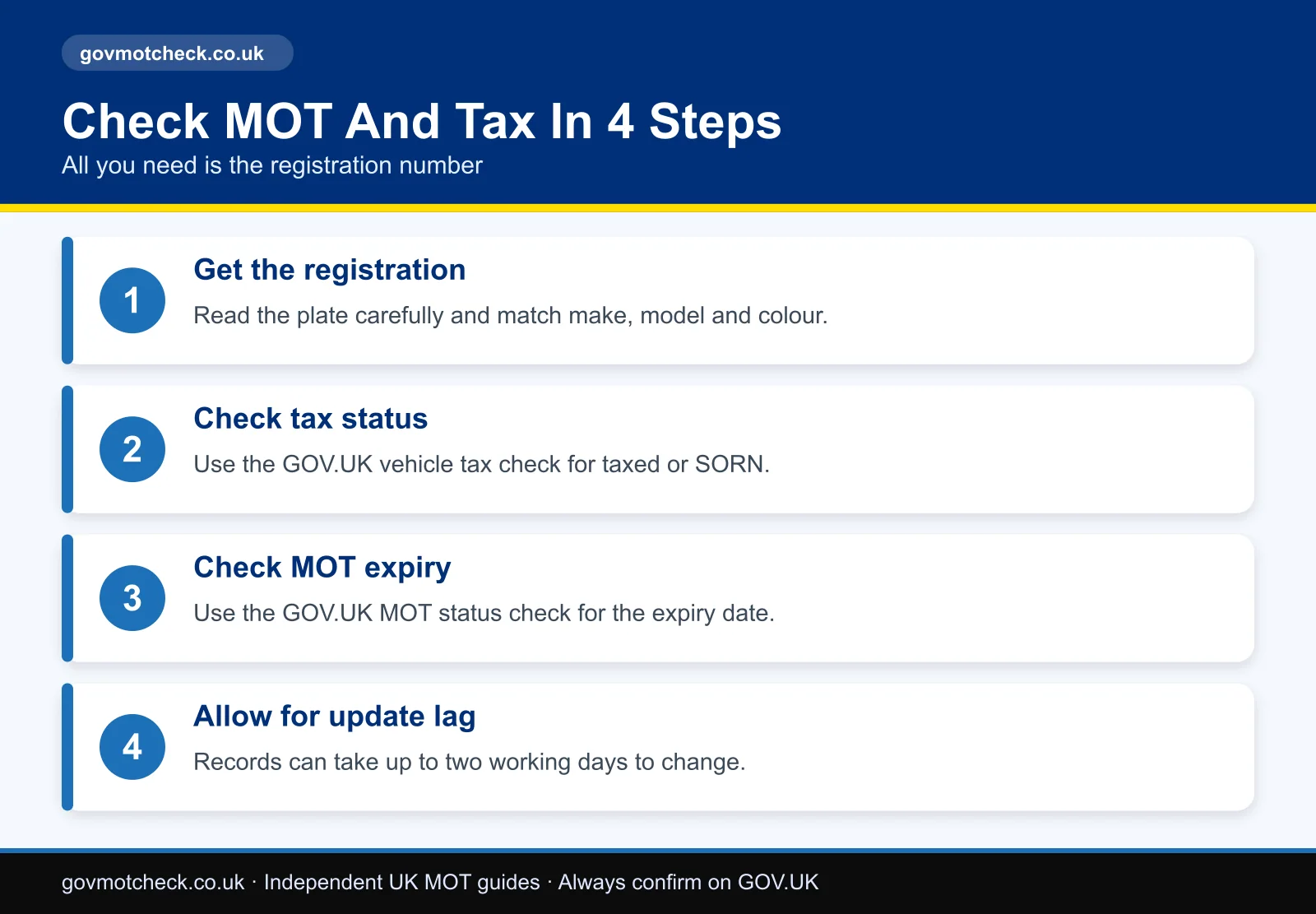
The quick route looks like this:
- Get the registration number. Read it from the number plate or the V5C.
- Check the tax status. Use the free GOV.UK vehicle tax check.
- Check the MOT status. Use the free GOV.UK MOT status check.
- Read the two results as a pair. The combination tells you far more than either answer alone.
Pro Tip
Save the registration number in your phone notes before you start, so you can paste it into each service without retyping and risking a typo.
What Does "Check MOT And Tax" Actually Mean?
It means confirming two separate legal statuses for one registration number. An MOT is the annual roadworthiness test run by the DVSA (Driver and Vehicle Standards Agency) in Great Britain.
Vehicle tax, formally VED (Vehicle Excise Duty) and often called road tax, is collected by the DVLA (Driver and Vehicle Licensing Agency). The two records live in different databases. A car can have one without the other, which is why a combined check is useful.
- MOT: a test record held by the DVSA.
- Vehicle tax: a payment or exemption record held by the DVLA.
- SORN: a declaration to the DVLA that the vehicle is off the road.
Which Details Do You Need Before You Start?
You need only the vehicle's registration number, also called the number plate. For a basic status check nothing else is required.
GOV.UK says that to see the current tax rate you also need the 11-digit reference number from the V5C log book, so keep it to hand if you own the vehicle.
Note
You do not need to own the vehicle to run the basic tax and MOT status checks. Only the tax-rate view needs the V5C reference.
Why Check Both Statuses At The Same Time?
The two statuses are linked by law and by DVLA's systems. As of November 2026, GOV.UK states you cannot renew vehicle tax if the MOT has expired. A vehicle showing "no MOT" and "taxed" at the same moment is therefore unusual, and worth understanding before you buy, sell or drive it.
Important
A clean tax result says nothing about the MOT, and a clean MOT result says nothing about tax. Always check both.
Who Benefits Most From A Combined Check?
Four groups use it most. Each is covered in later sections.
- Used-car buyers: want to know the car is legal before handing over money.
- Sellers: want to confirm what a buyer will see.
- Owners: want to spot a lapsed record before a fine arrives.
- Fleet managers: want a quick way to scan many vehicles.
Check Tax Status On GOV.UK
The official vehicle tax check tells you whether a vehicle is taxed or registered as off the road. It is free and needs only the registration number. DVLA can take up to two working days to update after a tax payment or a SORN.
How Do You Check If A Vehicle Is Taxed?
Use the GOV.UK "Check if a vehicle is taxed" service and enter the registration number. It reports either that the vehicle has up-to-date tax or that it is registered as off the road.
You will not need a login, and you do not need to be the owner.
Pro Tip
To check if a car is taxed before a viewing, run the lookup the evening before. If the answer changes on the day, you will know to ask why.
What Does The Vehicle Enquiry Service Show?
GOV.UK's vehicle enquiry service shows a long list of details. It also shows export status.
- Tax: status and expiry date.
- SORN: whether the vehicle is declared off the road.
- MOT: the expiry date.
- Registration: the first registration date and the issue date of the latest V5C.
- Technical details: fuel type, engine size and CO2 figures.
It does not show insurance, colour or keeper details.
Why Can A Tax Record Take Two Working Days To Update?
DVLA states that records can take up to two working days to change after you tax a vehicle or make a SORN. If you taxed a car this morning and the online check still says untaxed, wait before panicking.
Pro Tip
Keep your payment confirmation as proof in the meantime. Screenshot it or save the email.
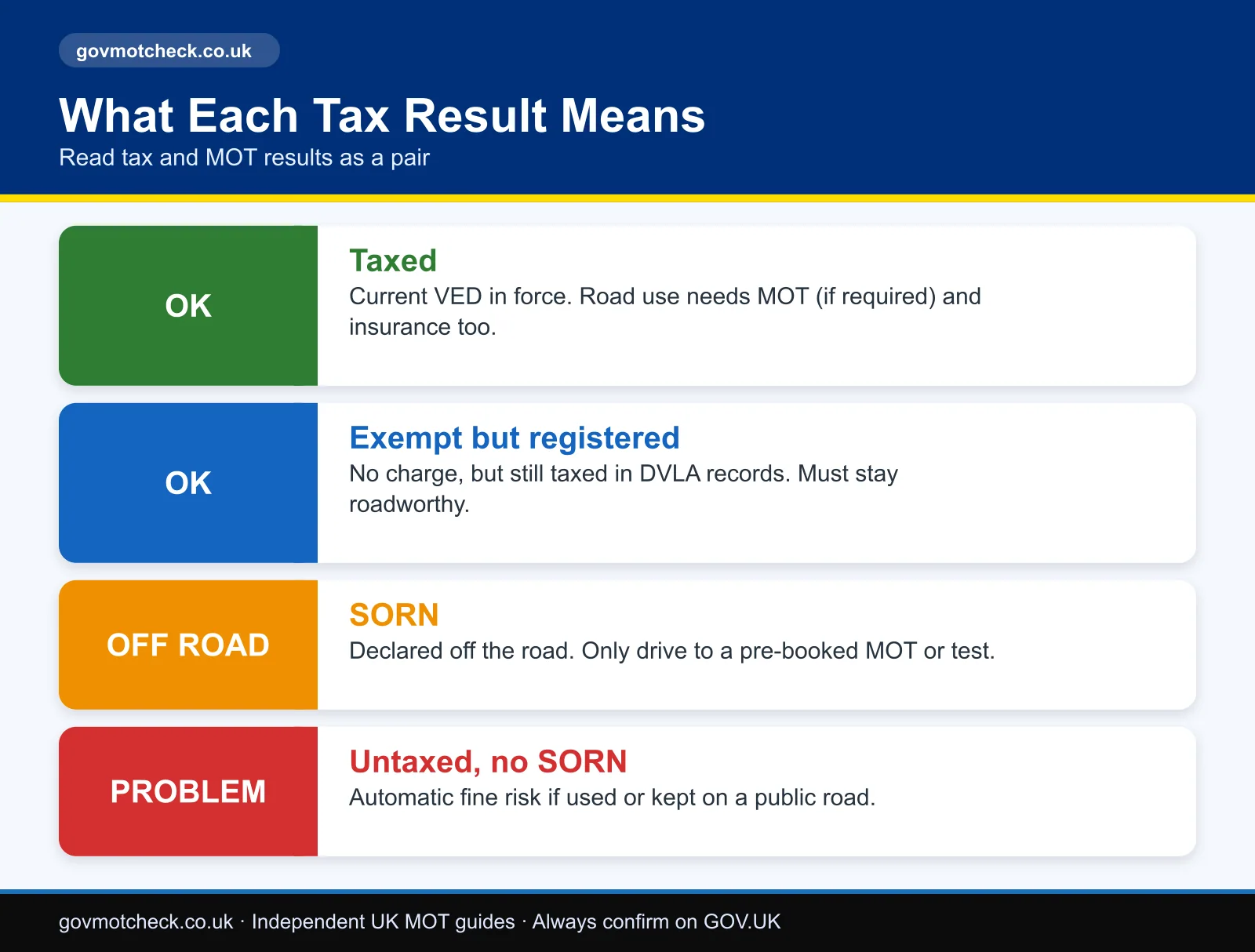
What Is The Difference Between "Taxed", "SORN" And "Untaxed"?
The three outcomes mean quite different things.
- Taxed: a current VED payment covers the vehicle.
- SORN: the keeper has declared it off the road.
- Untaxed: neither applies, which is a problem if the vehicle is used or kept on a public road.
The table below sets out each outcome.
| Status shown | What it means | Can it be on a public road? |
|---|---|---|
| Taxed | Current VED is in force | Yes, if MOT and insurance are also valid |
| SORN | Declared off the road | Only to or from a pre-booked MOT or test |
| Untaxed | No tax and no SORN | No, and an automatic fine can follow |
| Exempt (still taxed) | Zero or exempt rate, but taxed in DVLA records | Yes, if other requirements are met |
Warning
An untaxed vehicle with no SORN can trigger an automatic fine. Do not assume a lapse will go unnoticed.
Check MOT Status On GOV.UK
The GOV.UK MOT status check shows whether a vehicle has an MOT certificate and when it runs out. It needs only the registration number. For the full test-by-test record, use the dedicated history service described on our MOT history check page.
How Do You Check Whether A Car Has A Valid MOT?
Enter the registration number into the GOV.UK MOT status check. It confirms whether the vehicle has an MOT certificate and the date it expires.
- Date in the past: the MOT has lapsed.
- Date in the future: the certificate is valid until the end of that day.
Worked example
A hatchback shows an MOT expiry of 14 March. It is valid for the whole of 14 March, and lapses at the end of that day.
What If The MOT Expiry Date Says "No Results" Or "Not Due"?
A brand-new vehicle has no MOT record until its first test falls due, normally the third anniversary of registration. Some vehicles are exempt.
If a much older vehicle shows nothing, it may be a historic vehicle exempt from MOT or the registration may be mistyped. Re-enter the plate carefully before drawing conclusions.
How Is The MOT Expiry Date Different From The Tax Expiry Date?
They are independent. The MOT date comes from the DVSA test record and follows a yearly cycle. The tax date comes from DVLA and follows the payment you chose, such as 6 or 12 months.
They can fall in different months, and neither automatically renews the other.
MOT expiry date
Held by the DVSA and follows a yearly test cycle.
Tax expiry date
Held by DVLA and follows the payment you chose, such as 6 or 12 months.
Note
Because the dates differ, set two separate reminders: one for the MOT and one for tax.
Where Can You Work Out When The Next MOT Is Due?
If the status check shows a date and you want to know how early you may test without losing days, read our guide to the MOT due date and early-test rule. It covers the one-month-minus-a-day window and first-test ages in detail.
Reading The Tax And MOT Results Together
The two results are only useful when read as a pair. A valid MOT with valid tax is the normal healthy state. Other combinations point to specific situations, such as a SORN vehicle awaiting a test or a car whose owner forgot to retax.
The common pairings are:
- Taxed with MOT: both legal boxes ticked.
- SORN with valid MOT: stored or recently tested for sale.
- Untaxed with expired MOT: both lapsed, no SORN.
- Taxed with no MOT: rare, usually a timing issue.
Taxed with MOT
Both legal boxes are ticked. Still inspect the vehicle and read its history, because an MOT is a snapshot of one day.
Untaxed, no MOT, no SORN
The most worrying pairing. Ask the seller why before going any further.
What Does "Taxed With MOT" Mean For A Buyer?
It means both legal boxes are currently ticked. It does not mean the car is mechanically sound, because an MOT is a snapshot of condition on one day.
Treat a clean result as a minimum standard and still inspect the vehicle and read its history.
Important
A valid MOT is not a guarantee of condition. Inspect the car and read its test history before paying.
What Does "SORN With Valid MOT" Mean?
The keeper has declared the vehicle off the road, but a test certificate is still in date. This is common after a car has been stored, or when an owner took it off the road to avoid paying tax and then tested it for sale.
The new keeper must tax it before driving it on a public road.
What Does "Untaxed With Expired MOT" Mean?
Both records have lapsed and no SORN is in place. The vehicle may be neglected, recently bought, or simply forgotten.
A buyer should ask why, because the seller will need to arrange an MOT before the car can legally be taxed for road use.
What Does "Taxed With No MOT" Mean?
This should be rare. Tax may have been bought before the MOT expired and still be running, since an expired MOT blocks renewal rather than cancelling existing tax. It can also reflect an MOT record that has not yet updated.
Check again after two working days and ask the keeper for the certificate.
Note
If the tax is still running and the MOT has simply expired, the existing tax stays in force. It is the next renewal that is blocked.
Which Combination Should Worry A Buyer Most?
Untaxed, no MOT and no SORN is the most worrying combination, because it suggests the vehicle has not been maintained or declared for some time. The tax and MOT rules for each case appear in the sections that follow.
Our MOT rules and exemptions page covers the penalties for no MOT.
Warning
If a seller cannot explain an untaxed, untested car with no SORN, walk away until they can show the paperwork.
Why Tax And MOT Records Get Out Of Step
The records fall out of step because they are renewed on different dates by different bodies. Understanding the usual causes stops you misreading a result and helps you fix a problem quickly.
The usual causes are:
- Changes of ownership: tax is cancelled, the MOT stays.
- Typos: a wrong character returns another vehicle.
- Update delays: tax and MOT data can take up to two days.
How Do Changes Of Ownership Cause Mismatches?
When a vehicle is sold, the previous keeper's tax is cancelled once DVLA is told, and the buyer has to tax it in their own name. The MOT, by contrast, belongs to the vehicle and stays valid.
So a freshly bought car often shows a valid MOT and no tax.
What changes on sale
The previous keeper's tax is cancelled once DVLA is told.
What stays with the car
The MOT belongs to the vehicle, so the remaining validity stays.
Worked example
A 2016 saloon is sold on Friday. On Saturday the check shows an MOT valid to October but the tax as cancelled. That is normal: the buyer now needs to tax it.
Can A Typo In The Registration Number Give A False Result?
Yes. A single wrong character will return a different vehicle or no record at all. Common slips are mixing the letter O and zero, or the letter I and the number 1.
Always compare the make, model, colour and year on screen with the car in front of you.
Why Might The Tax Status Look Wrong Straight After Paying?
The tax system can take up to two working days to update. Payments by Direct Debit have their own timing too.
GOV.UK says the first Direct Debit payment is taken once the tax starts, which can take up to 10 days, and you can use the vehicle before then.
Can A New MOT Pass Fail To Appear Immediately?
GOV.UK says MOT information can take up to two days to update, so you may not be able to tax straight after a pass. If you are at a Post Office and the system cannot see the new certificate, you may need to show the paper evidence instead.
Pro Tip
Keep the paper pass certificate with you when you go to tax a car in person.
What Should You Do If A Record Is Genuinely Wrong?
If a record is wrong after the update window, contact the body that owns it.
- DVLA: tax, SORN and keeper records.
- DVSA: MOT test results.
Our guide to the MOT certificate explains how test results and certificates are corrected.
What The Lookup Tool On This Page Does And Does Not Do
The tool on this page is an independent lookup that presents tax and MOT information in one place for convenience. It is not part of GOV.UK, DVLA or DVSA, and it does not replace the official services.
Is This Site Connected To DVLA Or DVSA?
No. GovMotCheck is independent and is not affiliated with DVLA, DVSA, DVA or GOV.UK. We present publicly available vehicle data for convenience.
For anything with legal weight, such as proving tax status to the police or a buyer, rely on the official service itself.
Does The Tool Check Insurance?
No. Insurance status is held by the Motor Insurance Database and is checked through askMID, a separate service. The insurance section further down explains what askMID shows and what the law expects of keepers.
How Fresh Is The Data?
Results reflect the official records at the time of lookup, which themselves can lag by up to two working days after a change. If the data matters, such as just before a sale, run the check again on the day you hand over the keys.
Pro Tip
Re-run the check on handover day and note the time. It protects both buyer and seller.
Can You Use The Result As Proof For A Buyer?
A screenshot is helpful but not binding. Buyers should run their own check. A seller can print or save the official GOV.UK result with the date visible, which is stronger evidence than a screenshot from any third-party site.
Tax And MOT Checks For Northern Ireland Vehicles
Northern Ireland runs a separate system. Testing is handled by the DVA (Driver and Vehicle Agency), and tax and MOT interact differently. GOV.UK's tax page notes that at a Post Office in Northern Ireland you also need a paper copy of insurance and an original MOT certificate or evidence of a Temporary Exemption Certificate.
Does The GB Tax Check Cover Northern Ireland?
DVLA maintains vehicle tax records for the whole UK, so the vehicle tax check can usually show NI-registered vehicles. MOT data, however, is held by the DVA for NI vehicles.
Tax records
DVLA holds vehicle tax records for the whole UK, so the tax check can usually show NI vehicles.
MOT records
For NI-registered vehicles the MOT data is held by the DVA.
See our Northern Ireland MOT page for the NI test scheme, centres and verified figures.
Read the Northern Ireland guide
What Extra Documents Does Tax In Northern Ireland Need?
According to GOV.UK, a Northern Ireland Post Office tax application requires:
- Insurance: a paper copy of your insurance certificate or cover note.
- MOT evidence: an original MOT certificate, or evidence of a Temporary Exemption Certificate.
Online renewal works differently, so check the instructions on the service you use.
Note
The Post Office paperwork rules in Northern Ireland differ from online renewal. Read the instructions for the route you choose.
What Is A Temporary Exemption Certificate?
A Temporary Exemption Certificate, or TEC, is an NI document covering a vehicle that cannot be tested when due. GOV.UK names it as acceptable evidence when taxing in Northern Ireland.
For eligibility and applications, follow NI Direct or the DVA, as the rules are not the same as in Great Britain.
Should NI Buyers Rely On The GB Checker Alone?
No. Use the GB-style tax check for the DVLA side and the DVA's own tools for the MOT side. This avoids contradictory results.
Our NI page keeps those figures in one place so they are not mixed with Great Britain rules.
Can You Tax A Car Without An MOT?
Usually no, if the car is old enough to need one. As of November 2026, GOV.UK states you cannot renew vehicle tax if the MOT has expired. The practical route is to declare the car off the road, get the MOT done, then tax it once it passes.
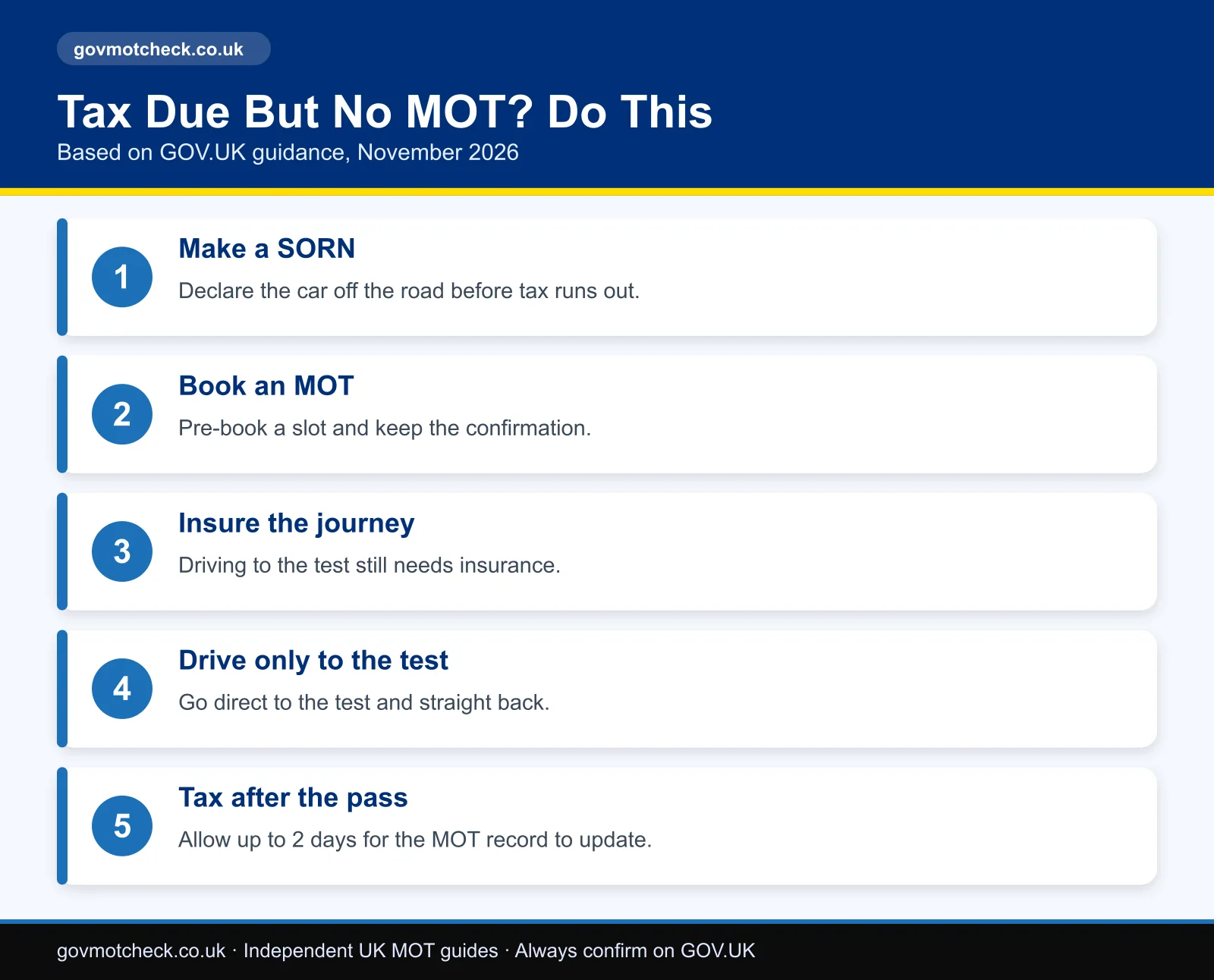
The route in three steps:
- Make a SORN. Declare the car off the road if your tax is about to run out.
- Pass an MOT. Book a test and drive only to that pre-booked appointment.
- Tax the car. Renew once the pass is on record.
Important
Whether you can tax a car without an MOT depends on whether the car legally needs one. Cars within their first three years and exempt vehicles do not.
What Does GOV.UK Say About Taxing With An Expired MOT?
GOV.UK's MOT guidance says you can't renew vehicle tax if the MOT has expired. Its advice is to register the vehicle as off the road (SORN) first if your tax is about to run out, then book an MOT and tax the vehicle once it passes.
Why Does DVLA Link Tax To The MOT?
The link stops untested vehicles being taxed for road use. When you tax online, DVLA's system looks up the DVSA test record automatically.
No valid certificate on file means the service cannot complete the renewal for a vehicle that needs one.
Which Vehicles Can Be Taxed With No MOT At All?
Vehicles that legally need no MOT can be taxed without one. That includes:
- New vehicles: those still within their first three years.
- Exempt vehicles: such as many historic vehicles.
Our what is an MOT page explains which vehicles the test applies to.
Tax Without MOT: The Rules By Situation
The rule changes depending on why the MOT is missing. A new car, a lapsed car and an exempt car are all different, and so is what you can do next.
Note
Check the table at the end of this section if you want the answer for your situation at a glance.
Can You Tax A Brand-New Car Without An MOT?
Yes. A new car does not need an MOT until the third anniversary of its registration, according to GOV.UK, and it is taxed when first registered. The first tax payment is set by CO2 emissions and covers 12 months.
Can You Tax A Car Whose MOT Ran Out Last Week?
Not online, if the car needs an MOT, because the renewal is blocked. If existing tax is still running, you do not lose it simply because the MOT expired, but you cannot renew it.
Book a test quickly and tax again after the pass.
Existing tax still running
It stays in force when the MOT expires, but you cannot renew it.
Driving without an MOT
An offence in its own right, even if the tax is still running.
Warning
Driving a car without a valid MOT is an offence in its own right, even if the tax is still running.
Can You Tax A Car That Has Failed Its MOT?
A fail does not give you a valid certificate, so you cannot renew tax on the strength of the test. You can keep driving only if an earlier MOT is still in date and the car is not dangerous.
Read our MOT failures and advisories guide for what happens next.
Can You Tax A Vehicle With A SORN And No MOT?
Yes, but only if you first cancel the SORN by taxing it, and taxing needs a valid MOT for vehicles that require one. In practice you keep the SORN, drive the car only to a pre-booked test, then tax after the pass.
Is It Different At The Post Office?
GOV.UK says that at a Post Office you may need MOT evidence, which "must be valid when the tax starts". MOT data can take up to two days to update, so you may not be able to tax straight after a pass and may need your paper certificate.
| Situation | Can you tax it? | What to do |
|---|---|---|
| New car under 3 years | Yes | Tax at registration; first MOT due on third anniversary |
| MOT expired, tax running | Existing tax stays; no renewal | Book MOT, retax after pass |
| MOT expired, tax expiring | Not renewable | Make SORN, test, then tax |
| MOT-exempt historic vehicle | Yes | Still register tax, even if nothing to pay |
| Just failed MOT | Not on that test | Repair, retest, then tax |
Worked example
A 2018 hatchback has tax until 30 June, but its MOT ran out on 10 June. The keeper cannot renew in time, so they make a SORN before 30 June, pass an MOT, then tax it.
What To Do When Tax Is Due Before Your MOT
When tax runs out before the MOT can be done, the answer is a SORN, not driving untaxed. A SORN protects you from the automatic fine and lets you drive legally to a pre-booked test.
How Do You Handle Tax Expiring Next Week With No MOT?
Make a SORN for the vehicle if you will not use it on the road before the test. Then follow these steps.
- Make the SORN. Do it before the tax runs out.
- Book a test slot. Get a confirmed appointment.
- Tax after the pass. Renew online once the pass is on record.
Do not leave tax to lapse without a SORN, because DVLA fines automatically in that situation.
Warning
An untaxed vehicle with no SORN can receive an automatic fine, even if it never leaves your drive. Move fast.
What If You Need The Car Every Day?
If you need the car, test it before the tax expires. You can take an MOT up to a month minus a day before its expiry and keep the same renewal date, per GOV.UK. Testing early removes the clash.
See the MOT due date guide.
Pro Tip
Book your test about three weeks before the MOT expiry. That sits inside the early-test window and leaves time for a retest if needed.
Can You Drive An Untaxed Car To An MOT?
Only if it is registered as SORN and the test is pre-booked, according to GOV.UK. Driving a SORN vehicle on a public road for any other reason risks prosecution and a fine of up to £2,500.
An untaxed car without a SORN has no such protection.
Does A SORN Cost Anything?
GOV.UK lists no application fee for making a SORN, and you automatically get a refund for any full months of tax remaining. The refund is calculated from the date DVLA receives the SORN, and only whole months count.
Driving To An MOT Without Tax
The law lets you drive an unroadworthy or SORN vehicle only to a pre-booked MOT, and a few other narrow cases. The detail matters, because many drivers assume it covers an untaxed car, which is a different position.
Can You Drive To An MOT Without Road Tax?
If the car is declared SORN and the MOT is pre-booked, yes. GOV.UK permits driving a SORN vehicle on a public road to or from a pre-booked MOT or other testing appointment. The car must still be insured for the journey.
SORN and pre-booked test
You may drive to or from the appointment. Keep the booking confirmation and make sure the car is insured.
Any other journey
Shops and errands are not covered. GOV.UK says a court fine of up to £2,500 is possible.
Important
The exception covers driving to an MOT without tax only when a SORN is in place. It is not a general permission to use an untaxed car.
What Counts As "Pre-Booked"?
A pre-booked appointment means you have a confirmed slot with a test station, not simply an intention to find one. Keep the booking confirmation on your phone.
If stopped, being able to show the booking is the easiest way to explain the journey.
Pro Tip
Screenshot the booking confirmation so it is available even without a signal.
Can You Stop At A Shop On The Way?
No. The exception is for travelling to or from the test, not for errands. GOV.UK says any other reason for driving a SORN vehicle on the road risks a court fine of up to £2,500.
Take the direct route and go straight home afterwards.
What If The Test Is A Failed-And-Return Journey?
Driving to a repairer after a failure is a separate exception under the MOT rules for driving without a valid MOT, as GOV.UK describes it. For a SORN car, collect a new pre-booked retest slot and keep evidence of the repair booking as well.
Does Insurance Still Apply To The Test Drive?
Yes. Driving any vehicle on a public road needs insurance, even a short trip to a test station. Take out cover that includes the journey.
Day insurance is one option some drivers use, but check that the policy allows driving to a test.
Driving To An MOT Without Insurance
You cannot lawfully drive to an MOT without insurance. The law requires cover for every journey on a public road, and no MOT exception relaxes that. The test station itself does not check your policy, but the police can.
Do MOT Stations Ask For Insurance?
Usually not. The station is testing the vehicle, not your paperwork. Even so, an accident on the way or on their forecourt would be uninsured.
Some stations ask for insurance on the vehicle once it is on their premises, so check their terms when booking.
Is It Legal To Drive A Car With No Tax And No Insurance To A Test?
No. Even if the SORN allowance covers tax for the test journey, nothing excuses a lack of insurance. As of November 2026, GOV.UK describes continuous insurance enforcement. The consequences can include:
- Fine: a £100 fine.
- Clamping: the vehicle may be clamped.
- Court action: a fine of up to £1,000.
Warning
Uninsured driving can lead to clamping and court action, not just a fine. Never rely on the test appointment as an excuse.
How Do You Get Cover Just For The Test?
The options include:
- Short-term policy: cover for a limited period.
- Add to an existing policy: adding the vehicle for the day.
- Trade provider: ask about cover for a test.
Premiums and conditions vary. Ask the provider directly whether the policy covers driving to a pre-booked MOT.
Can You MOT A Car Without Tax?
Yes, the vehicle does not need to be taxed to be tested. An MOT is an inspection of condition, and the test station does not check tax before accepting the vehicle. The difficulty is getting the car there legally.
Does The Test Station Care Whether The Car Is Taxed?
Not for the test itself. The tester records the vehicle by registration and carries out the inspection. They are not responsible for enforcing tax.
They may, however, refuse a vehicle they believe unsafe to drive, so arrive in a sound state.
Note
A garage can test an untaxed car. The legal risk lies in the journey to the garage, not the test.
Can You MOT A Car That Is SORN?
Yes. A SORN car can be tested and you can drive it to a pre-booked test, per GOV.UK. This is the standard route for a stored car.
Our book an MOT page explains how to arrange a slot and what to take with you.
What About An Untaxed Car With No SORN?
It can still be tested, but getting it there is risky because tax was not declared off the road. The sensible order is:
- SORN first. Declare the car off the road.
- Test second. Drive only to the pre-booked appointment.
- Tax third. Renew after the pass.
This avoids both the automatic fine and any dispute at the roadside.
Can You Get Road Tax Without An MOT For A Classic Or Historic Vehicle?
Yes, historic vehicles that need no MOT can be taxed without one. They must still be taxed, even where the rate is nothing. The exemption rules changed on 1 April 2026, so check your vehicle against the current GOV.UK wording.
Pro Tip
Run the registration through the vehicle enquiry service first. It shows the first registration date, which decides which exemption rules apply.
Do Historic Vehicles Still Need To Be Taxed?
Yes. GOV.UK says you must tax your vehicle even if you do not have to pay anything because it is exempt. An exempt vehicle is recorded in DVLA's system and appears as taxed, usually in the historic tax class, so a check should still show a status.
What Is The Historic Tax Class?
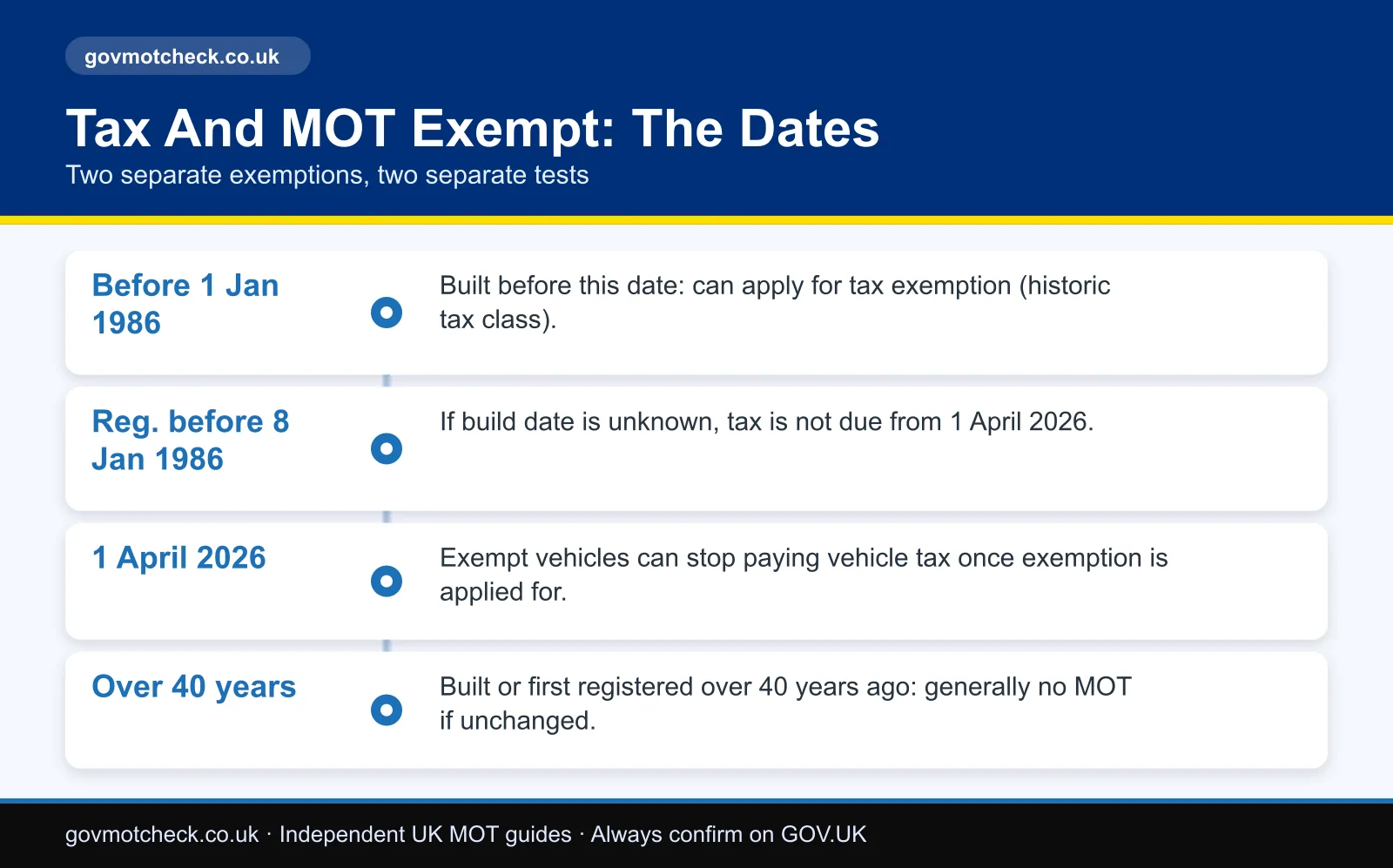
The historic tax class is the DVLA classification for vehicles exempt from VED on age. GOV.UK says vehicles built before 1 January 1986 can stop paying vehicle tax from 1 April 2026, and you must apply for the exemption, which places the vehicle in that class.
How Does The MOT Exemption Differ?
The MOT exemption covers vehicles built or first registered more than 40 years ago with no substantial changes. GOV.UK says you do not need to apply to skip the MOT, though the vehicle must stay roadworthy.
The tax and MOT age tests are different dates, so check each separately.
Tax exemption
Vehicles built before 1 January 1986 can stop paying from 1 April 2026, but you must apply.
MOT exemption
Vehicles built or first registered more than 40 years ago need no test unless substantially changed. No application is needed.
Important
Being exempt from MOT does not make a vehicle exempt from tax, and the reverse is also true. Check each exemption on its own.
Tax And MOT Exempt Vehicles
A vehicle can be exempt from tax, from MOT, or from both. The two exemptions are separate legal tests with different cut-offs, so a car that is "tax and MOT exempt" must satisfy both individually.
What Year Is A Car Tax And MOT Exempt?
The two cut-offs differ.
- Tax: GOV.UK says vehicles built before 1 January 1986 can stop paying from 1 April 2026.
- MOT: a vehicle built or first registered more than 40 years ago generally needs no test unless substantially changed.
Both must be true for a car to be exempt from both.
Worked example
A 1984 estate built before 1 January 1986 can apply for tax exemption. If it is also over 40 years old and unmodified, it needs no MOT either.
What Counts As A Substantial Change?
GOV.UK describes substantial changes as replacing the chassis, body, axles or engine in a way that changes how the vehicle works. A modified car may therefore lose its MOT exemption even if it is old.
Doubtful cases need the full MOT exemption criteria or a historic vehicle expert.
Do You Have To Apply To Be Tax Exempt?
Yes. GOV.UK says that to stop paying you must apply for a vehicle tax exemption, which puts the vehicle into the historic tax class. For MOT, GOV.UK says you do not need to apply to skip the annual test.
Full detail is on our rules and exemptions page.
Can You Buy A Tax And MOT Exempt Car Safely?
Yes, but check the claim rather than trusting the advert.
- Run the registration: use the vehicle enquiry service.
- Confirm the date: check the first registration date.
- Ask about changes: find out whether any substantial changes have been made.
An exempt classic still needs to be roadworthy and insured.
Common Mistakes When Taxing Around An MOT
Most tax and MOT problems come from a handful of repeat errors. They are cheap to avoid when you know them, and expensive when they lead to an automatic fine or a failed sale.
Pro Tip
Skim the five mistakes below before your next renewal. Each takes under a minute to avoid.
Letting tax lapse
With no SORN, DVLA can issue an automatic £80 fine.
Making a SORN
It is free and avoids the automatic fine when a car is parked up.
Letting Tax Lapse Instead Of Making A SORN
If tax expires and you do not renew or declare SORN, DVLA can issue an automatic £80 fine, GOV.UK says, for not having a SORN while the vehicle is untaxed or uninsured. A free SORN avoids this entirely when a car is parked up.
Warning
The £80 fine can arrive even if the vehicle never moved. A SORN is the simple, free fix.
Assuming A Valid MOT Covers Tax
An MOT certificate says nothing about tax. They are separate legal duties held in separate systems. A seller who says "it has a full MOT" has told you nothing about whether the car can be driven away legally.
Testing Too Early And Losing Renewal Days
Testing more than a month minus a day before expiry moves the renewal date to a year minus a day after the new pass date, according to GOV.UK. That is not a penalty, but it can shift your tax and MOT cycles out of sync.
Relying On An Old SORN
A SORN does not transfer to a new keeper and cannot be backdated, GOV.UK says. A buyer of a SORN car must tax it or declare their own SORN before using or keeping it on the road.
Forgetting To Tell DVLA About A Sale
If you do not tell DVLA you have sold a vehicle, reminders and potential fines can follow you. The seller's duties are covered in the selling section below.
What Is SORN And When Do You Need One?
A SORN (Statutory Off Road Notification) is a declaration to DVLA that a vehicle is not being kept or used on a public road. It lets you stop taxing and insuring the vehicle legally. It applies in Great Britain, with different arrangements in Northern Ireland.
Important
A SORN car without MOT is perfectly legal while it stays off the road. The MOT only matters again when you want to tax it and drive it.
When Must You Make A SORN?
GOV.UK says you must make one in these cases:
- No tax: the vehicle is not taxed.
- No insurance: the vehicle is not insured, even briefly.
- Breaking for parts: you want to break it down for parts before scrapping.
- Newly bought: you buy a vehicle and want to keep it off the road, because a SORN cannot transfer from the previous keeper.
What Counts As "Off The Road"?
A vehicle is off the road if it is not kept or used on a public road. A garage, a drive or private land all qualify.
Parking it on the street, even unused, does not, which is why people who leave a car at the kerb still need tax and insurance.
Off the road
A garage, a drive or private land all qualify.
Not off the road
A car parked on the street is still kept on a public road and needs tax and insurance.
Warning
A car parked on the street is still "kept on a public road". It needs tax and insurance even if it never moves.
How Do You Make A SORN?
You can make a SORN online, by phone or by post, per GOV.UK. Have the registration number and, usually, the V5C reference number or other identifying details ready.
Keep the confirmation. DVLA's record can take up to two working days to update.
Pro Tip
Online is the quickest route. Save the confirmation page or email as proof.
SORN Timing, Refunds And Ending A SORN
A SORN takes effect immediately in most cases and cannot be backdated. It ends automatically when you tax the vehicle again, or sell, export or scrap it. It does not need renewing.
When Does A SORN Start?
GOV.UK says it starts immediately if the tax has expired or you are not applying in the month it is due to expire. If you apply in the month the tax is due to expire, the SORN starts on the first day of the next month. It cannot be backdated.
Worked example
Tax on a 2017 estate expires on 20 July and the keeper applies for SORN on 12 July. The SORN starts on 1 August, because they applied in the month the tax was due to expire.
Do You Get A Refund When You Make A SORN?
Yes. You automatically get a refund for any full remaining months of tax once DVLA has the SORN. Partial months are not refunded. Direct Debits are cancelled automatically.
The refund goes to the name and address on the log book.
How Does A SORN End?
It ends in four ways:
- Taxing: you tax the vehicle.
- Selling: you sell it.
- Exporting: you permanently export it.
- Scrapping: you scrap it.
There is no renewal. The vehicle must stay in the UK for the SORN to remain valid, so a car taken abroad needs different arrangements.
What Happens If You Forget To SORN?
An automatic fine of £80 applies when a vehicle has no tax or insurance and no SORN, per GOV.UK. There may also be continuous insurance enforcement action.
Declaring SORN promptly costs nothing and removes both risks.
Warning
Forgetting a SORN is the most common route to an automatic £80 fine. It is easily avoided.
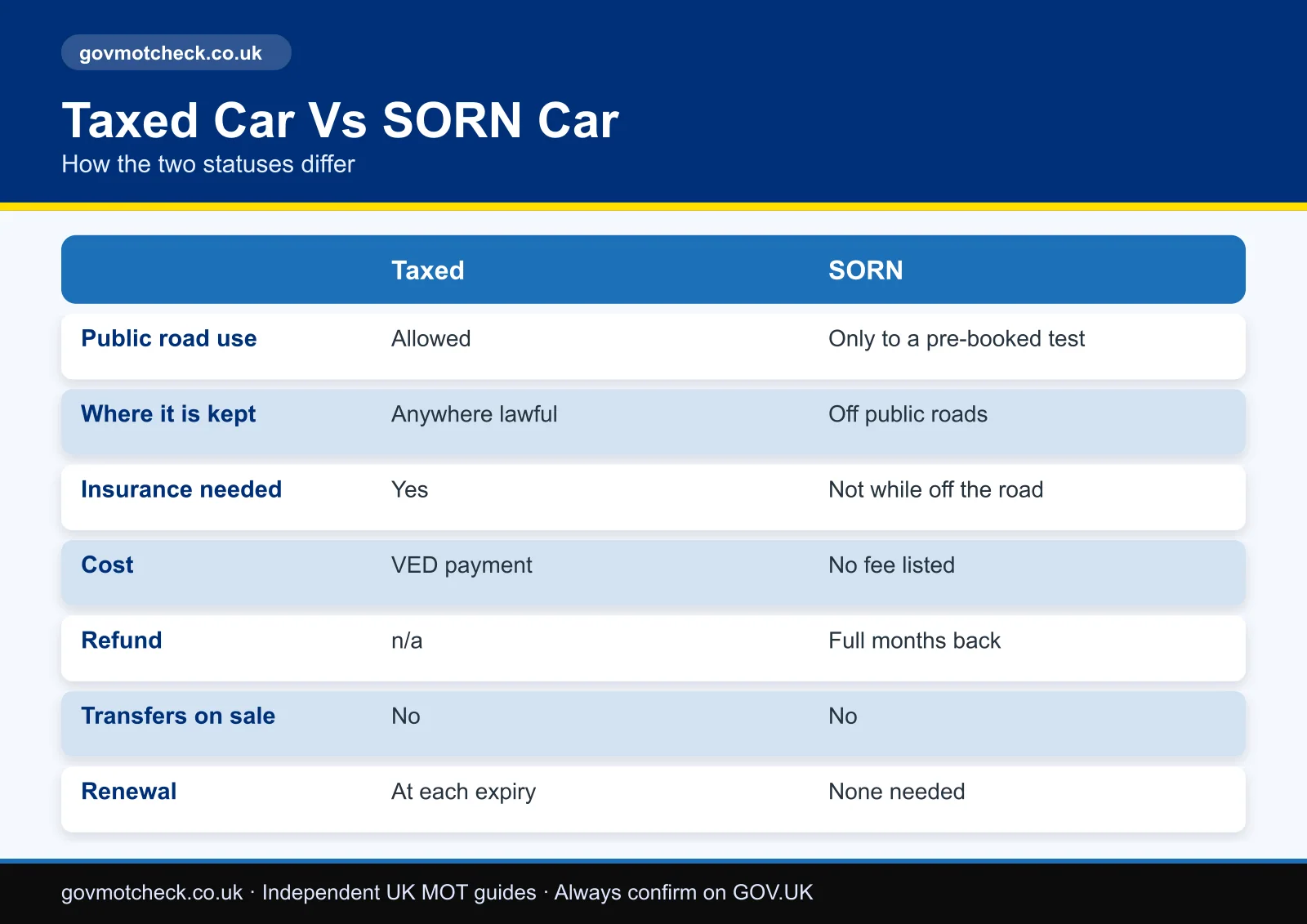
| SORN rule | What GOV.UK says |
|---|---|
| Start date | Immediately, unless made in the month the tax expires, then the first day of next month |
| Backdating | Not possible |
| Renewal | None needed; ends when you tax, sell, export or scrap |
| Driving on the road | Only to or from a pre-booked MOT or testing appointment |
| Fine for no SORN, tax or insurance | Automatic £80 |
| Fine for other road use of a SORN vehicle | Court fine of up to £2,500 |
Driving A SORN Vehicle
A SORN vehicle can be on a public road only for a pre-booked MOT or testing appointment. Anything else risks a court fine of up to £2,500, according to GOV.UK, plus the vehicle being treated as untaxed.
Important
Treat a SORN vehicle as off limits on public roads, apart from a pre-booked test. That single exception is all GOV.UK allows.
Can You Drive A SORN Car To The Garage For Repairs?
GOV.UK only allows a SORN vehicle on a public road to or from a pre-booked MOT or other testing appointment. A repair trip is not listed for SORN vehicles, so tax the car properly or have it transported, and do not rely on a general garage exemption.
Can You Keep A SORN Car Parked On The Street?
No. A SORN car must be kept off public roads. If it is on the street it is being kept on a public road, which requires tax and insurance.
Using a drive, garage or private land is the usual compliant route.
Can You Tax A SORN Car For A Single Day?
Tax is sold in fixed periods rather than by the day. The options are:
- 6-month payment
- 12-month payment
- Monthly Direct Debit
Check the options on GOV.UK. Monthly Direct Debit is the closest to a short period.
Note
Because tax is not sold by the day, keep the car on SORN until you are ready to use it regularly.
VED Explained: What Road Tax Actually Is
VED (Vehicle Excise Duty) is the annual tax paid to DVLA for using a vehicle on UK public roads. People call it road tax or car tax, but the legal name is VED. It is separate from the MOT fee and the insurance premium.
How Much Is Vehicle Tax In 2026?
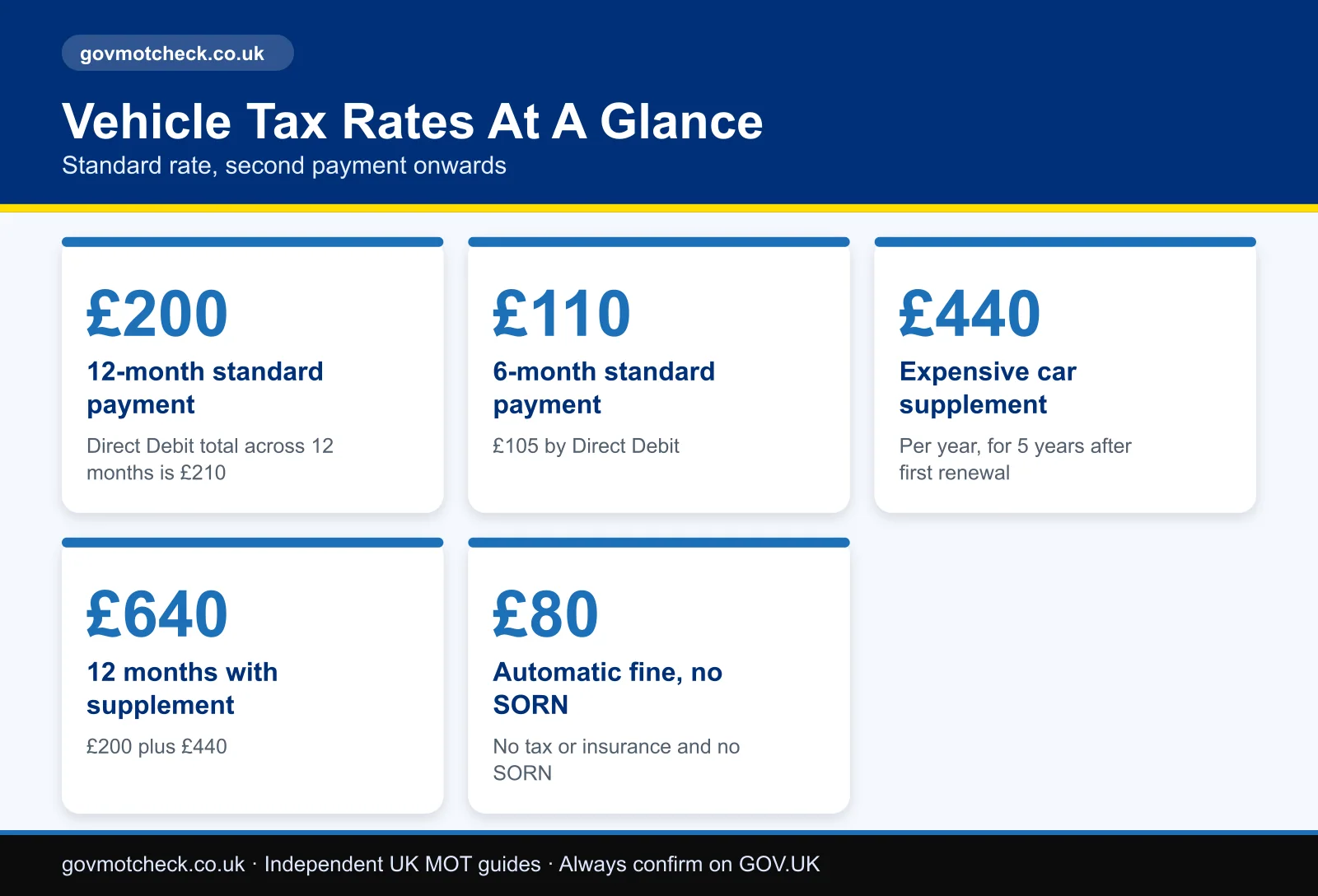
GOV.UK's rate tables state a standard rate of £200 for a 12-month payment, or £110 for six months. Paying by Direct Debit works out at £200 for a year, or £210 in total across 12 monthly payments. Check GOV.UK for any later change.
Pro Tip
If you can afford it, pay the 12-month amount in one go. It is the cheapest option.
What Is The First-Year Rate?
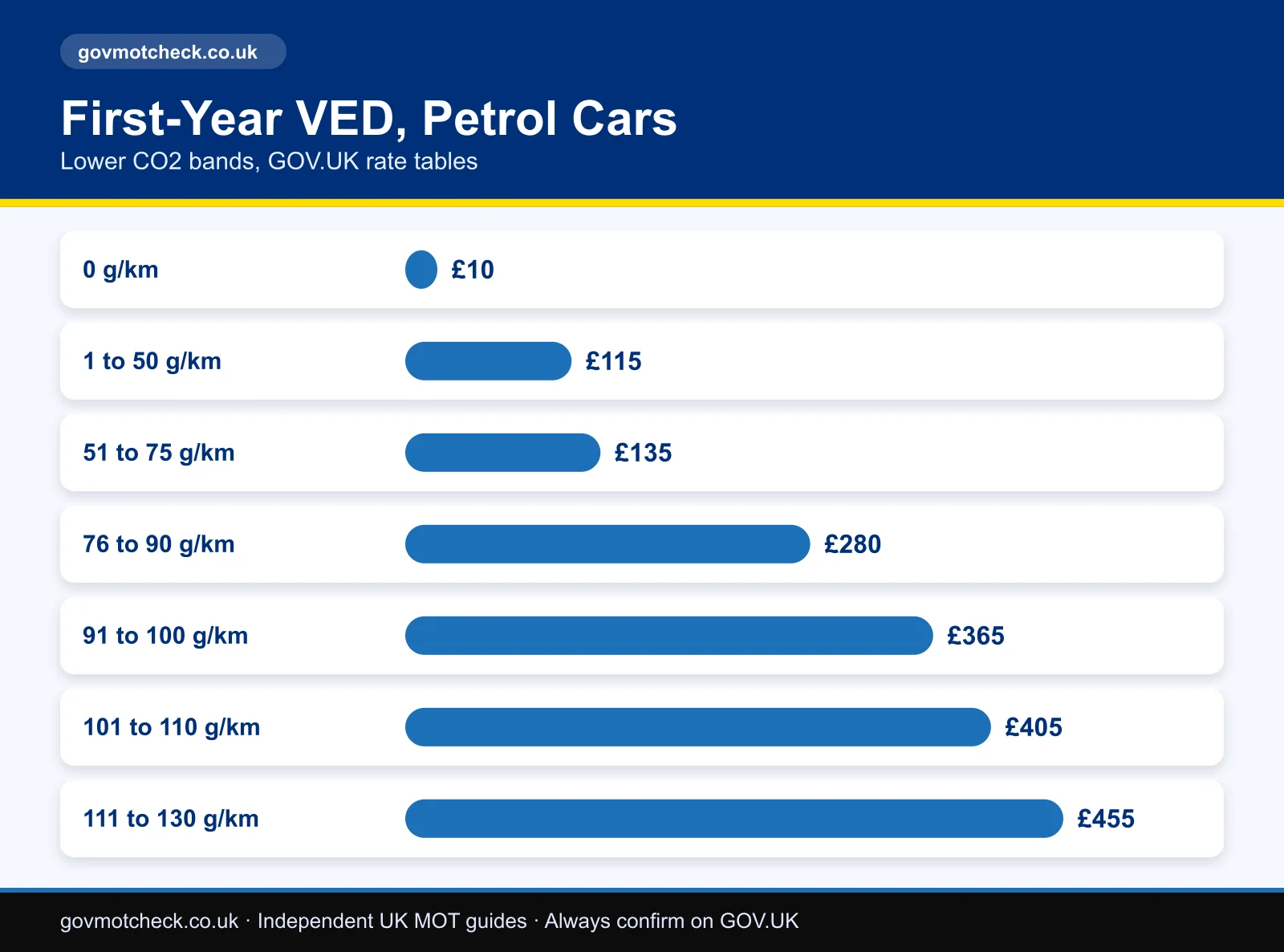
The first-year rate is paid at registration and covers 12 months. It depends on CO2 emissions, from £10 at 0 g/km up to £5,690 over 255 g/km for petrol and alternative-fuel cars.
Other diesels pay different amounts in several bands. The table below shows the petrol band figures GOV.UK lists.
| CO2 (g/km) | First-year rate, petrol and alternative fuel | First-year rate, other diesel |
|---|---|---|
| 0 | £10 | £10 |
| 1 to 50 | £115 | £135 |
| 51 to 75 | £135 | £280 |
| 91 to 100 | £365 | £405 |
| 131 to 150 | £560 | £1,410 |
| 171 to 190 | £2,270 | £3,420 |
| Over 255 | £5,690 | £5,690 |
Note
The first-year rate applies once, at registration. From the second payment, most cars pay the standard rate.
What Is The Expensive Car Supplement?
The supplement applies to higher-priced cars, according to GOV.UK:
Petrol or diesel cars
A list price above £40,000.
Electric cars
A list price above £50,000.
They pay an extra £440 a year. Second-payment rates at this level are £640 for 12 months. You pay it for five years starting from the second time the vehicle is taxed.
Electric Cars And Vehicle Tax
Electric cars now pay VED rather than being exempt. For zero-emission cars registered before 1 April 2025 the supplement does not apply, but cars registered from 1 April 2025 to 31 March 2026 are within the supplement rules if the list price is over £50,000.
Do Electric Cars Pay Road Tax?
Yes, under current GOV.UK rates. A zero-emission car pays £10 at first registration, then the standard rate of £200 for 12 months from the second payment. Those with a list price over £50,000 also pay the supplement.
See the motorcycles, vans and EVs page for EV test details.
Worked example
A zero-emission car registered in 2025 pays £10 for its first 12 months, then the standard £200 a year from the second payment, plus the supplement only if its list price is over £50,000.
Does An Electric Car Need An MOT?
Yes, once it reaches its first test age, the same as a petrol car. Tax and MOT work the same way for an EV: no valid MOT, no tax renewal. EV-specific checks are covered on a separate page so they are not repeated here.
Which EV Rules Apply To Older Zero-Emission Cars?
GOV.UK says zero-emission vehicles registered before 1 April 2025 are exempt from the supplement. Check the first registration date on the vehicle enquiry service to see which side of the line a particular car falls.
Rules can change, so confirm on GOV.UK.
How To Pay Vehicle Tax
Vehicle tax can be paid online, by phone or at a Post Office. You need a reference from a DVLA reminder, the V5C log book in your name, or the green new-keeper slip. Direct Debit carries a surcharge for monthly and six-monthly payments.
What Documents Do You Need To Tax A Vehicle?
GOV.UK lists three options:
- DVLA reminder: a reference number from a recent reminder or "last chance" letter.
- V5C log book: the one in your name.
- Green new-keeper slip: if you have just bought the vehicle.
If you have none, apply for a new log book and tax at the same time.
Pro Tip
Have the reference to hand before you start, and check the MOT is on record. It saves a failed attempt.
What Payment Methods Are Available?
The options depend on how you tax:
- Online: debit or credit card, or Direct Debit.
- By phone: debit or credit card. Direct Debit is not available by phone.
- Post Office: bring the tax payment or your bank details for a Direct Debit. Exempt vehicles need no payment details.
| Payment option | Standard-rate figure from GOV.UK |
|---|---|
| 12 months, single payment | £200 |
| 12 months, Direct Debit in one payment | £200 |
| 12 monthly Direct Debit payments | £210 in total |
| 6 months, single payment | £110 |
| 6 months, Direct Debit | £105 |
Is There A Surcharge For Paying Monthly?
GOV.UK says paying monthly or every six months by Direct Debit adds a 5% surcharge, and yearly payments have none. A single six-month payment carries a 10% surcharge, and these surcharges are not refunded. A 12-month payment is therefore the cheapest way to pay.
12-month payment
No surcharge on yearly payments, so it is the cheapest way to pay.
Monthly or six-monthly
Direct Debit adds a 5% surcharge, and a single six-month payment adds 10%. Surcharges are not refunded.
Warning
Surcharges are not refunded when you SORN or sell. Factor them in if you may not keep the car all year.
How Long Does A Direct Debit Take To Start?
The first payment is taken once the tax starts, which can take up to 10 days, and you can use the vehicle before then. Later payments are taken on the first working day of the month, per GOV.UK.
Getting A Vehicle Tax Refund
A tax refund is automatic when you tell DVLA you have sold, scrapped, exported or SORNed a vehicle. You get money back for each full remaining month. GOV.UK says there is no other way to cancel vehicle tax.
How Is The Refund Calculated?
Only whole months remaining count. For the first tax payment on a vehicle, the refund is based on the lower of the first payment or the second-payment-onwards rate. Credit card fees and the Direct Debit surcharges are not refunded.
Worked example
A keeper sells a car with 7 months and 10 days of tax left. They are refunded for 7 full months, and the extra 10 days are not refunded.
How Long Does A Refund Take To Arrive?
The refund starts from the date DVLA receives your information. Use these time limits:
- Not received: if you have not received the cheque after eight weeks, contact DVLA.
- Wrong name: if it is in the wrong name, return it and tell DVLA the correct name.
- Replacement: a replacement that has not arrived after four weeks needs another call.
Can You Transfer Tax To A New Vehicle?
GOV.UK's refund guidance does not describe any transfer of tax between vehicles or people. The refund route is how a seller recovers unused tax, and the new keeper taxes the vehicle themselves.
Seller
Tells DVLA and receives a refund for each full remaining month.
Buyer
Taxes the vehicle in their own name. The previous keeper's tax does not pass to them.
Important
Do not assume tax stays with a car you buy. The previous keeper's tax does not pass to you.
Insurance, Tax And MOT: The Three Legal Requirements
Driving legally needs three things: insurance, tax (or a valid SORN if off the road) and, for vehicles that require one, an MOT. They are separate duties enforced by different bodies, and failing one does not cure another.
- Insurance: checked on askMID.
- Tax or SORN: checked on the GOV.UK vehicle tax service.
- MOT: checked on the GOV.UK MOT status service.
Which Check Covers Insurance?
Insurance is checked on askMID, the service for the Motor Insurance Database, which GOV.UK points to for this purpose. It sits apart from the tax and MOT checks and is not part of the DVLA vehicle enquiry service.
Is Insurance Still Valid If The Car Has No MOT?
An expired MOT does not itself cancel a policy automatically in most cases, but it can affect a claim. GOV.UK does not give a rule on this, so read your policy wording. Insurers can refuse a claim if the car was unroadworthy or used illegally.
Note
GOV.UK gives no rule on how an expired MOT affects a policy. Check your own wording or ask your insurer.
Can You Insure A Car Without An MOT?
Yes, insurers will usually quote for a car with no MOT, because the policy covers the risk of driving, not test status. Tell the insurer honestly. Some will ask for a test within a set time, and driving without an MOT remains an offence.
Vehicle Tax Rates Quick Reference
This quick reference gathers the main VED figures GOV.UK publishes in its rate tables, as read in November 2026. Rates change, so confirm on GOV.UK before paying or advising anyone.
Warning
Do not rely on a figure copied from any third-party page, including this one, when you are about to pay. Confirm the amount on GOV.UK first.
Where Do The Standard Figures Come From?
They come from GOV.UK's vehicle tax rate tables. The standard rate applies from the second payment onwards for most cars. Special rates apply to some vehicle types, such as motorcycles and vans, and are on the same GOV.UK page.
See our motorcycles, vans and EVs page for the test side.
Scams And Look-Alike Sites For Tax And MOT Checks
The official vehicle tax check and MOT status check are free on GOV.UK. Be wary of any site that charges you to tax a vehicle or to carry out a basic status check, because you can do both directly with no extra fee.
Important
You never need to pay a third party to check tax or MOT status. The official checks are free.
How Do You Spot A Look-Alike Site?
Check the address and the price before you enter any card details.
Signs of the real service
The address ends in gov.uk, and GOV.UK only charges the actual tax.
Red flags
A page asking for a service fee on top of the VED, or promising a refund of tax.
Pro Tip
Type gov.uk into your browser yourself, or follow a link from a trusted page, rather than clicking an advert.
Does GovMotCheck Charge For Lookups?
This site is independent and presents data for convenience. It is not an official tax service. Whenever you need to tax a vehicle, do it on GOV.UK so the payment goes directly to DVLA and you pay no extra.
Typos And Misread Plates
Wrong characters are the commonest reason a check returns nothing or the wrong car. Always read the plate carefully and cross-check the make, model and colour against what you are looking at.
Which Characters Get Confused Most?
These pairs are the usual culprits:
- O and 0: the letter O and the number zero.
- I and 1: the letter I and the number one.
- S and 5: the letter S and the number five.
- B and 8: the letter B and the number eight.
Also watch for spacing: a registration is entered without gaps in most official forms, and capital letters are normal.
Pro Tip
If a lookup returns nothing, try swapping the confusable characters one at a time before assuming the record is missing.
What If The Check Returns A Different Car?
Stop and compare the details. A differing make or colour means either a typo or a cloned or misrepresented vehicle.
For a purchase, walk away until the seller can show the V5C and a matching vehicle identification number (VIN).
Warning
A mismatch between the screen and the car in front of you is a serious red flag. Do not hand over money until it is explained.
Tax And MOT On Finance And Leased Vehicles
On a financed or leased vehicle, the registered keeper is often the finance company or the user, depending on the agreement. Tax and MOT duties are usually written into the contract, so check who pays and who books the test.
Who Pays Tax On A Leased Car?
It depends on the contract. Some leases include VED, some leave it to the driver. The lease agreement states which.
Whichever applies, the registered keeper is the party DVLA writes to, so keep your details on the V5C up to date.
Note
Never assume the lease covers tax or MOT. Read the agreement and confirm who books and pays for each.
Can You Buy A Car That Still Has Finance On It?
That is outside the tax and MOT scope, but a basic vehicle check can reveal outstanding finance. A taxed car with a valid MOT can still be subject to finance. Use a full history service if you are buying privately.
Tax And MOT If You Move A Vehicle Abroad
If you permanently export a vehicle, tell DVLA, and the SORN and tax records are updated. GOV.UK says a SORN is automatically cancelled on permanent export and tax is refunded for full months remaining.
Does A Temporary Trip Abroad Affect Tax?
GOV.UK says the vehicle must stay in the UK for a SORN to be valid. A taxed car taken on holiday stays taxed, but check the insurance and any requirements for the country you visit. The MOT remains valid for the original period.
Pro Tip
Before a trip abroad, confirm with your insurer that the policy covers the countries you will visit.
What To Do If You Have Been Fined
If you receive a penalty for tax, SORN or insurance, read the notice carefully, check the vehicle's status, and respond within the deadline stated. Do not ignore it, because unpaid amounts can escalate.
Warning
Ignoring a penalty notice does not make it go away. Unpaid amounts can escalate, so respond before the deadline.
Should You Pay Straight Away?
If the fine is correct, paying promptly may be sensible. If it is wrong, such as a car you sold or a SORN that was not processed, gather evidence and contact DVLA.
If the fine is correct
Paying promptly may be sensible.
If the fine is wrong
Gather evidence, such as a car you sold or a SORN that was not processed, and contact DVLA.
Our page cannot give legal advice, so check official guidance for appeal routes.
How Do You Prove You Sold The Vehicle?
Keep the date, buyer details and your confirmation that you told DVLA. These items help show the vehicle was no longer yours:
- Screenshot: the vehicle enquiry result.
- V5C slip: a copy of the slip you sent or kept.
- Messages: any messages with the buyer.
Privacy: What A Tax And MOT Check Reveals
A registration lookup reveals vehicle facts, not the keeper's identity. GOV.UK says registered keeper details need a written request to DVLA, so a lookup alone will not tell you who owns a car.
What Data Does The Vehicle Enquiry Service Hold?
It shows these items:
- Tax: rate and expiry.
- SORN: status.
- MOT: expiry.
- Registration: first registration date and V5C issue date.
- Technical data: specification, emissions and export status.
It does not show colour, insurance or keeper details. Insurance sits on askMID separately.
Note
Because keeper details are not shown, a lookup is safe to run on any plate for a quick legal check.
Checking A Vehicle At Auction Or From A Dealer
Auction and trade buyers should check tax and MOT status the same way as private buyers. Sale conditions vary widely, so the condition of paperwork can differ from a private sale.
Is Tax Or MOT Included In An Auction Sale?
Not automatically. Many vehicles at auction are sold without a current MOT, and tax belongs to the previous keeper. Read the sale terms. Expect to tax the vehicle yourself and to arrange a test before use.
Worked example
You win a 2014 saloon at auction. It shows no tax and an expired MOT, so you must arrange recovery or a pre-booked test, then tax it in your own name.
What Should Dealers Show?
A dealer can show the MOT record and tax status and should be able to produce the V5C. A motor trader's exceptions are on a separate GOV.UK page.
A buyer can still run their own check on the registration before paying.
At auction
Many vehicles are sold without a current MOT, and tax belongs to the previous keeper. Read the sale terms.
From a dealer
They can show the MOT record and tax status, and should produce the V5C.
Checking Tax And MOT When Buying A Used Car
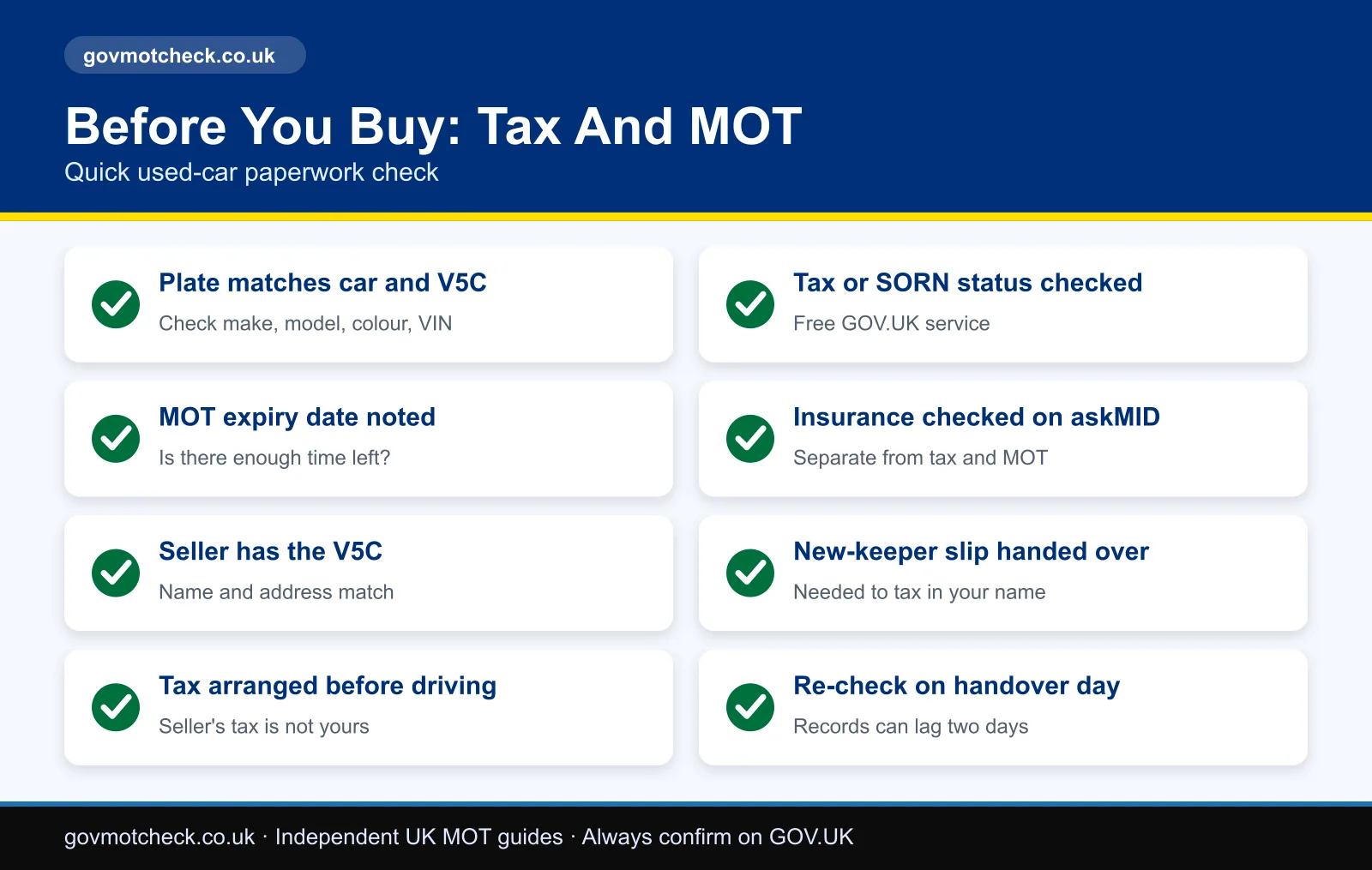
Before paying for a used car, check tax and MOT on the registration number, then compare the result with what the seller says and what the V5C log book shows. A mismatch is a reason to ask questions, not necessarily to walk away.
What Should You Check Before Handing Over Money?
Run through this list before you pay:
- Identity: the registration, make, model and colour against the V5C.
- MOT: confirm the MOT expiry date.
- Tax: check the tax or SORN status.
- History: look at the test record for mileage patterns.
Never pay a deposit on a car whose paperwork the seller cannot produce.
Pro Tip
Photograph the V5C and the screen result at the viewing. It gives you a record if anything is disputed later.
Why Does The Seller's Tax Not Help You?
Tax belongs to the keeper, not the car's future. After purchase you need to tax the vehicle yourself before driving it away.
Plan for this by having your card ready and the green new-keeper slip, which GOV.UK lists as a valid reference for taxing.
Important
The seller's tax does not pass to you. You must tax the car in your own name before driving it.
Tax After You Buy A Vehicle
The new keeper must tax the vehicle in their own name before using it on the road. A SORN does not transfer either, so a bought SORN car needs fresh tax or a fresh SORN from you.
How Do You Tax A Car You Have Just Bought?
Use the green new-keeper slip from the V5C, which GOV.UK accepts as a reference for taxing online, by phone or at a Post Office. The car needs a valid MOT if it requires one, because the tax renewal checks for it.
- Check the MOT. Confirm it is valid on the GOV.UK status check.
- Gather the reference. Have the green slip to hand.
- Tax the car. Pay online, by phone or at a Post Office.
What If The Car Has No MOT When You Buy It?
You cannot tax it for road use until it has one, if it needs one. Make a SORN, arrange transport or a pre-booked test, then tax after the pass.
A car that is not yet tested should not be driven home on the road unless the journey fits the lawful exceptions.
Warning
Driving an untested, untaxed car home is the easiest way to pick up a fine on day one of ownership.
Can You Drive A Bought Car Home Untaxed?
Not safely. Untaxed use on a public road risks an automatic fine, and a seller's tax is not yours. Tax online before leaving, which is usually possible within minutes if the MOT is valid, or arrange a trailer or recovery for an untaxed, untested car.
Tax before you leave
Check the MOT, tax online with the green slip, and make sure you are insured.
Driving home untaxed
It risks an automatic fine on day one of ownership.
Worked example
You buy a 2017 hatchback with six months of MOT left. You tax it on your phone using the green slip in the car park, then drive home legally, provided you are also insured.
Selling A Car: What Happens To Tax And MOT
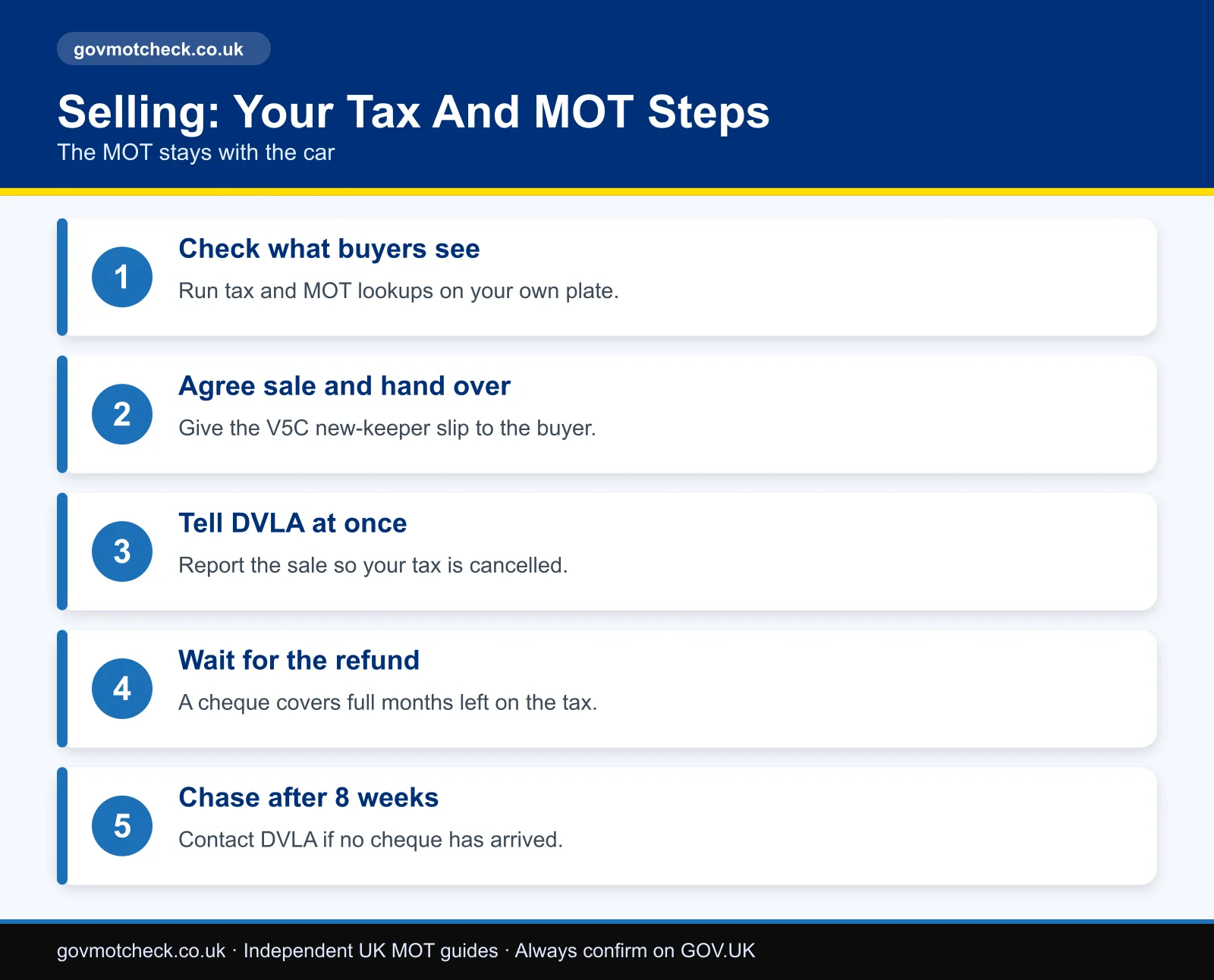
When you sell, tell DVLA straight away so your tax is cancelled and the refund is calculated. The MOT stays with the car. The buyer will need to tax it, so give them the paperwork they need.
Seller
Tell DVLA straight away so tax is cancelled and the refund is calculated.
Buyer
The MOT stays with the car, but you must tax it in your own name.
What Must The Seller Do About Tax?
Tell DVLA the vehicle has been sold or transferred. GOV.UK then sends a refund for any full months remaining, to the name and address on the log book. You cannot cancel tax any other way. Direct Debits are cancelled automatically.
Pro Tip
Tell DVLA on the day of sale, and keep the confirmation. The refund runs from the date DVLA receives your information.
What Happens To The MOT When You Sell?
Nothing changes. The MOT certificate is tied to the vehicle's registration, so the buyer inherits the remaining validity. This is a selling point, and a car with several months left is easier to sell.
See the certificate guide.
What If You Forget To Tell DVLA?
DVLA may keep treating you as the keeper, so reminders and possible enforcement letters can arrive at your address for a car you no longer own. Telling DVLA is quick online or with the V5C slip and protects you from penalties for the new owner's use.
Warning
If DVLA still shows you as keeper, you may be chased for a car you no longer own. Always report the sale.
Selling A Car With No MOT Or Tax
You can sell a car with no MOT or tax, but you must be honest about it and the buyer must move it lawfully. Most people sell these as non-runners, for repair or for scrap, and say so plainly in the advert.
Is It Legal To Sell A Car Without An MOT?
Yes, selling is not the same as driving. The offence is using the car on the road without an MOT. Say clearly in the advert that it has no MOT, and do not describe a car as "roadworthy" when it is not.
Note
State "no MOT" and "no tax" clearly in the advert. It avoids disputes and sets honest expectations.
Can A Buyer Collect An Untaxed, Untested Car?
Not by driving it, in most cases. Without tax the buyer faces fines, and without an MOT the journey is only lawful for narrow exceptions. A trailer or recovery lorry is the safe approach.
A SORN already in place ends when the vehicle is sold.
What About Selling For Scrap?
GOV.UK says a SORN is cancelled automatically when you scrap a vehicle, and tax is refunded for full months. Follow these steps:
- Tell DVLA. Report the scrapping.
- Use an authorised treatment facility. Do not use an unlicensed scrapper.
- Keep the certificate. Hold on to the certificate of destruction they give you.
Reporting A Car With No Tax Or MOT
You can report an untaxed vehicle to DVLA online, anonymously. Vehicles with no MOT are covered by a separate GOV.UK reporting route. Check the details first, because a wrong report wastes time and may point at the wrong vehicle.
How Do You Report An Untaxed Vehicle?
Check it first on the free vehicle tax service, then use DVLA's untaxed vehicle form. GOV.UK says you need:
- Registration: the registration number.
- Vehicle: make, model and colour.
- Location: the street, town and postcode where you saw it.
The report is anonymous.
Pro Tip
Run the tax check first. A car you think is untaxed may simply have taxed this week.
Can You Report A Car With No MOT?
GOV.UK has a separate page for reporting a vehicle with no MOT. Check the MOT status first. Remember that these cases are lawful, so a missing record does not always mean an offence:
- New vehicles: those in their first three years.
- Historic vehicles: those that are MOT exempt.
- Test journeys: cars driving to a pre-booked test.
What Happens After You Report?
GOV.UK says the report will be investigated, but does not describe the process or outcome, and you may not be told the result. Do not confront the keeper.
If you suspect dangerous driving or an abandoned vehicle, use the relevant GOV.UK reporting pages instead.
Report through official routes
Check the status first. Reports are anonymous.
Confronting the keeper
Never confront the keeper of a vehicle you have reported.
Warning
Never confront the keeper of a vehicle you have reported. Use the official routes only.
What Enforcement Looks Like For Untaxed Vehicles
Enforcement is mostly automatic. DVLA matches its tax and SORN records against vehicles it detects or is told about, then sends fines or letters. Insurance uses a similar approach through continuous insurance enforcement.
Do Cameras Check Tax And MOT?
DVLA and police use number plate recognition cameras in enforcement. This page cannot give a precise list of what each camera checks, so treat it as likely that tax and insurance can be detected by registration alone. MOT validity is also in the record.
What Penalties Apply For No Tax?
GOV.UK states an automatic £80 fine for a vehicle with no tax or insurance and no SORN. For insurance, GOV.UK describes a £100 fine, possible clamping, impounding or destruction, and court action up to £1,000. Check GOV.UK for current amounts.
| Offence | Consequence stated on GOV.UK |
|---|---|
| No tax or insurance and no SORN | Automatic £80 fine |
| Uninsured and not declared SORN | £100 fine, possible clamping, impounding or destruction, court fine up to £1,000 |
| Driving without a valid MOT | Fine of up to £1,000, with exceptions for repairs and pre-arranged tests |
| SORN vehicle on the road for other reasons | Possible prosecution and fine of up to £2,500 |
Important
A SORN is free and removes the automatic £80 fine risk. Use it whenever a vehicle is not on the road.
What If You Cannot Afford The Tax?
SORN is the free alternative when a vehicle is not being used. If you do use the car, tax it. Monthly Direct Debit spreads the cost but adds a 5% surcharge, so a 12-month payment is cheaper where you can manage it.
Checking Insurance As Part Of A Vehicle Check
Tax and MOT are checkable by registration on GOV.UK, and insurance is checkable through askMID. A full check of a car covers all three, but the three records belong to three different bodies.
How Do You Check If A Car Is Insured?
Use askMID, which GOV.UK points to. It tells you whether the vehicle is on the Motor Insurance Database. It does not replace asking to see a policy, and a vehicle that is not on it may simply not yet have updated.
Note
A missing askMID result is a prompt to ask questions, not proof that the car is uninsured. The record may not have updated yet.
Do You Need Insurance To Take A Car For An MOT?
Yes, if you drive it on a public road. The test station tests the car, but you need cover to drive it there. See the earlier section on driving to an MOT for what GOV.UK says about SORN vehicles.
What Is "MOT Insurance"?
The phrase usually means one of three things:
- Journey cover: cover for a car on a drive to the test.
- Failure cover: cover that pays for repair after a failed test.
- Garage plan: a plan from a garage.
These are commercial products, not government schemes, so read the terms.
Checking Tax And MOT For A Fleet
Fleet operators check many registrations on a schedule, because one lapse on a single vehicle can put a driver and the company at risk. A simple register, plus regular lookups, covers most of the exposure.
What Should A Fleet Tax And MOT Register Hold?
Hold these items for each vehicle:
- Registration: the plate.
- Tax expiry: the date it ends.
- MOT expiry: the date it ends.
- Keeper name: the registered keeper.
- SORN status: on or off the road.
- Insurance renewal: the renewal date.
Review monthly and set reminders for 30 days before expiry. Our MOT due date guide explains how the early-test window affects the renewal date.
Pro Tip
Colour-code the register by days remaining, so the vehicles closest to a lapse stand out.
Who Is Responsible For A Company Vehicle?
Responsibility follows the registered keeper, so a company is normally responsible for tax on vehicles registered to it. Drivers still have personal duties, such as not driving an unroadworthy vehicle. Leasing arrangements vary, so read your contract.
Worked Examples
These examples use made-up vehicles to show how the rules play out. Treat them as illustrations, not legal advice. Always confirm current rules on GOV.UK.
Example: 2019 Hatchback, MOT Expired, Tax Due In Two Weeks
The keeper cannot renew tax until the car passes an MOT. They follow this order:
- Make a SORN. Do it before the tax runs out.
- Book a test. Choose a confirmed slot.
- Drive only to the test. Take the direct route.
- Tax on the pass. Renew once the pass is on record.
The refund for full SORN months arrives by cheque, so they pay attention to the timing.
Worked example
If this hatchback's tax ran for three more full months after the SORN date, those three months would be refunded and any odd days would not.
Example: 1984 Estate Car Bought As A Classic
Built before 1 January 1986, it can be placed in the historic tax class from 1 April 2026 after applying. It is over 40 years old, so unless substantially changed it needs no MOT. The buyer still registers tax and insures it.
Example: Private Sale Of A 2015 Diesel With No Tax
The seller tells DVLA it has been sold. The buyer checks the MOT, finds six months left, and taxes online using the green slip before driving. Both parties keep a copy of the sale details.
Common Myths About Tax And MOT
Many beliefs about these rules are half-true. The myths below are the ones most often seen in questions and forums, with the accurate position as GOV.UK states it.
Myth: An MOT Certificate Makes A Car Legal To Drive
An MOT is one of three duties. A car with an MOT but no tax or insurance is not legal on the road. Only all required duties together make a vehicle lawful.
Important
Legal driving needs insurance, tax (or SORN) and, where required, an MOT. One does not stand in for another.
Myth: Tax Passes To The New Owner With The Car
It does not. GOV.UK describes cancelling and refunding the seller's tax, and the new keeper taxes in their own name. Do not buy a car assuming its tax is yours to use.
Myth
Tax passes to the new owner with the car.
Fact
The seller's tax is cancelled and refunded, and the new keeper taxes in their own name.
Myth: A SORN Car Can Be Driven Anywhere
It cannot. GOV.UK limits SORN vehicles on a public road to a pre-booked MOT or testing appointment, and other use risks prosecution and a fine of up to £2,500.
Myth: Exempt Means No Paperwork
Exempt vehicles must still be taxed in the system, even at no cost, GOV.UK says. Exemption removes the charge, not the registration step.
Myth
Exempt means no paperwork.
Fact
Exempt vehicles must still be taxed in the system, even at no cost.
Tax And MOT At A Glance
This summary collects the main rules from the page. Each line reflects the GOV.UK position as of November 2026, so check for updates before relying on it.
Key Rules In Brief
- You cannot renew tax with an expired MOT when the vehicle needs one.
- A SORN allows driving only to a pre-booked MOT or test.
- Tax is not transferable to a buyer; the seller gets a refund for full months.
- Exempt vehicles must still be taxed.
- Insurance is checked separately on askMID.
Official Services To Use
The free GOV.UK vehicle tax check, MOT status check and vehicle enquiry service cover tax, SORN and MOT. For insurance use askMID. For contested records contact DVLA or DVSA. Northern Ireland tests are managed by the DVA.
Pro Tip
Bookmark the three official GOV.UK services so you never have to search for them under pressure.
Glossary Of Terms Used On This Page
Short definitions of the terms in this page are listed below for quick reference, in the order most readers meet them.
Core Terms
- MOT: the annual roadworthiness test for vehicles over a set age.
- DVSA: the agency that runs MOT testing in Great Britain.
- DVLA: the agency that keeps vehicle and driver records and collects VED.
- DVA: the Northern Ireland agency for vehicle testing.
- VED: Vehicle Excise Duty, commonly called road tax.
- SORN: Statutory Off Road Notification.
- V5C: the vehicle registration certificate, also called the log book.
- askMID: the service for checking a vehicle's insurance record.
Reminders And How To Avoid Lapses
Lapses are avoidable with simple habits. DVLA sends tax reminders, and many test stations text MOT reminders. Add your own diary alerts as a second safety net.
Which Reminders Should You Set?
Set these three alerts:
- MOT: an alert 30 days before MOT expiry.
- Tax: another for the tax end date.
- Insurance: one for insurance renewal.
If you pay by Direct Debit, keep an eye on the account. Reminders sent to a previous address can be missed, so update your V5C.
Note
If you move house, update the address on your V5C promptly. Reminders go to the address DVLA holds.
Limits Of This Page And Where To Check Official Guidance
This page gives general information as of November 2026. Rates, exemptions and procedures can change, and individual circumstances vary. For decisions with legal or financial effect, rely on the official source.
Where Can You Confirm Current Rules?
GOV.UK is the primary source for tax, SORN and MOT rules. Contact DVLA for tax records, DVSA for test records, and NI Direct for Northern Ireland. If a figure on this page differs from GOV.UK, GOV.UK is correct.
Important
If anything on this page differs from GOV.UK, trust GOV.UK. Confirm before you pay or act.
Insurance And MOT: What Happens To Your Cover Without A Test
Many drivers search "are you insured without an MOT" expecting a yes or no. The honest answer has two parts: the policy usually still exists, but driving without an MOT is an offence and can damage a claim.
Are You Insured Without An MOT?
Usually yes, the policy itself stays in force, but cover is not guaranteed in practice. Insurers quote for cars with no MOT, and an expired MOT does not normally cancel a policy by itself. GOV.UK gives no rule on this, so your policy wording decides.
- Policy stays active: the car usually remains on the Motor Insurance Database, so askMID can still show it as insured.
- Claims can be challenged: an insurer may argue the car was unroadworthy or being used illegally.
- Third parties: ask your insurer how an injured third party would be treated and whether it could pursue you afterwards.
Pro Tip
Phone your insurer and ask: "Does an expired MOT affect my cover or a claim?" Ask for the answer in writing.
Is Insurance Invalid If You Have No MOT?
Not automatically. Most policies do not say "no MOT, no cover", but many require the vehicle to be roadworthy and legally used. If a fault that an MOT would have caught causes a crash, a claim is at higher risk of being reduced or refused. Read the "conditions" and "general exclusions" sections of your policy.
Is A Car Legal If It Is Taxed And Insured But Has No MOT?
No. Being taxed and insured does not make an expired MOT legal. The three duties are separate. GOV.UK says you can be fined up to £1,000 for driving without a valid MOT, apart from the two exceptions: a pre-arranged test, or a journey to a place of repair.
What Happens If You Are Caught Without MOT Or Tax
What follows depends on which record is missing. The consequences differ, and they can stack when both are missing.
What Happens If You Get Caught Without An MOT Or Tax?
You face separate consequences for each failure: a possible fine of up to £1,000 for no valid MOT, and for no tax, an automatic £80 fine if there is no SORN, plus possible clamping or impounding. Check GOV.UK for current amounts.
| Missing | Typical outcome stated on GOV.UK |
|---|---|
| MOT only | Fine of up to £1,000 |
| Tax only (no SORN) | Automatic £80 fine, possible clamping or impounding |
| Tax and MOT | Both consequences can apply |
| Tax, MOT and insurance | All three, with the insurance penalties on top |
How Do You Reduce The Risk Once You Realise?
Stop using the car for ordinary journeys, book an MOT, make a SORN if tax has also lapsed, and drive only to the pre-booked test or a repairer. The SORN sections above explain what that covers.
Warning
An MOT certificate or tax disc is not a defence for a car in an unsafe condition. Dangerous defects are a separate matter.
What Age Does A Car Become Tax And MOT Exempt?
The two exemptions use different cut-offs, so there is no single age that gives both at once.
At What Age Is A Car Tax And MOT Exempt?
- MOT: a vehicle built or first registered more than 40 years ago and not substantially changed generally needs no test.
- Tax: as explained earlier on this page, GOV.UK says vehicles built before 1 January 1986 can stop paying from 1 April 2026. That is a fixed date, not a rolling age.
A car can therefore be exempt from one and not the other, and a substantially changed car may lose the MOT exemption.
Warning
An exempt vehicle must still be taxed in DVLA's system. Run the registration through the check to confirm how the record appears.
MOT Failure Insurance And MOT Protection Products
These search terms cover commercial products, not government schemes. This page does not recommend any provider.
What Is MOT Failure Insurance?
It is an optional product that pays towards repair costs if a car fails its MOT, subject to its terms. Features vary:
- Excess and limits: a cap on what is paid per claim.
- Exclusions: wear and tear, existing faults or items outside the terms.
- Waiting periods: some must be bought well before the test.
Compare the terms with simply budgeting for repairs. It does not change the legal result of a failed test.
What Is MOT Protection Insurance?
The term is used for similar plans, sometimes bundled by garages or breakdown providers. Read the policy documents, check what counts as a claim, and make sure it does not replace the motor cover you need to drive legally.
Is MOT Garage Insurance The Same Thing?
Not necessarily. "Garage insurance" can mean a motor trade policy for businesses, a garage service plan, or short-term cover for a test journey. Check which product you are being offered before paying.
Note
None of these products is needed to take an MOT. The car simply needs valid cover to be driven on the road.
Reporting A Car With No Tax And No MOT
How Do You Report An Untaxed Car With No MOT?
Report the missing tax through the GOV.UK untaxed vehicle service, which asks for the registration and where the vehicle is kept. State in any free-text field if you can see the MOT has expired, but check GOV.UK for the current route for MOT concerns.
Warning
Do not confront the keeper. Use the official route and give only facts you can see.
Frequently Asked Questions
Can you tax a car without an MOT?
Not if the car needs an MOT and its certificate has expired. GOV.UK states you cannot renew vehicle tax with an expired MOT. Vehicles that legally need no MOT, such as new cars within three years or exempt historic vehicles, can be taxed without one. If tax is about to run out, make a SORN first, test the car, then tax it.
Can I tax my car without an MOT?
Only if your car does not need one. For a car that needs a test, DVLA's service checks the MOT record and will not renew the tax if it has expired. The usual route is to declare the car off the road with a SORN, book a test, and tax it after it passes.
Can you get road tax without an MOT?
Road tax is the everyday name for VED. You can get it without an MOT only for vehicles that are not required to have one. Otherwise GOV.UK says you cannot renew it after the MOT expires, so you need a pass first. Check the vehicle's status with the tax and MOT lookup above.
Do you need an MOT to tax a car?
Yes, if the car is old enough to need one. The tax system checks for a valid MOT when you renew. A car under three years old, or one that is exempt, does not need a certificate to be taxed. Exempt vehicles must still be taxed, even where nothing is payable.
Can you insure a car without an MOT?
Yes, many insurers will quote for a car with no MOT, because the policy covers driving risk rather than test status. Be open about the situation. Driving without an MOT is still an offence unless you are going to a pre-booked test or repair, so insurance does not make the journey lawful.
Is insurance valid without an MOT?
Often the policy still exists, but an expired MOT can complicate a claim. GOV.UK does not set a rule on this, so read your policy wording or ask your insurer. An insurer may refuse to pay if the vehicle was unroadworthy or being used illegally at the time of an incident.
Does no MOT void insurance?
Not automatically in every case, but it can put cover at risk. Policies differ, and insurers may refuse claims linked to an unroadworthy vehicle. GOV.UK gives no general rule. Check your policy terms and speak to your insurer, and get the car tested as soon as you can.
Can I drive my car to an MOT without tax?
Only if the vehicle is declared SORN and the test is pre-booked, according to GOV.UK. A SORN vehicle on the road for any other reason can bring prosecution and a fine of up to £2,500. Insurance is still required for the journey, so arrange cover first.
Can you drive an untaxed car to an MOT?
GOV.UK allows a SORN vehicle on the road only to or from a pre-booked MOT or testing appointment. An untaxed car with no SORN does not have that protection and risks an automatic fine. Make a SORN first, keep the booking confirmation, and go straight to the test station and back.
Can I drive to an MOT without insurance?
No. Any vehicle used on a public road needs insurance, including a short trip to a test station. The MOT exceptions do not relax that requirement. Arrange cover before travelling, or have the car transported to the test by a recovery vehicle or trailer.
Can you get an MOT without tax?
Yes. The MOT tests the vehicle's condition, and the test station does not require the car to be taxed. The difficulty is travelling there lawfully, which requires a SORN and a pre-booked appointment. After the pass, tax the car before driving it normally.
Can you get an MOT without insurance?
The test station does not normally ask for a policy, so the test can be done. You do need insurance to drive the car to the station on a public road. Some centres have conditions once the car is on their premises, so ask when you book.
Can I MOT a car without insurance?
You can have it tested, but only if it gets there lawfully. Driving it there uninsured is an offence. Use a recovery vehicle, a trailer, or a short-term policy that covers the journey. Ask the test station about their own requirements before you arrive.
What is SORN?
SORN stands for Statutory Off Road Notification. It is a declaration to DVLA that a vehicle is not kept or used on a public road, so it needs no tax or insurance. You make it online, by phone or by post. It does not need renewing and ends automatically when you tax, sell, export or scrap the vehicle.
Does SORN cost anything?
GOV.UK lists no fee for making a SORN. You automatically get a refund for any full months of tax remaining, and Direct Debits are cancelled automatically. The refund goes to the name and address on the log book. Partial months are not refunded.
What is the penalty for not having a SORN?
GOV.UK states an automatic £80 fine applies when a vehicle has no tax or insurance and no SORN. Driving a SORN vehicle on a public road for any reason other than a pre-booked MOT or test can lead to court prosecution and a fine of up to £2,500.
Can I drive a SORN car on the road?
Only to or from a pre-booked MOT or other testing appointment, per GOV.UK. Any other use risks prosecution and a fine of up to £2,500. A SORN vehicle must be kept off public roads, such as on a drive, in a garage or on private land.
Does a SORN transfer when I sell?
No. GOV.UK says a SORN cannot be transferred from the previous keeper. If you buy a SORN vehicle and want to keep it off the road, you must make your own SORN. If you want to use it, you must tax it first.
What is VED?
VED stands for Vehicle Excise Duty, the tax paid to DVLA for using a vehicle on public roads. It is commonly called road tax or car tax. It is separate from the MOT test fee and from insurance. The rate depends on factors such as the vehicle's CO2 emissions and when it was registered.
How much is vehicle tax?
As of November 2026, GOV.UK's rate tables show a standard rate of £200 for a 12-month payment and £110 for six months. Direct Debit is £200 for a year or £210 in total across 12 monthly payments. First-year rates vary by CO2 emissions. Check GOV.UK for any change.
Is there a surcharge for paying monthly?
Yes. GOV.UK says paying monthly or every six months by Direct Debit adds a 5% surcharge, while yearly payments carry none. A single six-month payment carries a 10% surcharge. These surcharges are not refunded, so a 12-month payment is the cheapest option.
What is the expensive car supplement?
It is an extra £440 a year for petrol or diesel cars listing above £40,000, and electric cars listing above £50,000. The 12-month rate at that level is £640. GOV.UK says you pay it for five years, counted from the second time the vehicle is taxed.
Do electric cars pay vehicle tax?
Yes. GOV.UK shows a zero-emission car pays £10 at first registration, then the standard rate from the second payment. Electric cars listing above £50,000 also pay the expensive car supplement. Zero-emission cars registered before 1 April 2025 are exempt from that supplement.
What year is a car tax and MOT exempt?
For tax, GOV.UK says vehicles built before 1 January 1986 can stop paying from 1 April 2026 after applying for exemption. For MOT, a vehicle built or first registered more than 40 years ago generally needs none if it has no substantial changes. The two tests use different dates.
Do tax exempt vehicles still need to be taxed?
Yes. GOV.UK says you must tax your vehicle even if you do not have to pay anything because it is exempt. The vehicle then appears in the DVLA system, normally in the historic tax class. Without that registration step you could still be treated as untaxed.
How do I apply for tax exemption?
GOV.UK says you must apply for a vehicle tax exemption to stop paying, which places the vehicle in the historic tax class. It applies to vehicles built before 1 January 1986 from 1 April 2026. Follow the application steps on the GOV.UK exemption page, as the detail is not repeated here.
Do historic vehicles need an MOT?
Not if built or first registered more than 40 years ago and not substantially changed, according to GOV.UK. You do not need to apply to skip the test, but the vehicle must stay roadworthy. A dangerous vehicle can still bring a fine of up to £2,500 and three penalty points.
What counts as a substantial change to a classic?
GOV.UK describes it as replacing the chassis, body, axles or engine in a way that changes how the vehicle works. Such changes can remove the MOT exemption. If you are unsure, refer to the full MOT exemption criteria guidance on GOV.UK or consult a historic vehicle expert.
How do I check if a vehicle is taxed?
Use the free GOV.UK vehicle tax check with the registration number. It shows whether the vehicle has up-to-date tax or is registered as off the road. Records can take up to two working days to update after you tax or declare SORN, so recent changes may not show yet.
How do I check if a car has a valid MOT?
Use the GOV.UK MOT status check and enter the registration number. It shows whether the vehicle has an MOT certificate and when it expires. For the full test-by-test record, use the MOT history service explained on our home page. A newly tested car may take up to two days to update.
Can I check tax and MOT in one go?
GOV.UK's vehicle enquiry service shows tax rate and expiry, SORN status and MOT expiry together for a registration number. The lookup tool on this page presents the same kind of information in one place. Neither shows insurance, which is checked separately on askMID.
How do I check insurance on a car?
Use askMID, the Motor Insurance Database service that GOV.UK points to. It is separate from the DVLA vehicle enquiry service. A result shows whether the vehicle is recorded as insured. It does not replace asking to see a policy certificate when buying a car.
Does the vehicle enquiry service show insurance?
No. It shows tax, SORN, MOT expiry, registration dates, technical details and export status. Insurance is checked through askMID. Colour and keeper details are not available online, and registered keeper information needs a written request to DVLA.
Why does my tax show as unpaid after I paid?
Records can take up to two working days to update after you tax a vehicle. If it still shows untaxed after that, check your payment confirmation and contact DVLA. For Direct Debit, GOV.UK says the first payment is taken once the tax starts, which can take up to 10 days.
Why can't I tax my car straight after an MOT pass?
GOV.UK says MOT information can take up to two days to update, so the tax service may not see your new certificate immediately. Wait and retry, or at a Post Office bring the paper certificate as evidence. The MOT must be valid when the tax starts.
What documents do I need to tax a car?
GOV.UK lists a reference number from a recent DVLA reminder or last chance letter, the V5C log book in your name, or the green new-keeper slip. If you have none, apply for a new log book and tax the vehicle at the same time. At a Post Office you may need MOT evidence too.
Can I tax a car I just bought?
Yes, use the green new-keeper slip from the V5C. The tax belongs to the previous keeper and is not yours, so tax it in your own name before driving. If the car needs an MOT, it must be valid or the renewal will be refused. A SORN also does not transfer.
Does tax transfer to the new owner?
No. The seller tells DVLA about the sale and gets a refund for full months remaining. The new keeper must tax the vehicle in their own name. GOV.UK says there is no other way to cancel vehicle tax, and it does not describe any transfer of tax between owners.
How do I get a refund on vehicle tax?
Tell DVLA the vehicle is sold, scrapped, exported, SORNed or registered as exempt, and you automatically get a refund for full months remaining. The cheque goes to the name and address on the log book. If it has not arrived after eight weeks, contact DVLA.
Are credit card fees and surcharges refunded?
No. GOV.UK states credit card fees, the 5% surcharge on some Direct Debit payments and the 10% surcharge on a single six-month payment are not refunded. Only whole remaining months of tax are refunded, so timing a sale or SORN near the start of a month loses less.
Can I sell a car with no MOT or tax?
Yes. Selling is not the same as driving. Be honest in the advert, describe it as having no MOT, and arrange collection by trailer or recovery. The buyer must tax the car and test it before using it. Tell DVLA about the sale so you receive your refund.
How do I report a car with no tax?
Check the vehicle on the free tax service, then use DVLA's untaxed vehicle form. GOV.UK says you need the registration number, make, model and colour, plus the street, town and postcode where you saw it. Reports are anonymous and are investigated, though outcomes are not described.
How do I report a car with no MOT?
GOV.UK has a separate page for reporting a vehicle with no MOT. Check its MOT status first, and remember that cars within their first three years, historic vehicles, and cars driving to a pre-booked test may lawfully be on the road. Use the official reporting route.
What is the penalty for driving without tax and MOT?
GOV.UK says driving without a valid MOT can bring a fine of up to £1,000. For tax, an automatic £80 fine applies where there is no tax, insurance or SORN. Other consequences can follow. Check GOV.UK for current amounts and see our rules page for MOT penalties.
What is the fine for driving without an MOT?
GOV.UK states you can be fined up to £1,000 for driving without a valid MOT. The exceptions are driving to or from a repair, or to a pre-arranged MOT test. A dangerous vehicle can attract a larger fine and penalty points, so fix faults promptly.
Is there a fine for no insurance?
GOV.UK describes continuous insurance enforcement for uninsured vehicles not declared SORN: a £100 fine, possible clamping, impounding or destruction of the vehicle, and court action with a maximum fine of £1,000. Insurance is a separate legal duty from tax and MOT, and Northern Ireland has different rules.
Do cameras check tax and MOT?
Number plate recognition cameras are used in enforcement, and DVLA matches registrations against its records. This page cannot list exactly what each system checks. Assume that tax, insurance and MOT status linked to your registration can be detected, so keep all three in order.
Can I get a day of insurance just for an MOT?
Some providers sell short-term or day cover, but terms vary. Ask whether the policy covers driving to a pre-booked MOT, and whether it needs the vehicle to be taxed. Do not assume a day policy covers an untaxed car, and read the conditions.
How soon after an MOT can I tax my car?
You can often tax within minutes, but GOV.UK says MOT information can take up to two days to update, so the system may not recognise your pass straight away. If the service refuses, wait and try again or use your paper certificate at a Post Office.
How early can I get an MOT without losing days?
GOV.UK says you can test up to a month minus a day before expiry and keep the same renewal date. Testing earlier moves the renewal date to a year minus a day after the new pass date. See our MOT due date page for worked examples.
Does an MOT run out the same day as my tax?
No. The two dates are independent. The MOT follows the DVSA test cycle and the tax follows the period you paid for. They can expire in different months. Check both on the lookup tool and set separate reminders so neither lapses without you noticing.
Can I check another person's car tax and MOT?
Yes. The tax and MOT status checks need only a registration number and work for any vehicle. They do not reveal the keeper's identity or personal details. Registered keeper information needs a written request to DVLA, which has its own conditions.
Is the tax and MOT check free?
GOV.UK's vehicle tax check and MOT status check are free to use. You pay only the actual tax when you tax a vehicle. Be cautious of sites that add a service fee on top. This site is independent and is not an official GOV.UK service.
What does tax and MOT exempt mean?
It means the vehicle is excused from the tax charge, the MOT test, or both, usually because of age. Exempt from tax still means you must register the vehicle as taxed. Exempt from MOT still means the vehicle must be roadworthy. The two exemptions have different age rules.
Do I need an MOT to SORN a car?
No. A SORN has no MOT requirement. In fact, it is the usual way to handle a car whose MOT and tax are about to lapse. You only need an MOT when you want to tax the vehicle again for road use, if it requires one.
How do I unSORN a car with no MOT?
A SORN ends automatically when you tax the vehicle, but taxing needs a valid MOT if the car requires one. So get the MOT first, driving to a pre-booked test while the SORN stays in place, then tax the car after the pass. The SORN then ends.
What happens if I forget to tell DVLA I sold my car?
You may continue to receive tax reminders and could be treated as the keeper, which can lead to penalties for a car you no longer own. GOV.UK says that once you tell DVLA about a sale you receive confirmation. Do it as soon as the sale completes.
Is this site official?
No. GovMotCheck is independent and is not affiliated with DVLA, DVSA, DVA or GOV.UK. It presents public vehicle information for convenience. For proof of tax or MOT status, or to make a payment, use the official GOV.UK services.
Are you insured without an MOT?
Usually the policy stays in force, because most policies do not cancel when an MOT expires. Driving without an MOT is still an offence, and an insurer may challenge a claim if the car was unroadworthy. GOV.UK gives no rule on this, so check your policy wording or ask your insurer.
If you have no MOT is your insurance invalid?
Not automatically, but it can put a claim at risk. Many policies require the vehicle to be roadworthy and legally used. Read the conditions and exclusions, and ask your insurer in writing if you are unsure.
What happens if I get caught without MOT or tax?
Each failure carries its own consequence. GOV.UK states a fine of up to £1,000 for driving without a valid MOT, and an automatic £80 fine for an untaxed vehicle with no SORN, plus possible clamping or impounding. Check GOV.UK for current amounts.
What age does a car become tax and MOT exempt?
There is no single age. The MOT exemption applies to vehicles built or first registered more than 40 years ago without substantial changes. The tax exemption described on this page applies to vehicles built before 1 January 1986, from 1 April 2026. Check each separately on GOV.UK.
How do I report an untaxed car with no MOT?
Use the GOV.UK untaxed vehicle reporting service with the registration number and location. Mention the missing MOT if you can see it has expired, but do not confront the keeper. Check GOV.UK for the current reporting route.
What is MOT failure insurance?
It is an optional commercial product that pays towards repairs if a car fails its MOT, subject to limits, excess and exclusions. It is not a government scheme and does not change the legal outcome of a failed test. Read the terms and compare with simply budgeting for repairs.
What is MOT protection insurance?
It is a similar plan sometimes sold by garages or breakdown providers. Check what counts as a claim, any waiting period and any exclusions for existing faults. It does not replace the motor insurance you need to drive legally.
Is my car legal if it is taxed and insured but has no MOT?
No. Tax and insurance do not cover an expired MOT. GOV.UK says you can be fined up to £1,000 for driving without a valid MOT, unless you are driving to a pre-arranged test or to a place of repair.
Is MOT garage insurance the same as MOT insurance?
Not always. It may refer to short-term cover for a test journey, a garage service plan or a motor trade policy. Check which product is being offered and what it actually covers before paying.
Can a car be insured and have an MOT but still be untaxed?
Yes, the records are separate. A car can be insured with a valid MOT but untaxed, which can lead to an automatic fine unless it has a SORN. Check each record on its own service.