Motorcycle MOT At A Glance
A motorcycle MOT is the annual roadworthiness and environmental test that applies to most motorcycles, mopeds and sidecar outfits in Great Britain once they reach three years old. The test is run by the DVSA (Driver and Vehicle Standards Agency), which sets the rules that every authorised test station follows.
This page covers:
- Motorcycles (classes 1 and 2), mopeds and trikes
- Vans (classes 4 and 7)
- Electric and hybrid vehicles
- Campervans and motorhomes
- Brief notes on minibuses, taxis and trailers
For an ordinary car, see what an MOT is. Everything below reflects GOV.UK guidance as of November 2026.
Note
This guide covers Great Britain only. Northern Ireland runs a separate scheme, so do not assume a GB rule or fee applies there.
Great Britain
This guide applies here. The test is run by the DVSA and the fees below are GOV.UK maximums.
Northern Ireland
It runs a separate scheme with its own fees, so do not assume a GB rule or fee applies there.
The Short Version
Most motorcycles need an MOT every year from the third anniversary of registration. The key maximum fees GOV.UK lists are:
- Standard motorcycle: £29.65
- Motorcycle with a sidecar: £37.80
- Vans up to 3,000kg design gross weight (class 4): £54.85
- Heavier vans (class 7): £58.60
Important
These figures are maximum fees, not fixed prices. A test station may charge less, but never more than the ceiling for your class.
How To Use This Page
Skim the headings to find your vehicle type. Each section starts with a direct answer, followed by detail and worked examples. Any example vehicle labelled "example" is made up to illustrate a rule.
Fees quoted come from the GOV.UK MOT fees table and are the maximum a station may charge, not a fixed price.
Do Motorcycles Need An MOT?
Yes. A motorcycle, moped or motorcycle with sidecar registered in Great Britain needs an MOT once it reaches the age shown in the GOV.UK MOT fees table, which is three years for every motorcycle class. The exception is a vehicle that qualifies for an exemption such as the rolling 40-year rule.
Pro Tip
Not sure whether your bike is due? Enter the registration number on the free GOV.UK MOT history service and read the expiry date on the latest pass.
Do Motorbikes Need MOT Every Year?
After the first test, a motorbike needs an MOT every 12 months. GOV.UK states you must get an MOT by:
- The third anniversary of registration, for a newer bike
- The anniversary of the last MOT, if the vehicle is over three years old
Annual testing is the rule, not a choice.
Do Mopeds Need An MOT?
Yes. A moped is treated as a motorcycle for testing, so it needs an MOT at three years old and then annually. Mopeds, including 50cc scooters, fall into class 1, which the DVSA defines as motorcycles up to 200cc.
The fee ceiling is the same £29.65 as other class 1 and 2 bikes.
Warning
Do not assume a small scooter is exempt because it is low powered. Mopeds are tested as class 1 motorcycles.
Does A New Motorbike Need An MOT?
No, not at first. A brand-new motorbike needs no MOT until its third anniversary of registration. Until then, it only needs the usual tax and insurance, covered on our MOT and tax page.
Worked example
A bike first registered on 12 March 2024 must have a valid MOT by 12 March 2027.
Motorcycle MOT Classes Explained
The MOT system sorts vehicles into numbered classes, and each class has its own test, equipment and maximum fee. The groupings are:
- Motorcycles: classes 1 and 2
- Three-wheelers: class 3 or 4
- Cars and light vans: class 4
- Heavier vans: class 7
Note
Your class decides both the test you receive and the fee ceiling, so it is worth confirming before you book.
What Is A Class 1 Motorcycle MOT?
A class 1 MOT covers motorcycles and motorcycle combinations up to 200cc. The DVSA testing guide also places certain electrically powered solo motorcycles in class 1. These are bikes with:
- A maximum continuous rated power of not more than 4kW
- A design speed up to 45km/h
What Is A Class 2 Motorcycle MOT?
A class 2 MOT covers all other motorcycles and combinations, including electric variants, outside the L1 category. In plain terms, if your bike is above 200cc, such as a 650cc roadster or a 1200cc tourer, it is class 2.
The test is the same as class 1 in structure.
Is There Any Difference Between Class 1 And Class 2 In The Test?
The test procedure is the same for both classes, with class 2 reflecting larger and faster machines. The practical difference is the engine size boundary, not the checks.
The GOV.UK fee ceiling is identical at £29.65 for both. The class matters when you search for a station approved for your bike.
Class 1
Motorcycles up to 200cc, including mopeds and 50cc scooters. Maximum fee £29.65.
Class 2
All other motorcycles, such as a 650cc roadster or a 1200cc tourer. Maximum fee £29.65.
Pro Tip
Ring the station before booking and quote your bike's engine size, so they can confirm they are approved for its class.
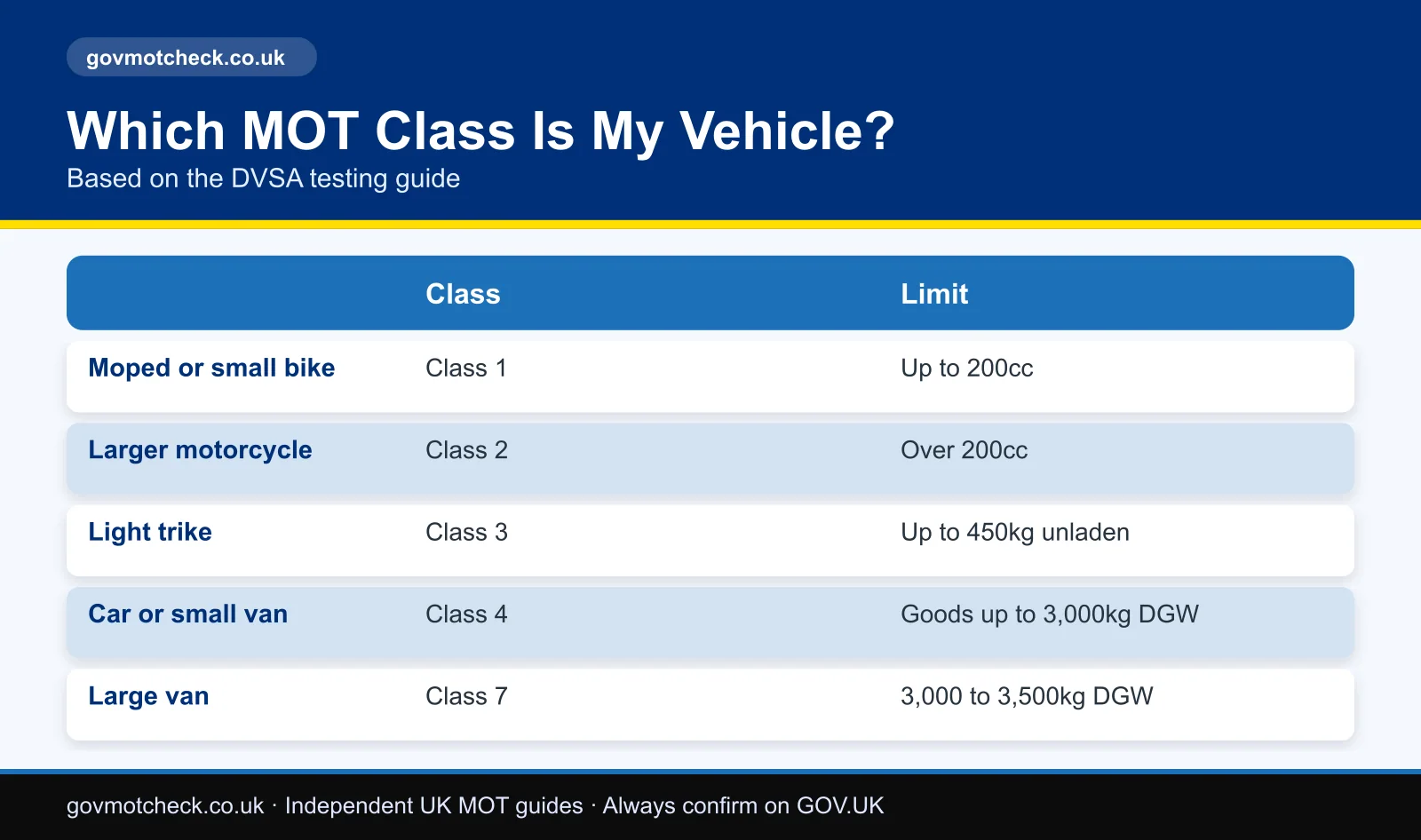
MOT Classes For Every Vehicle In This Guide
GOV.UK and the DVSA testing guide split everything below buses into a handful of classes. The table summarises the classes relevant to this page, using the descriptions published by the DVSA and the GOV.UK fees table.
| Class | Typical vehicles | Key limit |
|---|---|---|
| 1 | Motorcycles, mopeds and combinations | Up to 200cc |
| 2 | Motorcycles and combinations | Over 200cc |
| 3 | Three-wheelers | Up to 450kg unladen |
| 4 | Cars, motor caravans, light vans, quads, dual-purpose | Up to 8 seats; goods up to 3,000kg design gross weight |
| 5 | Larger passenger vehicles | 13 or more seats |
| 7 | Heavier goods vehicles | Over 3,000kg up to 3,500kg design gross weight |
What Does Design Gross Weight Mean?
Design gross weight (DGW) is the maximum weight the manufacturer designed the vehicle to carry on the road, including the vehicle itself, load and passengers. It is not the weight of your van as it stands on the driveway.
You can find it on the vehicle's plate, usually in the door shut or engine bay.
Important
Quote the design gross weight, not the kerb weight, when you ask for a class or a price. Mixing them up can send you to the wrong fee.
Where Do I Find My Vehicle's Class?
Your class depends on three things:
- Vehicle type
- Engine size or weight
- Number of seats
The V5C registration certificate (the logbook issued by the DVLA, the Driver and Vehicle Licensing Agency) shows the body type and weights.
If unsure, ask the test station before booking, because stations can only test the classes they are approved for.
Motorcycle MOT Cost
The most any test station can charge for a standard motorcycle MOT is £29.65, according to the GOV.UK MOT fees table as of November 2026. Stations may charge less, and many do, but they cannot charge more than the maximum for your class.
Pro Tip
Phone two or three approved stations and compare quotes. The ceiling is the same everywhere, but real prices often are not.
How Much Is A Motorcycle MOT?
A motorcycle MOT costs:
- Up to £29.65 for a class 1 or 2 bike
- Up to £37.80 for a motorcycle with a sidecar
GOV.UK also states you do not pay VAT on the fee. Typical shop prices can be lower, because the maximum is a ceiling.
How Much Is A Moped MOT?
A moped MOT costs up to £29.65, because mopeds are tested as class 1 motorcycles. Prices at individual stations can be lower.
If a station quotes a figure above £29.65 for the test alone, ask for an itemised quote, since extra charges may be for repairs or other services.
Warning
A quote above the ceiling for the test itself is a red flag. Make sure any extra amount is for work you agreed to.
How Much Is A Class 7 MOT?
A class 7 MOT costs up to £58.60 for petrol, diesel and hybrid goods vehicles between 3,000kg and 3,500kg design gross weight. GOV.UK lists the same £58.60 for zero emission goods vehicles between 3,501kg and 4,250kg.
We expand on vans further below.
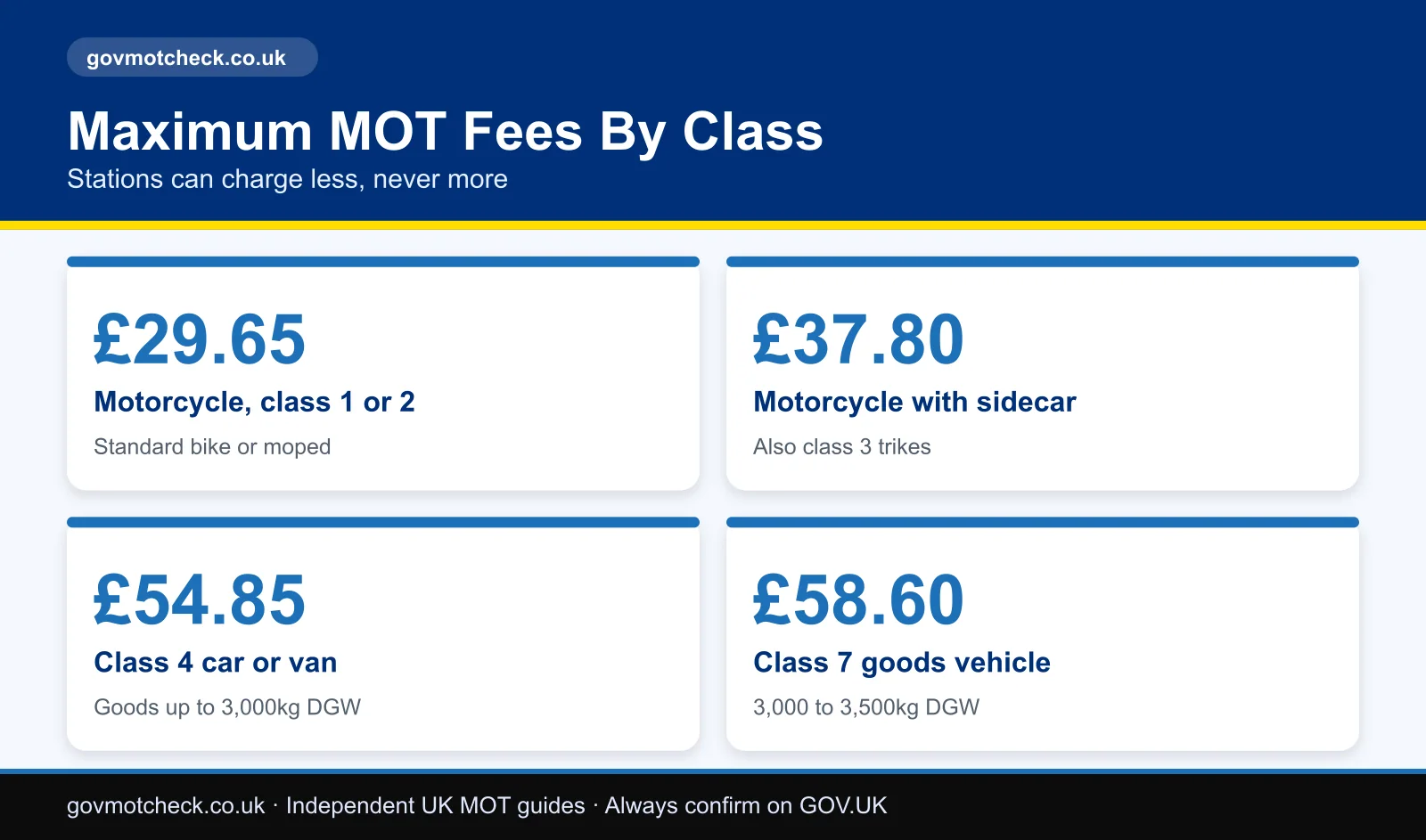
Maximum MOT Fees By Class
The table below reproduces the GOV.UK MOT fees table for the classes in scope. Always confirm on GOV.UK, as fees are set by regulation and can change. For the booking process and how to compare quotes, see how to book an MOT.
| Class | Vehicle | Max fee |
|---|---|---|
| 1 | Motorcycle up to 200cc | £29.65 |
| 1 | Motorcycle with sidecar up to 200cc | £37.80 |
| 2 | Motorcycle over 200cc | £29.65 |
| 2 | Motorcycle with sidecar over 200cc | £37.80 |
| 3 | Three-wheeled vehicle up to 450kg unladen | £37.80 |
| 4 | Three-wheeled over 450kg, cars, motor caravans, quads, goods up to 3,000kg DGW | £54.85 |
| 4 | Private passenger vehicles and ambulances, 9 to 12 seats | £57.30 |
| 4a | Class 4, 9 to 12 seats, with seatbelt installation check | £64.00 |
| 5 | Private passenger vehicles, 13 to 16 seats | £59.55 |
| 5 | Over 16 seats and playbuses | £80.65 |
| 7 | Goods vehicles 3,000 to 3,500kg; zero emission goods 3,501 to 4,250kg | £58.60 |
Note
Fees are set by regulation and can change, so treat any figure on this page as accurate to November 2026 and check GOV.UK before you pay.
Is The Motorcycle MOT Fee The Same Everywhere In Britain?
The maximum is the same across England, Scotland and Wales, but the price you pay can differ between stations. Northern Ireland runs a separate scheme with its own fees, covered on our Northern Ireland MOT page.
Never assume a GB figure applies in NI.
Why Do Some Stations Charge Less Than The Maximum?
Stations compete for work, and a bike test takes less time than a larger vehicle test. Common reasons for a lower price are:
- Discounted bike tests to attract regular customers
- Bundles that combine the test with a service
- Quiet periods when the station wants to fill its bays
A low test price is fine, but check whether the quote covers retests and what happens if a repair is needed.
Pro Tip
Ask one simple question when you call: "What happens if my bike fails?" The answer tells you a lot about the station.
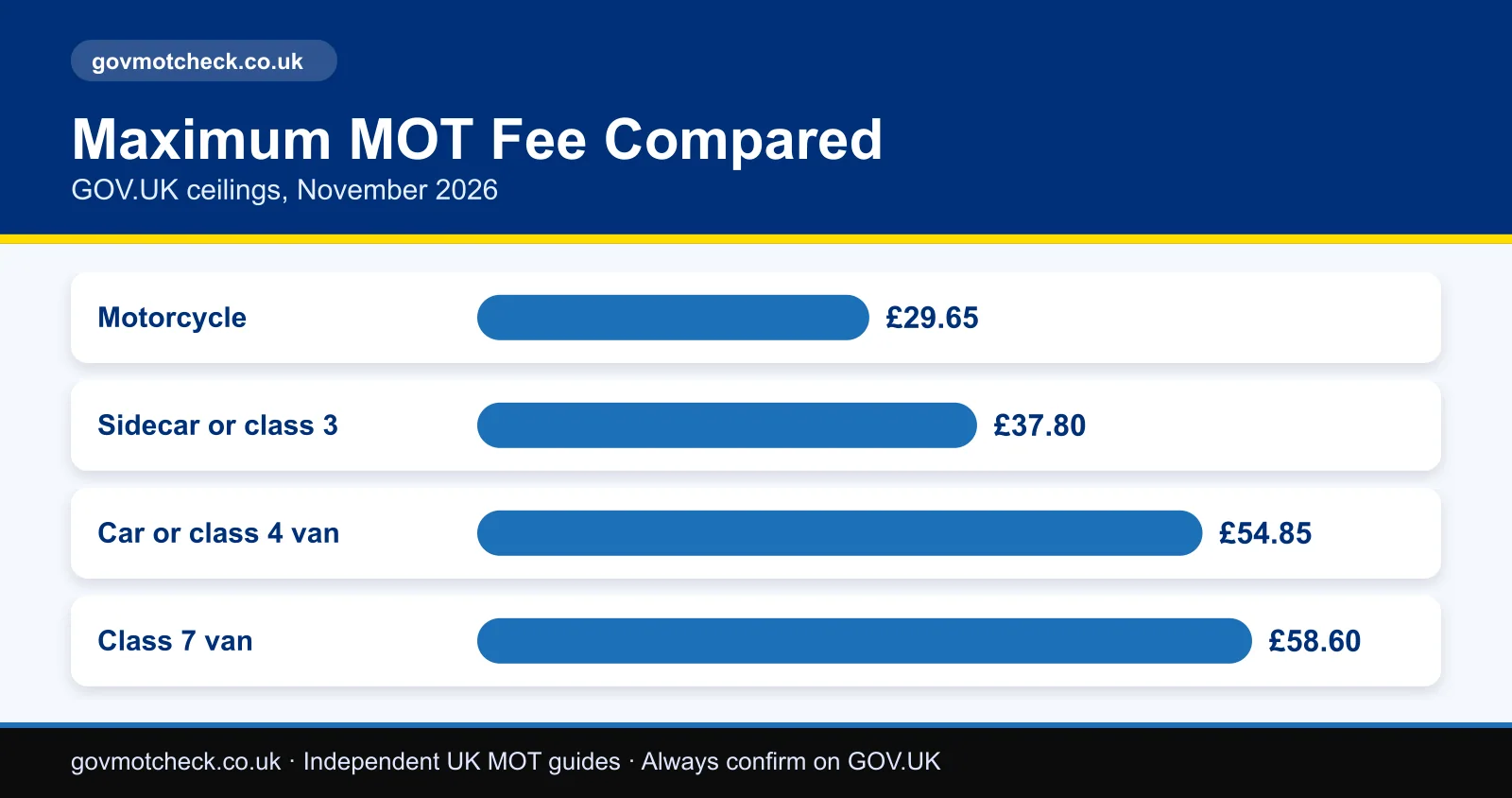
What Does A Motorcycle MOT Cost Compared With Other Vehicles?
A motorcycle MOT has the lowest fee ceiling of the main classes. At £29.65, it is roughly half the £54.85 ceiling for a car or light van, reflecting the shorter test on a smaller machine.
Motorcycle
Maximum fee £29.65 for class 1 or 2, a shorter test on a smaller machine.
Car or light van
Maximum fee £54.85 for class 4, roughly double the motorcycle ceiling.
Worked example
A class 2 bike tested at the ceiling costs £29.65, whereas a class 4 van tested at its ceiling costs £54.85, a difference of £25.20.
How Does The Sidecar Fee Work?
If your motorcycle has a sidecar attached, GOV.UK lists a higher maximum of £37.80, which applies whether the bike is up to or over 200cc. The extra charge reflects additional items to inspect, such as:
- The sidecar wheel
- The mounting
- The lighting
Take the outfit as it normally runs.
Is There A Fee For A Retest?
GOV.UK covers retests on its "retest after a repair" page, and the rules on free and partial retests depend on whether the vehicle stays at the station and how soon it returns. Check that page for the current conditions.
Our failures and advisories page explains the process in more depth.
Note
Whether a retest is free or partial depends on timing and where the repair is done, so ask the station before you take the bike away.
What Is Checked On A Motorcycle MOT?
A motorcycle MOT checks the safety-critical and environmental parts of the bike that can be examined without dismantling it. The DVSA publishes a motorcycle testing guide for classes 1 and 2 that every tester follows, so the checks are consistent from one station to the next.
The Main Areas Inspected
Testers work through the machine systematically. The headline areas are:
- Lighting and signalling
- Braking
- Tyres and wheels
- Steering and suspension
- The frame and fixed components
- The drive chain or belt
- The exhaust and noise
- Controls
- Identification, such as the registration plate and vehicle identification number (VIN)
Pro Tip
Use that list as your own pre-test walk-round. If you can see a problem in each area, the tester will too.
Why The Test Is Limited To What Can Be Seen And Measured
The MOT is a snapshot of roadworthiness on the day, not a mechanical health check. The tester does not strip the bike down, so internal wear, loose fixings hidden behind panels or a failing component that still works on the day may not be spotted.
Treat a pass as a minimum legal standard.
Important
A pass certificate does not mean the bike is mechanically sound. It means it met the minimum standard on that day.
Which Three Motorcycle Components Are Not Checked In An MOT Test?
The MOT does not test the condition of the engine, the clutch or the gearbox. These are the three motorcycle components that the DVSA guidance leaves outside the test, so a pass says nothing about their health.
Checked in the test
- Lighting and signalling
- Braking
- Tyres and wheels
- Steering and suspension
Not checked
- The engine
- The clutch
- The gearbox
Check the current DVSA guide for the exact wording.
Why Engine, Clutch And Gearbox Are Excluded
These parts cannot be judged reliably without running or dismantling the bike. The MOT focuses on whether the machine is safe to ride on the road and not excessively noisy or polluting.
A bike can pass with a slipping clutch or a worn gearbox and still need expensive repairs soon after.
Warning
Do not buy a used bike on the strength of a fresh MOT alone. The most expensive parts to repair are the ones the test ignores.
What To Do About Parts The MOT Ignores
Book a service or a pre-purchase inspection if you are worried about the drivetrain. When buying a used bike, an MOT history check shows previous advisories, but it will never mention clutch wear.
Our MOT history check explains what the online record includes and what it leaves out.
Lights, Indicators And Horn
Lighting is one of the most routine checks. The tester confirms that:
- The headlamp works on dip and main beam
- The beam is aimed correctly
- The stop lamp operates with both brake controls
- The horn works and is of a suitable type
Pro Tip
Press each brake lever and the foot pedal in turn while a friend watches the tail lamp. It takes a minute and catches a common fault.
Do You Need Indicators On A Motorcycle For MOT?
It depends on the bike's age. Direction indicators are required on motorcycles first used from a date set in the DVSA inspection manual, and older machines first used before that date may legally run without them.
Check the manual's lighting section for the date that applies to your bike.
Headlamp Aim And Bulb Faults
A headlamp that points too high dazzles other drivers and fails. Mis-aimed lights often come from a changed suspension setup or a heavy pillion load at the time of adjustment.
Bulbs that blow just before the test are a classic cause of failure. Carry a spare bulb for the headlamp and tail lamp.
Note
Check the aim with the bike carrying its normal load, because a heavy pillion or luggage changes where the beam points.
Motorcycle Brakes At MOT
The tester checks each brake control, the condition of linings or pads, discs and drums, hoses, and the effectiveness of both the front and rear brake on a roller brake tester where used. A bike must stop evenly without the brakes binding.
Common Brake Failure Points
Typical defects include:
- Contaminated or worn pads
- Warped or scored discs
- Seized calipers
- Leaking hydraulic hoses
- A weak or spongy lever
The tester also looks at brake fluid reservoirs and the condition of cables on non-hydraulic systems. Fix any pulsing or dragging before the test.
Warning
Brakes that drag or pulse are a safety risk as well as a likely failure. Do not ride to the test if you suspect a seized caliper.
Brake Efficiency And Balance
A brake efficiency reading compares the braking force to the weight of the bike and rider setup used on the test. Poor efficiency or a big imbalance between the wheels leads to a failure.
Replacing pads and bleeding the fluid before the test is cheap insurance.
Motorcycle Tyres And Wheels
Tyres must be the correct size and type, free of cuts and bulges, and have enough tread depth. The tester inspects tyre sidewalls, the valve condition and wheel rims for damage. Mixed tyre types or an incorrect rating can lead to failure.
What Is The Motorcycle Tyre Tread Limit?
The legal minimum tread depth for a motorcycle over 50cc is 1mm across the central three-quarters of the tread width, around the whole circumference. The MOT applies the legal limit.
For wet-weather grip, many riders replace tyres well before that point.
Pro Tip
Treat 1mm as the point of no return, not a target. Replacing a tyre early gives you better grip in the wet.
Motorcycle Tyre Requirements And Age
Tyres need to be:
- Seated correctly on the rim
- Inflated to the correct pressure
- Free from damage or deterioration, such as cracking
The tester looks for cuts, exposed cords and bulges. Old tyres can crack with age even if the tread looks fine, so inspect sidewalls every season.
Steering, Suspension And Frame
The tester checks that the steering moves freely without excessive play, the head bearings are secure, the forks do not leak, and the suspension components operate properly. The frame is inspected for cracks, bends or poor repairs.
Worked example
A rider lifts the front wheel on a paddock stand and turns the bars lock to lock. A notchy feel suggests worn head bearings, which is worth fixing before the test.
Fork Seals And Oil Leaks
Leaking fork seals are a typical advisory or failure. Oil on the stanchions can get onto brake components and become a safety problem.
Replacing seals is a modest job on many bikes, and doing it before the MOT avoids a failure.
Wheel Bearings And Swinging Arm
Play in the wheel bearings or the swinging arm bushes can cause a failure. The tester grips the wheel and checks for movement.
Worn bearings generate noise and an imprecise feel, so listen for rumbling or notice vague handling during your own pre-test ride.
Chain, Belt, Exhaust And Noise
Drive chains and belts are inspected for condition, tension and guards. The exhaust must be secure, free from leaks and not excessively noisy. The tester may also check that the silencer is not obviously modified in a way that raises noise.
Chain And Sprocket Wear
A chain that is too tight, too slack, kinked or rusted can fail. Hooked or shark-fin sprockets also lead to failure.
Lubricate and adjust the chain a few days before the test, and replace chain and sprockets as a set when worn.
Pro Tip
Adjust the chain a few days ahead, not on the morning of the test, so you have time to recheck it after a short ride.
Exhaust Condition And Aftermarket Silencers
Aftermarket exhausts must be properly fitted, securely mounted and not leak. A silencer that is obviously not fit for road use, or one with a missing baffle, can fail on noise or condition.
Keep the paperwork for any approved aftermarket system with the bike.
Stands, Controls And Other Fittings
The tester checks that:
- The side stand or centre stand returns to its position
- Control levers are secure, with protective ends where required
- The throttle snaps closed
- The seat is properly secured
Why The Throttle And Stand Matter
A throttle that sticks open or a side stand that drops down mid-corner are genuine hazards. Both are tested for that reason.
If your throttle feels sticky, clean and lubricate the cable. A weak stand spring is cheap to replace and prevents an easy failure.
Warning
A throttle that does not snap shut is dangerous on the road. Do not ride the bike until it is fixed.
Mirrors, Handlebars And Fairings
Mirrors where fitted must be secure, and handlebars must be free of cracks and bends. Fairings and body panels should not be loose or sharp enough to cause injury.
A cracked fairing held with tape can fail if it could fall off or snag.
Registration Plate, VIN And Identification
The registration plate must be the correct format, legible and securely attached. The tester also confirms the VIN matches the record where it can be found, because identification protects against stolen or cloned machines.
Number Plate Rules For Bikes
Plates must use the correct font, spacing and colours, and show the registration clearly. Faded, cracked or non-standard plates are a frequent cause of a minor or major defect.
Replace damaged plates from a registered supplier before the test.
What If The VIN Is Hard To Find?
If the VIN is hidden or damaged, the tester may record this as a defect or an advisory depending on the situation. Check where the VIN is stamped on your frame and keep it clean.
Your V5C logbook shows the number to compare.
Note
If you cannot find the VIN on the frame, look at the V5C first. It tells you the number to look for.
Common Motorcycle MOT Failures
The most common motorcycle MOT problems are routine items: lights, tyres, brakes, chains and plates. Most of them can be spotted in ten minutes with a torch. We do not quote failure percentages here because we cannot verify current DVSA figures for bikes.
Typical Failure Reasons
Riders commonly see failures for:
- Blown bulbs
- Worn or damaged tyres
- Binding or weak brakes
- Chain and sprocket wear
- Leaking forks
- Loose or cracked mountings
- An inoperative horn
- A damaged number plate
The pattern is clear: neglect of simple maintenance causes most fails.
How Defect Categories Work On A Bike
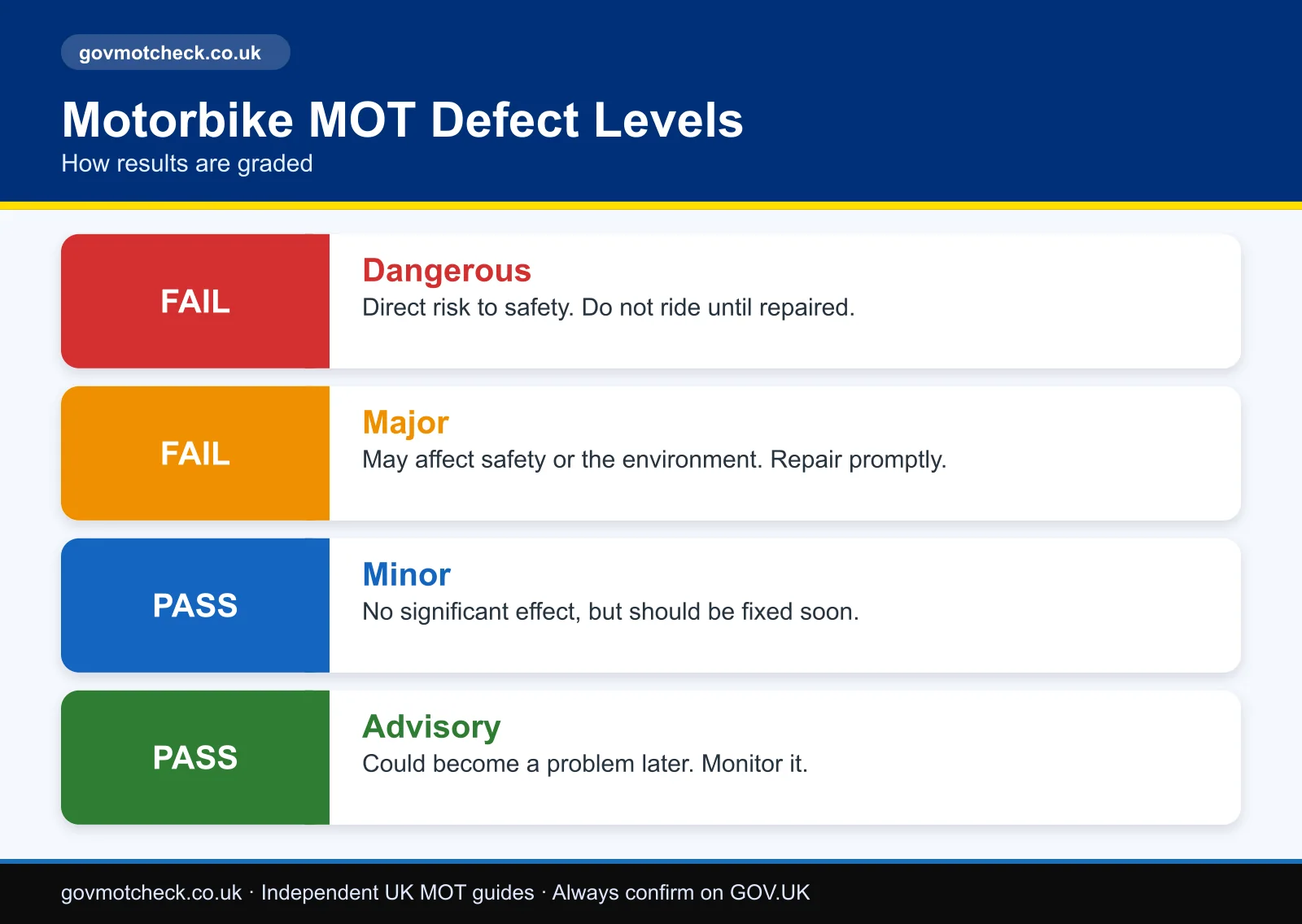
Since the 2018 changes, defects are graded as dangerous, major, minor or advisory. Dangerous and major defects fail the test, whereas minor and advisory items pass but are recorded.
The full explanation sits on our failures and advisories page.
Fails the test
Dangerous and major defects fail the test.
Passes but recorded
Minor and advisory items pass but are recorded, so deal with them before the next test.
Important
Only dangerous and major defects fail the test. Minor and advisory items still appear on the record, so deal with them before the next test.
Motorcycle MOT Checklist Before You Go
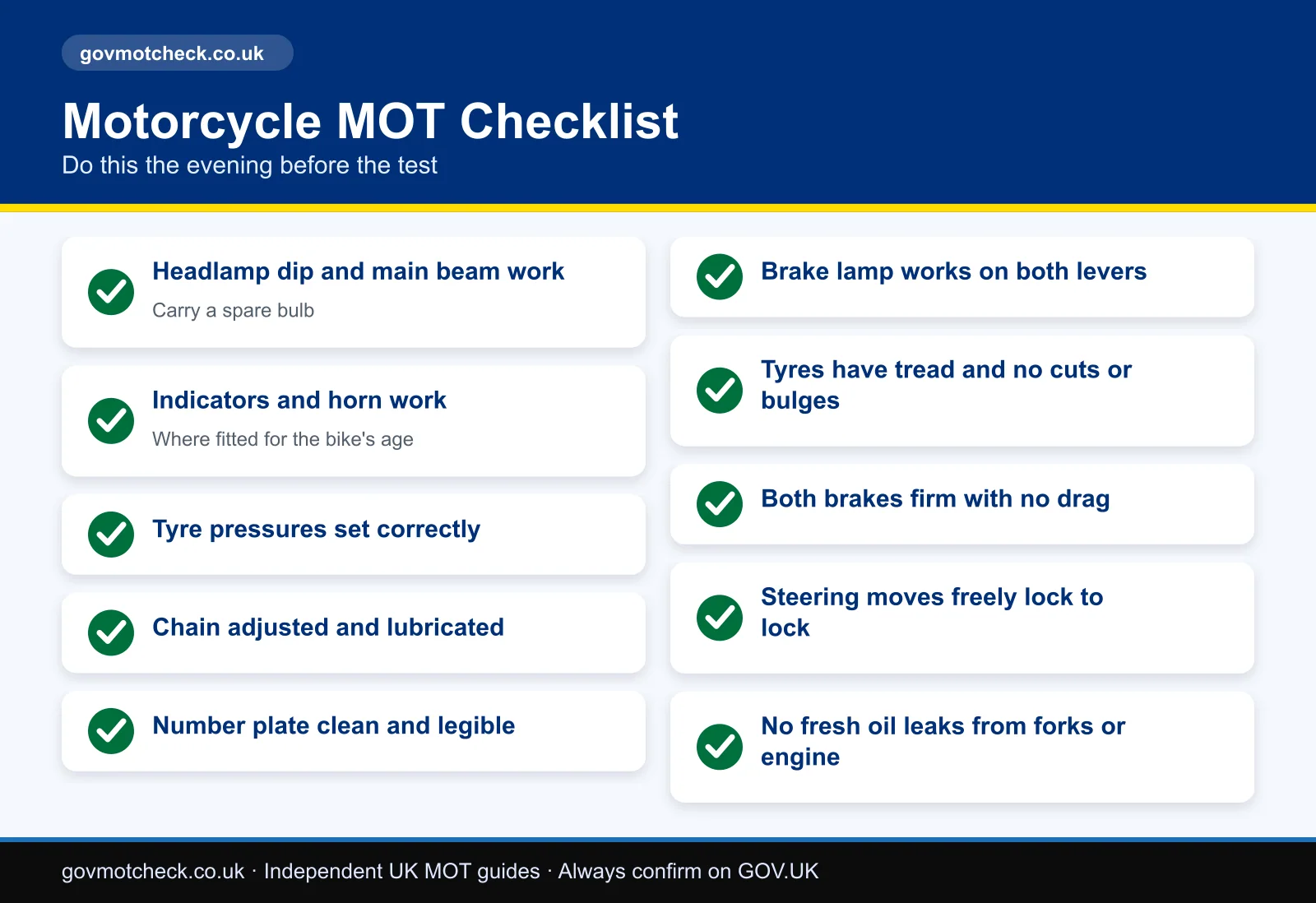
A short pre-MOT check by the rider fixes the majority of avoidable fails. Use this list the evening before the test, with the bike on its stand and the engine cold.
| Area | Quick check |
|---|---|
| Lights | Dip, main beam, brake lamp on both levers, tail lamp, indicators |
| Horn | Works with a clear, continuous note |
| Tyres | Visible tread, no cuts or bulges, correct pressure |
| Brakes | Firm levers, no drag, pads with material left |
| Chain | Correct slack, lubricated, no tight links |
| Steering | Moves lock to lock without notches or play |
| Plate | Clean, legible, securely mounted |
| Fluids | No fresh leaks from forks, engine or brake lines |
Pro Tip
Photograph the checklist on your phone and tick each line as you go. It keeps the evening check quick and consistent.
How To Prepare In 15 Minutes
A quick routine before you leave:
- Wash the bike so the tester can see the frame and welds.
- Charge the battery so the lights and horn work properly.
- Check the bulbs on the headlamp, tail lamp and indicators.
- Set the tyre pressures to the recommended figures.
- Lubricate the chain and check the slack.
Bring your keys, the fuel filler cap key if fitted, and any locking wheel nut key. A clean, working bike makes the tester's job quick.
Before you go
- Wash the bike
- Charge the battery
- Carry a spare bulb
- Set tyre pressures
Common mistakes
- Riding to the test with a seized caliper
- Adjusting the chain on the morning of the test
- Leaving a blown bulb until the day
Should I Service The Bike Before The MOT?
A service is not required, but it tends to catch the faults the test will find. If the bike is due a service anyway, do it a few days before the test.
Remember that an MOT is not a service, as our what is an MOT page explains.
Worked example
A rider books a service on Monday for a Friday test. The garage replaces worn pads and a blown tail bulb, and the bike passes first time.
How Long Does A Motorbike MOT Take?
A motorbike MOT usually takes less time than a car test because there is less to inspect, and many stations quote well under an hour. Ask the station for its own estimate, since it depends on workload and whether you are waiting.
Can I Wait While The Bike Is Tested?
Many stations let you wait or return later in the day, while some prefer drop-off. Ask when you book. Booking a first-thing slot often means you can leave and collect within the morning.
Our book an MOT page covers waiting, walk-ins and same-day options.
What If The Bike Fails?
You will receive a refusal of an MOT certificate listing the defects. You may then repair at the station or elsewhere. GOV.UK states you may drive a vehicle to or from a repair or to a pre-arranged MOT test, but only if it is safe to do so.
Warning
If the bike has a dangerous defect, do not ride it away. Arrange recovery or have it repaired at the station.
When Does A Motorcycle Become MOT Exempt?
A motorcycle becomes MOT exempt when it was built or first registered more than 40 years ago and has had no substantial changes. GOV.UK states this rule for historic vehicles, and the 40-year line moves forward each year.
Note
The rule is rolling. A bike that is not exempt this year may qualify in a later year as it passes the 40-year mark.
What Counts As A Substantial Change?
GOV.UK describes a substantial change as one that alters how the vehicle works, such as replacing the chassis, body, axles or engine. Fitting a modern frame, a different engine or a conversion that changes the character of the bike could remove the exemption.
If unsure, GOV.UK points to its exemption guidance and to historic vehicle experts.
Does An Exempt Bike Still Have To Be Roadworthy?
Yes. GOV.UK warns that even without an MOT you must keep the vehicle roadworthy, and that driving one in a dangerous condition can bring a fine of up to £2,500 and 3 penalty points. Many classic owners still book a voluntary MOT for peace of mind.
For the legal side, see MOT rules and exemptions.
Warning
Exempt does not mean unregulated. A dangerous exempt bike can still lead to a fine of up to £2,500 and 3 penalty points.
Tax And MOT Exempt Motorcycles
MOT exemption and tax exemption are separate things with different dates. The MOT exemption follows the rolling 40-year rule, while GOV.UK separately states that vehicles built before 1 January 1986 can stop paying vehicle tax from 1 April 2026.
MOT exemption
Follows the rolling 40-year rule, so the line moves forward each year.
Tax exemption
Vehicles built before 1 January 1986 can stop paying vehicle tax from 1 April 2026.
Important
Do not mix up the two dates. One is a rolling 40-year line for the MOT, the other is a fixed built-before date for tax.
Do I Have To Declare An MOT Exemption?
GOV.UK says applying is not required for MOT exemption in the way it is for the historic tax class. When you tax an exempt vehicle, you declare that it is exempt as part of the process.
The MOT exemption form V112 is used for listed exempt vehicle types.
Which Date Applies To My Bike?
Work from the build or first registration date. Check GOV.UK for how to apply. Tax detail sits on our MOT and tax check page.
Worked example
A bike first registered in 1984 is over 40 years old in November 2026, so it is MOT-exempt if unchanged. It was also built before 1 January 1986, so the historic tax rule applies.
Can You Tax A Motorbike Without An MOT?
No, not if the bike needs an MOT. A vehicle that requires an MOT must have a valid one on record before you can tax it, because the DVLA checks MOT status when you renew. An MOT-exempt bike is the exception.
Can I Tax My Bike If The MOT Has Just Expired?
If the MOT has expired and the bike is not exempt, you cannot renew the tax until you pass a new test. Plan ahead: test the bike before the tax expiry date.
GOV.UK states you can have an MOT up to a month (minus a day) before it runs out and keep the same renewal date.
Pro Tip
Book the test a few weeks before the tax runs out, so a fail and repair do not leave you with an expired MOT on the renewal day.
What About A Bike On SORN?
A Statutory Off Road Notification (SORN) tells the DVLA that a vehicle is not being used or kept on public roads. A SORN bike does not need tax, but if you want to ride it you need to tax it first, which needs a valid MOT.
Details are on the MOT and tax page.
Can I Ride My Motorbike To An MOT Without Tax?
GOV.UK allows you to drive a vehicle to or from a pre-arranged MOT test, or to or from a repair. You still need valid insurance and the vehicle should be roadworthy. Tax is a separate matter, and an untaxed bike should be on SORN, with the route kept strictly to the test.
Allowed
- Riding to or from a pre-arranged MOT test or a repair
- Keeping valid insurance
- Keeping the route strictly to the test
Not covered
Riding an untaxed or uninsured bike beyond the route to a pre-arranged test.
Warning
Riding an untaxed or uninsured bike beyond the route to a pre-arranged test is not covered by this allowance.
Can You MOT A Bike Without Insurance?
The test itself does not require you to show insurance, but riding on the road does. If the bike is uninsured, you have two main options:
- Trailer or wheel it to the station
- Arrange cover that includes travelling to a test
Check your policy wording before you ride.
Do I Need To Bring Documents?
For the test itself, you usually only need the bike and its registration number. The V5C helps if there is any query about the VIN or description.
The station records the result on the national database, and no paper is needed for the record to exist.
Pro Tip
Keep the booking confirmation on your phone in case you are stopped on the way to the test.
When Is The First MOT Due On A Motorbike?
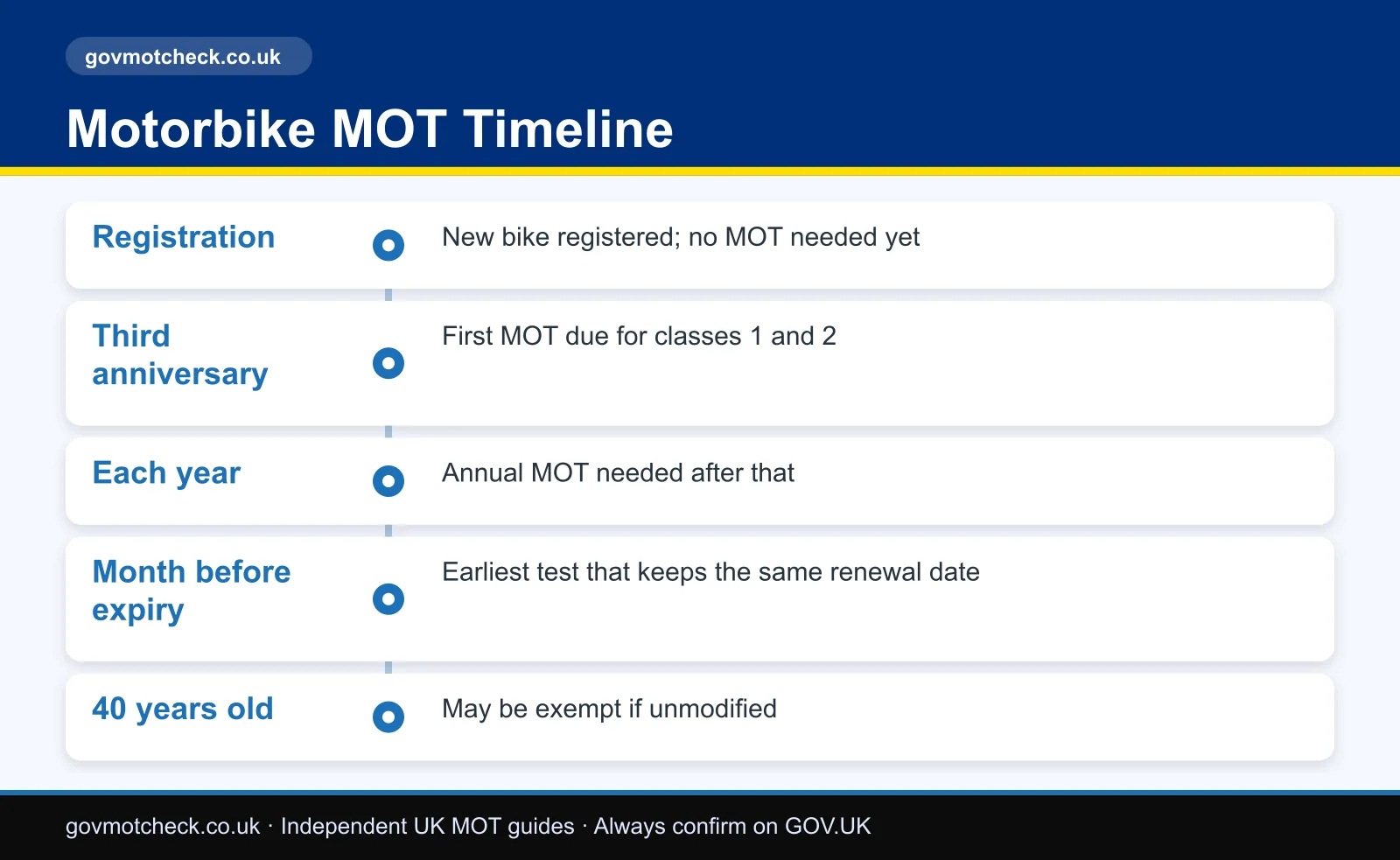
The first MOT is due by the third anniversary of registration for all motorcycle classes in the GOV.UK fees table. After that it should be renewed yearly.
Worked example
A moped registered on 5 June 2023 needs its first MOT by 5 June 2026.
How Early Can I Get A Bike MOT?
You can get an MOT up to a month (minus a day) before it runs out and keep the same renewal date, according to GOV.UK. Testing earlier moves the expiry date.
Full date rules are on the MOT due date page.
Worked example
If your MOT runs out on 15 May, the earliest date to keep the same renewal is 16 April.
How Do I Check When My Bike MOT Runs Out?
Enter the registration number on the free GOV.UK MOT history service, which shows the expiry date for the latest pass. Our MOT history checker walks through the lookup.
If no record appears, the bike may be under three years old or exempt.
How To Check A Motorcycle MOT Online
A motorcycle MOT can be checked online by entering the registration number on the official GOV.UK "check MOT history" service. It shows:
- Past test results
- Mileage readings
- The current expiry date
The lookup is free and needs no login.
What Does A Bike MOT History Show?
The record lists each test date, pass or fail, mileage, and any advisories or failure reasons. For a bike, this is valuable evidence of how it has been looked after.
Look for these warning signs:
- Repeated tyre or brake advisories
- Large mileage gaps
- Long periods without a test
Note
A gap in the record may have an innocent explanation, such as a period on SORN. Ask the seller.
Is The Bike MOT'd Right Now?
Look at the expiry date on the latest pass. If it is in the future, the bike has a current MOT. If you are checking a bike for sale, always compare the seller's paperwork with the online record.
Our certificate page explains the paper side.
Motorcycle MOT Near Me
To find a motorcycle MOT near you, look for a test station that is approved for class 1 and 2 testing, because not every garage tests bikes. GOV.UK lets you search for approved test stations by postcode, and many local garages advertise motorcycle bays.
How To Pick A Motorcycle MOT Centre
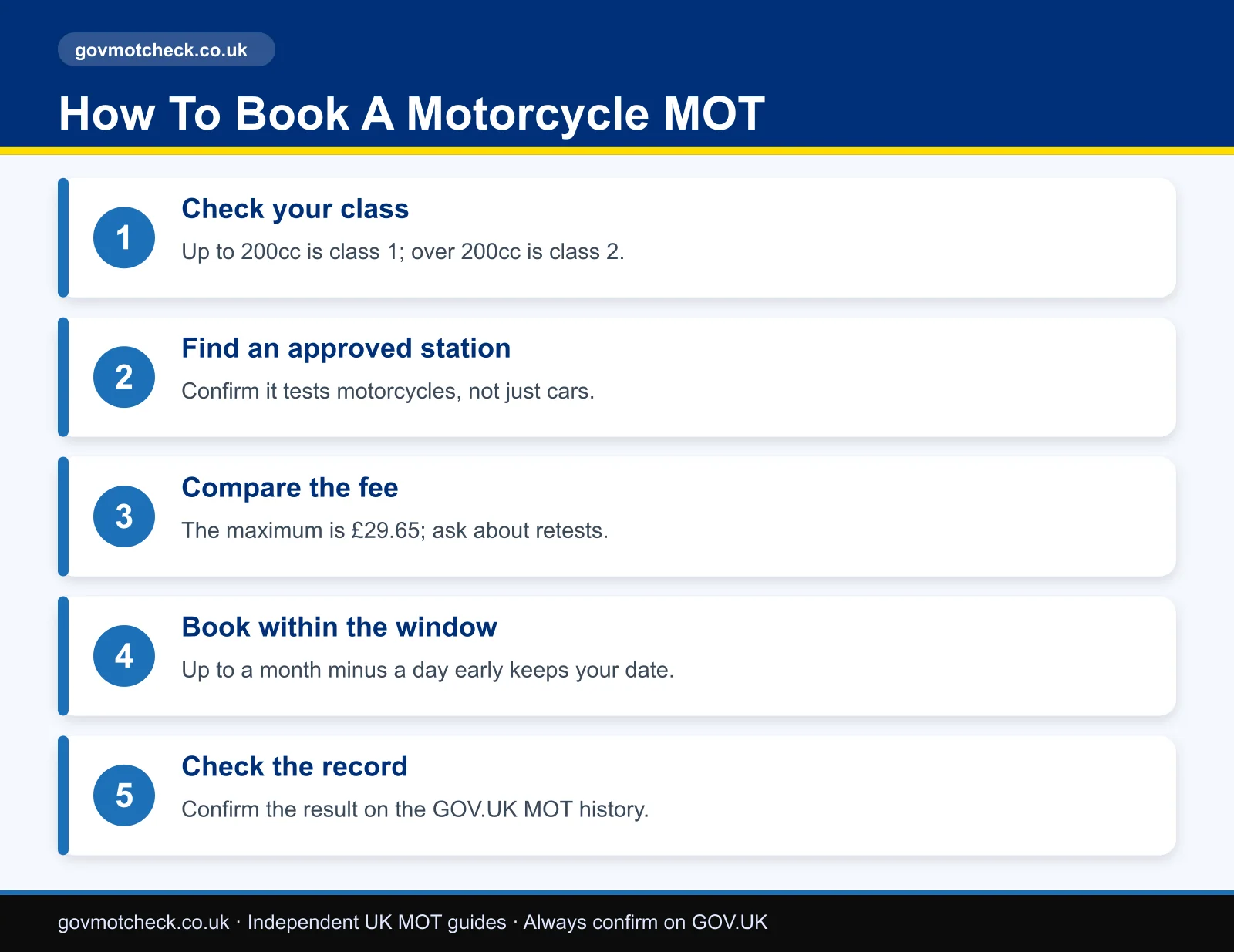
Work through this checklist:
- Check authorisation. Confirm the station is authorised for your class.
- Compare the fee. Measure the quote against the £29.65 ceiling.
- Read recent reviews. Look for comments from other riders.
- Ask about your machine. Check they handle your type, such as a scooter, big tourer or sidecar outfit.
- Ask about waiting. Find out whether they allow you to wait.
See booking an MOT for comparing quotes.
Pro Tip
Ring ahead rather than turning up. Bike bays are fewer than car bays, and a short call saves a wasted trip.
Do Cars And Bikes Use The Same Test Bay?
No. Bike tests use a motorcycle-approved set-up, and stations need to be authorised for the class they test. A garage that only holds a class 4 licence cannot test your bike.
That is why the number of bike stations is smaller than for cars.
Mobile Motorcycle MOT
A mobile motorcycle MOT service that tests at your home is not available, because the MOT must be carried out at an authorised test station. Be cautious of any firm that promises a roadside or home MOT certificate.
Legitimate
A garage collects the bike by van, takes it to the station and returns it. The test still happens at the station.
Red flags
- Very low prices
- Promises of a guaranteed pass
- Paying for a certificate without the bike present
Warning
A certificate issued without the bike being tested at an authorised station is not a genuine MOT.
Collection And Delivery Services
Some garages collect the bike by van, take it to the station, and return it. This is a legitimate convenience, and the test still happens at the station.
It can help if your bike is untaxed, uninsured or not roadworthy. Ask about the extra fee before agreeing.
How To Spot A Dodgy MOT Offer
Treat these as red flags:
- Very low prices
- Promises of a guaranteed pass
- Requests to pay for a certificate without the bike being present
A real MOT result appears on the national record immediately, so you can verify it with a free online check.
Trikes, Quads And Three-Wheelers
Three-wheeled vehicles are tested in class 3 or class 4 depending on their weight. GOV.UK lists:
Class 3
Up to 450kg unladen. Maximum fee £37.80.
Class 4
Over 450kg, the same class as a car. Maximum fee £54.85.
Are Trikes Treated As Motorcycles?
A trike under 450kg unladen weight is class 3, not class 1 or 2, so it has its own fee and test. Many large touring trikes exceed 450kg and fall into class 4, which is the same as a car.
The V5C and the plate show the weight.
Note
Check the unladen weight before you book, because it decides whether the trike is class 3 or class 4.
What About Quad Bikes?
GOV.UK lists quads under class 4 at £54.85, with limits of a maximum 400kg unladen weight (550kg for goods quads, 15kW). Quads used purely off-road may not need an MOT, since the requirement applies to vehicles used on public roads.
Check with the DVLA if your quad is road-registered.
MOT For A 125cc Bike Or Learner Machine
A 125cc motorcycle is class 1 and needs an MOT at three years old, with the same £29.65 maximum fee as other bikes up to 200cc. Learners often buy a 125cc, so the first test is a common surprise.
Important
A 125cc learner bike needs an MOT from its third anniversary of registration, just like a larger machine.
How Much Is An MOT For A 125cc Motorbike?
Up to £29.65. Because the class 1 ceiling is the same whether the bike is 50cc or 200cc, you do not pay more for a bigger learner bike. Compare quotes, as some stations offer lower rates.
Does The Learner Plate Matter At The Test?
L plates are not an MOT item. Tests concern the machine itself. However, the registration plate and lights are checked, so ensure any plate holder or accessories do not obscure them.
Pro Tip
If your L plate holder sits close to the number plate or tail lamp, check that it covers neither.
Buying A Used Motorcycle: MOT Checks
Before you buy a used bike, follow these steps:
- Check the MOT history online. Look at past results and advisories.
- Ask to see the current certificate, if any.
- Compare mileage readings across tests.
A long gap without a test or a mileage drop deserves questions.
What To Look For In The Bike's MOT History
Repeated advisories about the same part, such as tyres, brakes or corrosion, show a pattern of neglect. A recent failure followed by a pass is not necessarily bad. Check what was fixed.
A pass and the current expiry give you a baseline, nothing more.
Worked example
A bike shows brake pad advisories in three consecutive years. That suggests the owner put off the job, so inspect the brakes closely.
Should I Buy A Bike Without An MOT?
You can, but you need a valid MOT before riding it legally on the road in most cases, apart from travelling to a pre-arranged test. Factor in the cost of any repairs needed to pass.
Ask the seller for a recent test or negotiate the price down.
Selling A Motorcycle Without An MOT
You can sell a bike without a current MOT, but you should say so clearly and not describe it as "MOT'd" when it is not. Honest listings avoid disputes.
Selling "for spares or repair" is a recognised way to describe a bike that is not roadworthy.
Warning
Describing a bike as "MOT'd" when it is not can lead to a dispute with the buyer.
Do I Need To Give The Buyer The Certificate?
If the bike has a current MOT, passing on the certificate or telling the buyer it is on the online record is good practice. Legal duties differ depending on sale type, so see MOT rules.
What About The Tax When Selling?
When you sell a vehicle, vehicle tax is no longer transferred to the new owner. Tell the DVLA you have sold the bike, and the buyer taxes it in their own name.
This is covered on our MOT and tax page.
Note
The tax does not pass to the buyer, so remember to tell the DVLA you have sold the bike.
Modified And Custom Motorcycles
Modified bikes can be MOT tested as long as the changes are roadworthy and not extreme. Custom builds, café racers and bobbers often attract closer attention on frame integrity, lights, brakes and noise.
Which Modifications Commonly Cause Problems?
These commonly cause trouble:
- Lights in non-standard positions
- Loud exhausts
- Tiny or illegible plates
- Altered forks or handlebars
- Badly fitted aftermarket parts
Keep invoices and approval markings for components, and avoid removing indicators or mirrors where required.
Pro Tip
Keep a folder with receipts and approval markings for every aftermarket part. It helps if the tester queries a modification.
Do I Need To Tell The DVLA About Modifications?
Some changes need to be reported to the DVLA and may affect your insurance. Check the V5C notes and your insurer. A change that alters the vehicle's classification, such as converting a bike to a trike, needs particular care.
Van MOT: Which Class Applies?
A van MOT is a class 4 test if the van's design gross weight is up to 3,000kg, and a class 7 test if it is over 3,000kg and up to 3,500kg. Most small panel vans, such as car-derived vans, are class 4, while larger vans like many 3.5-tonne models are class 7.
Class 4 van
Design gross weight up to 3,000kg. Maximum fee £54.85.
Class 7 van
Over 3,000kg and up to 3,500kg. Maximum fee £58.60.
Is A Van MOT The Same As A Car MOT?
For class 4 vans the test is broadly the same as for a car, and the maximum fee is the same £54.85. Class 7 adds extra checks suited to heavier vehicles, such as larger brakes and load-bearing parts.
The class is set by weight, not by the van's appearance.
Where Do I Find A Van's Design Gross Weight?
Look for the manufacturer's plate, often in the door aperture or under the bonnet, which shows the gross vehicle weight. The V5C may also list it.
Worked example
A van with a plated weight of 3,500kg is class 7, while one at 2,800kg is class 4.
Van MOT Cost
A class 4 van MOT costs up to £54.85, and a class 7 van MOT costs up to £58.60, according to the GOV.UK fees table as of November 2026. These are ceilings, so many stations charge less, and there is no VAT on the test fee.
Pro Tip
Because class 7 approval is less common, ring around early. Availability can matter more than a few pounds of price.
How Much Is A Class 7 MOT?
Up to £58.60 for petrol, diesel and hybrid goods vehicles of 3,000kg to 3,500kg design gross weight. That is £3.75 more than the class 4 ceiling.
Because fewer stations hold class 7 approval, availability matters as much as price, so book early.
Do I Pay More For A Bigger Van?
Only if the van crosses into class 7. Within class 4, a long-wheelbase panel van pays the same ceiling as a small hatchback. Inside class 7, the ceiling is flat, whether the van is 3,200kg or 3,500kg.
When Does A Van Need Its First MOT?
A van needs its first MOT by the third anniversary of registration, according to the GOV.UK fees table for goods vehicles up to 3,500kg. After that it is tested every year.
What Does A New Van Need Until Then?
A new van needs tax and insurance but no MOT during its first three years. Many fleet managers still schedule safety inspections during that time, because MOT exemption is not the same as legal roadworthiness.
Our due date page has date examples.
Important
No MOT in the first three years does not remove your duty to keep the van roadworthy.
Can I Check A Van's MOT History?
Yes. Use the same GOV.UK lookup as for cars and bikes. Enter the registration, and you will see:
- Past tests
- Mileage
- Advisories
For fleet vans, comparing mileage across years can show how heavily the vehicle has been used. See the MOT history guide for step-by-step help.
Checks Specific To Vans
Vans carry loads, tow trailers and cover high mileage, so some checks matter more. The tester looks at:
- Load area security
- Tow bar fittings, where fitted
- Rear lights
- The condition of the underbody and axles
What A Van Owner Can Do Before The Test
A short checklist before the test:
- Empty the load area so the tester can see the floor and fixings.
- Check the tow bar electrics, if fitted.
- Check the number plate and tail lights.
- Test the wiper blades and washers.
Overloaded springs, worn bushes and brake imbalance appear often in work vans.
Pro Tip
Remove loose tools and cargo the night before. A clear load floor lets the tester see fixings and corrosion quickly.
Why Work Vans Fail More On Wear Items
Heavy loads wear tyres, brake components and suspension quickly. Rust around the sills and load floor is another concern.
Regular servicing and a quick inspection before the test avoid the cost of a retest. For defect types see failures and advisories.
Do Electric Cars Need An MOT?
Yes. Electric cars need an MOT once they are three years old, then every year, exactly like petrol and diesel cars. GOV.UK has no blanket exemption for electric cars, so a battery electric car is tested in class 4 with the same £54.85 maximum fee.
Myth
Electric cars are exempt from the MOT.
Fact
They need an MOT at three years old, then every year, as class 4 with a £54.85 maximum fee.
Important
An electric car is not exempt. It needs an MOT at three years old and then every year.
Why The Confusion About Electric Vehicles?
The confusion comes from an exemption that does exist, but only for a narrow group: GOV.UK states that electric goods vehicles registered before 1 March 2015 do not need an MOT. This does not apply to electric cars or newer electric vans.
How Often Do Electric Cars Need An MOT?
Annually after the first test at three years. The renewal date works the same way as for any car, including the early-test rule of up to a month (minus a day) before expiry.
EV owners should keep in mind that a low-maintenance powertrain does not remove brake, tyre or suspension wear.
What Is Tested On An Electric Car MOT?
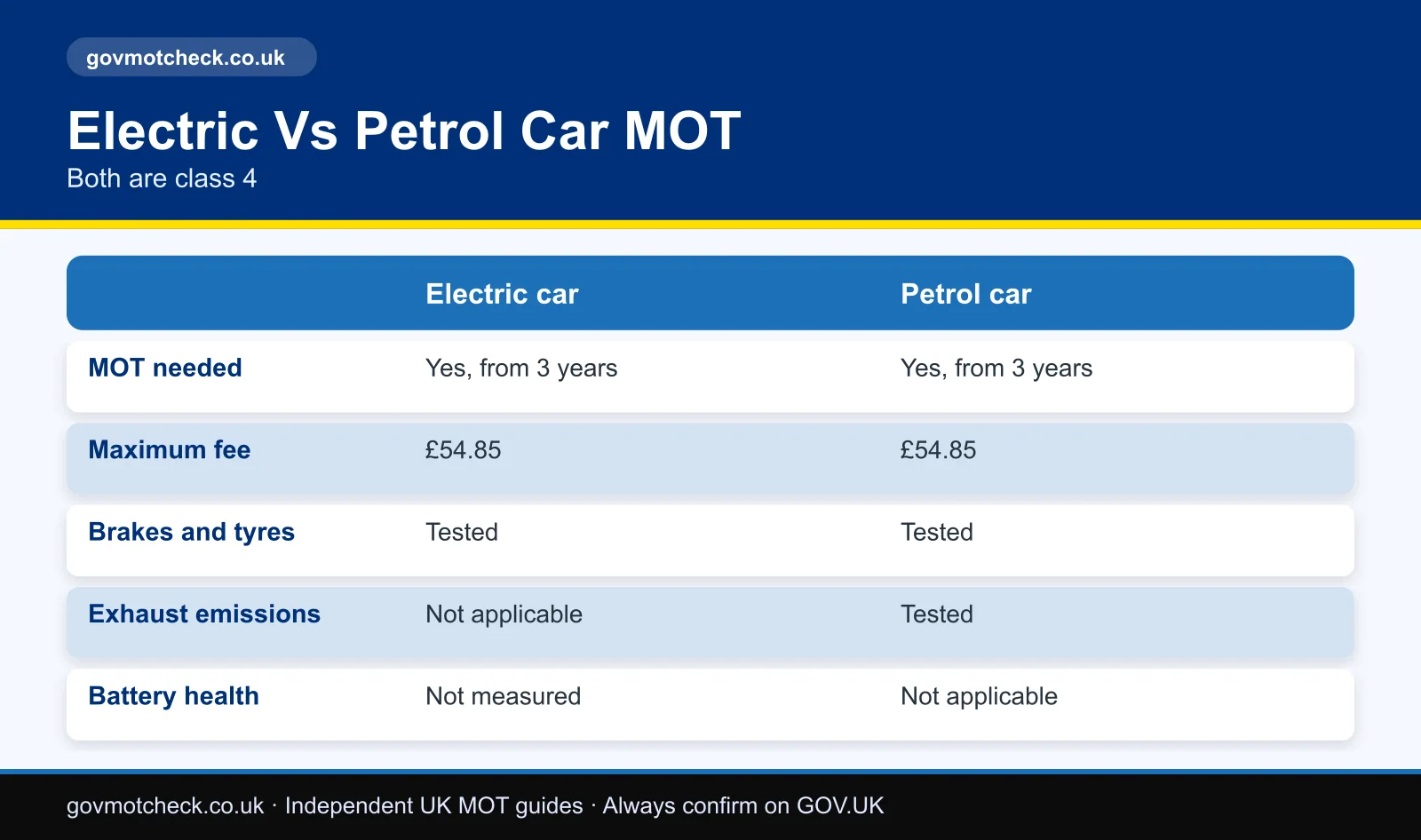
An electric car MOT checks the same safety items as a petrol car: brakes, tyres, steering, suspension, lights, seatbelts, body and visibility. The difference is what is absent, which is the exhaust and emissions test, because there is no combustion engine.
| Area | Electric car | Petrol or diesel car |
|---|---|---|
| Brakes, tyres, steering | Tested | Tested |
| Lights, seatbelts, body | Tested | Tested |
| Exhaust emissions | Not applicable | Tested |
| Exhaust system condition | Not applicable | Tested |
| Battery and wiring | Visible condition checked | Visible condition checked |
Note
No emissions test applies to a battery electric car, but every other safety check still does.
Is The High-Voltage Battery Tested?
The tester checks what is visible and accessible, such as secure mounting and evident damage to cables or the charging port. The test does not assess battery health or range.
Battery state of health is a separate matter worth checking when buying a used EV.
Does The Tester Need Special Training For EVs?
Testers follow the same DVSA manual, and electric vehicles are within the class 4 test. We cannot confirm any extra qualification requirement from GOV.UK, so ask your station whether it routinely tests EVs. Most stations can test them without issue.
Electric Car MOT Failures
Electric cars fail the MOT for the same reasons as other cars, with tyres, lights and suspension the usual suspects. Because EVs are heavier and quick off the line, tyres and brake discs can show wear or corrosion.
Pro Tip
Rotate and check tyres regularly. Heavier EVs can wear tyres faster, and tyres are a common reason for any car to fail.
Why Brakes Can Fail On EVs
Regenerative braking does most of the slowing, so the friction brakes are used less. Discs can corrode and calipers can seize from lack of use, which the tester may flag.
Using the friction brakes firmly now and then helps keep them clean.
Warning
Seized calipers and corroded discs are a failure risk on EVs, so do not ignore a brake that feels uneven or noisy.
What About The EV Initial MOT Pass Rate?
We do not quote an EV pass rate here, because we have not verified a current DVSA figure. Check the DVSA's published MOT statistics on GOV.UK if you need numbers.
Individual outcomes depend on the car's age, tyres and condition.
Electric Car MOT Cost
An electric car MOT is a class 4 test with a maximum fee of £54.85, the same as petrol and diesel cars, according to the GOV.UK fees table. There is no separate EV fee for cars, and the ceiling applies per test.
Do EVs Cost Less To MOT?
The ceiling is the same, though stations may price differently. EV owners often save on servicing, but the MOT fee is not discounted by law. Compare quotes on the booking page.
Can Any Garage MOT An Electric Car?
Any station approved for class 4 can test a car, including an electric car. In practice, you may prefer one familiar with EVs.
Ask when booking if the car has specific features such as a charging cable that must be stowed or an unusual layout.
Pro Tip
Mention that the car is electric when you book, so the station can plan for it.
Electric Vans And Electric Motorbikes
Electric vans are tested in class 4 or class 7 depending on weight, and electric motorbikes in class 1 or 2. GOV.UK states that zero emission goods vehicles between 3,501kg and 4,250kg design gross weight are also class 7, with a £58.60 maximum fee.
Electric vans
Tested in class 4 or class 7 depending on weight.
Electric motorbikes
Tested in class 1 or 2.
Heavy zero emission goods
3,501kg to 4,250kg design gross weight is class 7, at £58.60.
Which Electric Vans Are Exempt?
Only electric goods vehicles registered before 1 March 2015 are listed as exempt by GOV.UK. A newer electric van is tested like any other. Check your registration date on the V5C and the exemption page before assuming you are covered.
Warning
Do not assume an electric van is exempt. Only goods vehicles registered before 1 March 2015 are listed.
How Are Electric Motorcycles Classed?
The DVSA places certain electric solo motorcycles of up to 4kW and 45km/h design speed in class 1, and other electrically powered motorcycles in class 2.
The test is based on the bike's structure and equipment, so lights, brakes, tyres and steering are the core checks.
Hybrid MOT Tests
A hybrid car is tested as a class 4 vehicle at up to £54.85, and the emissions test applies to the combustion engine. GOV.UK also lists hybrid goods vehicles of 3,000kg to 3,500kg in class 7 at £58.60.
Is A Hybrid Test Different From A Petrol Car?
The safety checks are identical. The combustion engine is tested for emissions as normal, and the electric parts are inspected only as far as they are visible and relevant. Plug-in hybrids follow the same approach.
Does Regenerative Braking Affect A Hybrid's MOT?
It can. As with EVs, rarely used friction brakes can corrode. The usual hybrid-specific advisories are:
- Brake imbalance
- Sticking calipers
Servicing the brakes as recommended helps.
Note
The brake advice for hybrids mirrors the advice for EVs, because both rely on regenerative braking.
Campervan And Motorhome MOT
A campervan or motorhome generally needs an MOT at three years old, then annually, with a class 4 test and a £54.85 maximum fee when it is a motor caravan of the sizes listed by GOV.UK. Heavier motorhomes may fall under different classes.
How Does A Motorhome Pass The MOT?
The test checks the vehicle as a vehicle, so brakes, tyres, steering, lights and the cab. It is not an inspection of the living area, gas system or habitation fit. A separate habitation check is not part of the MOT.
Important
The MOT does not inspect the living area or gas system, so arrange a separate habitation check if you want one.
Which Class Is A Big Motorhome?
Motor caravans appear in class 4 in the GOV.UK table. For weights above the class 4 and class 7 limits, other rules for heavy vehicles may apply, and you should ask your station or the DVSA.
Do not assume a large coachbuilt is class 4.
Do Caravans Need An MOT?
A towed caravan does not have an MOT in the way a car does. The GOV.UK MOT fees table lists motor caravans, which are self-propelled, but not towed caravans. GOV.UK says lorries, buses and trailers need an annual test, which relates to heavy trailers.
Motor caravan
Self-propelled and listed in the GOV.UK table. Class 4 at £54.85.
Towed caravan
No MOT class in the GOV.UK table. The towing vehicle needs its own MOT.
Do Touring Caravans Need An MOT?
No MOT class exists for a standard touring caravan in the GOV.UK table. The towing vehicle needs its own MOT. Owners often have a voluntary caravan service for brakes, tyres, lights and the hitch, which is worthwhile for safety and insurance.
Pro Tip
Even without an MOT, have the caravan's brakes, tyres, lights and hitch checked before the touring season.
What About Other Trailers?
Lightweight trailers do not normally need an MOT, but heavy goods trailers need an annual test under a separate regime for lorries, buses and trailers. If you tow a heavy trailer for work, check the DVSA guidance and not the MOT pages.
Minibuses, Taxis And Ambulances
Passenger vehicles are tested by seat count:
- 9 to 12 seats: class 4 with a £57.30 ceiling, or £64.00 for class 4a with a seatbelt installation check
- 13 to 16 seats: class 5 at £59.55
- Over 16 seats: £80.65
Do Taxis And Ambulances Have Different Rules?
Yes. GOV.UK lists ambulances and taxis in class 4 with a first MOT at one year old instead of three, at £54.85. Private passenger vehicles and ambulances with 9 to 12 seats also start at one year.
Licensing authorities may add further tests.
Important
Taxis and ambulances need their first MOT at one year old, not three.
Why One Year For Some Vehicles?
Heavy daily use and passenger carrying raise safety stakes, so the first MOT arrives sooner. The rule is in the fees table.
If you operate such a vehicle, check the age column carefully and plan your first MOT for the first anniversary.
Common Myths About Bike, Van And EV MOTs
Several myths surround these MOTs, and some lead to real fines. The table below addresses the most frequent claims with what GOV.UK actually says.
| Myth | Reality |
|---|---|
| Electric cars do not need an MOT | They do, from three years old, as class 4 vehicles |
| Mopeds are exempt | They are tested as class 1 motorcycles from three years |
| A pass means the engine is healthy | Engine, clutch and gearbox condition are not tested on bikes |
| Vans are tested like lorries | Up to 3,500kg they are class 4 or 7, not heavy goods tests |
| Caravans need an MOT | Towed caravans have no MOT class; motor caravans do |
| A classic is automatically exempt | It must be over 40 years old and unmodified |
Is A Classic Bike Automatically Exempt?
No. The exemption requires the vehicle to be built or first registered over 40 years ago with no substantial changes. A heavily modified classic can lose it.
Does A Long MOT Mean The Bike Is Perfect?
No. The MOT is a minimum standard on one day. See the what is an MOT page for what the test does and does not do.
Fleet And Business Use Of Vans
Fleet operators must keep every van legally tested and roadworthy, and record dates reliably. A missed MOT leads to a fine of up to £1,000 per GOV.UK, plus potential insurance problems.
Warning
A missed MOT can mean a fine of up to £1,000 and could cause problems with your insurer.
How To Track MOT Dates For Many Vans
A simple routine:
- Keep a spreadsheet or fleet system listing every van and its expiry date.
- Diarise renewal dates at least a month ahead.
- Verify expiry dates with the free MOT history lookup.
Early testing within the month window keeps the renewal date unchanged. See due date rules.
What About Insurance For Work Vans?
Insurers may refuse claims on a vehicle without a valid MOT, depending on the policy. Confirm your policy wording. This page cannot give insurance advice, but keeping records of every certificate helps.
Worked Examples
These made-up examples show how the rules apply. Each is labelled "example" and uses invented vehicles.
Example: A 2023 125cc Scooter
A scooter first registered on 20 September 2023 is class 1, and its first MOT was due by 20 September 2026 at a ceiling of £29.65. Suppose it passes with an expiry of 19 September 2027.
Booking on 21 August 2027 or later is inside the one-month window, so the next certificate keeps the same renewal date. Booking in early August would move it earlier.
Worked example
Booking on 21 August 2027 keeps the 19 September renewal date, whereas booking on 5 August 2027 would move it earlier.
Example: A 2021 Electric Hatchback
An electric hatchback registered on 2 March 2021 needed its first MOT by 2 March 2024. As class 4, the ceiling is £54.85. No emissions test applies.
Example: A 3,500kg Panel Van
A van with a plated weight of 3,500kg is class 7, with a £58.60 ceiling. If it is diesel, the emissions test applies as normal.
Glossary Of Terms Used Here
Short definitions help when reading MOT paperwork.
| Term | Meaning |
|---|---|
| MOT | Ministry of Transport test, the annual vehicle safety and emissions check |
| DVSA | Driver and Vehicle Standards Agency, which runs the MOT in Great Britain |
| DVLA | Driver and Vehicle Licensing Agency, which holds vehicle registration and tax records |
| DGW | Design gross weight, the maximum designed weight on the road |
| V5C | The vehicle registration certificate, or logbook |
| VIN | Vehicle identification number, stamped on the frame or chassis |
| SORN | Statutory Off Road Notification |
Why Precise Terms Matter
Using the wrong term can lead you to the wrong fee or class. Quote the design gross weight and not the kerb weight, and the engine size and not the power.
Where To Go Next
If you are ready to test your vehicle, find a suitable station and compare fees on booking an MOT. For date questions see MOT due date, and for the legal side see MOT rules and exemptions.
Pro Tip
Start with the page that matches your next step: booking, dates or the legal rules.
Official Sources To Check
Always confirm figures against GOV.UK, as fees and rules can change. The GOV.UK pages on MOT fees, vehicle exemptions and historic vehicles are the starting points.
This site is independent and not affiliated with the DVSA, DVLA or GOV.UK.
Find A Van, Moped Or Class 7 MOT Centre Near Me
To find a van MOT near me, moped MOT near me or class 7 MOT centre near me, search for test stations by postcode, then phone to confirm the station is approved for your vehicle's class. A station can only test the classes it is approved for, so a garage that tests cars may not test bikes or heavier vans.
This site does not list or recommend garages. The steps below show how to find an approved one yourself.
How Do I Find A Van MOT Centre Near Me?
Most vans are class 4 (up to 3,000kg design gross weight), which most car test stations can test. Use the station search on GOV.UK or a local search, then ask two questions: "Do you test vans of my size?" and "Is the ramp or lift suitable for a long wheelbase or high-roof van?"
- Quote the registration and the design gross weight from the plate
- Mention a high roof, long wheelbase or tail lift, which some bays cannot take
- Compare the quote with the £54.85 ceiling for class 4
Pro Tip
Panel vans and Luton-style vans vary a lot in size. A station that happily tests a small van may turn away a long-wheelbase one, so ask before you drive over.
Where Can I Get A Class 7 MOT Near Me?
A class 7 MOT is for goods vehicles from 3,000kg to 3,500kg design gross weight, and fewer stations are approved for it. Search by postcode, then ring each station and ask whether it is approved for class 7 specifically, because class 4 approval does not cover it.
If nothing is close, widen the search radius rather than guessing. The maximum fee is £58.60, wherever you go. See how to book an MOT for comparing quotes.
Where Can I Get A Moped MOT Near Me?
A moped is tested as a class 1 motorcycle, so you need a station approved for motorcycles (classes 1 and 2), not just cars. Ask: "Are you approved for class 1 and 2, and do you test scooters?" The maximum fee is £29.65.
Note
Do not rely on a garage's website alone. Phone and confirm the class, because listings can be out of date.
Van (class 4 or 7)
Confirm the class and the bay size. Maximum fee £54.85 for class 4, £58.60 for class 7.
Moped or motorcycle
Confirm class 1 and 2 approval. Maximum fee £29.65, or £37.80 with a sidecar.
Motorcycle MOT Charges
Motorcycle MOT charges are capped by class: a station can charge up to £29.65 for a class 1 or 2 bike and up to £37.80 with a sidecar, according to the GOV.UK fees table as of November 2026. There is no VAT on the fee, and stations may charge less.
What Can A Station Charge On Top Of The Test Fee?
The test fee itself cannot exceed the ceiling. A station may legitimately charge separately for repairs, parts or a service that you agreed to. Ask for the test price and any extra work itemised, so you can see what the ceiling applies to.
Are Motorcycle MOT Charges Different For Scooters And Electric Bikes?
Scooters are tested by engine size in class 1 or 2, so the ceiling is the same £29.65. GOV.UK shows no separate fee for electric motorcycles, which also fall into class 1 or 2 by their specification. See the fee table earlier in this guide for every class.
Motorcycle MOT Requirements, Regulations And Criteria
The motorcycle MOT requirements are simple: a bike registered in Great Britain needs a valid MOT from its third anniversary of registration, then every 12 months, unless it is exempt. The criteria the tester applies are set by the DVSA in its testing guide for motorcycles.
What Are The Motorcycle MOT Regulations In Plain English?
The rules come from MOT testing regulations and DVSA guidance, and they set out:
- Who must test: most motorcycles, mopeds and sidecar outfits from three years old
- What is assessed: lights, brakes, tyres and wheels, steering and suspension, frame, controls, exhaust and noise, and identification
- What is not assessed: engine, clutch and gearbox condition
- Outcome: pass, or fail with defects graded as dangerous, major or minor, plus advisories
Important
Read the DVSA motorcycle testing guide on GOV.UK for the exact criteria. This page summarises them and does not replace them.
What Are The Motorcycle MOT Criteria For A Pass?
A bike passes when the tester finds no dangerous or major defects against the DVSA standards on the day. Minor defects and advisories are recorded but do not fail the bike. Our failures and advisories page explains each category.
What Is Checked On A Moped MOT?
A moped MOT follows the same class 1 test as a larger motorcycle: lights, horn, brakes, tyres and wheels, steering, suspension, frame, controls, exhaust and plates. As with any bike, the engine, clutch and gearbox (or variator on a scooter) condition is not tested.
What Does A Motorbike MOT Consist Of?
A motorbike MOT is a visual and operational inspection on the day, including a brake test and a check of noise and emissions where they apply. It usually takes well under an hour at a station used to bikes.
Is My Van Or Bike MOT'd?
To find out whether your van, bike or motorcycle is MOT'd, enter the registration number on the free GOV.UK MOT history service, or use the checker on our home page. The latest test shows a pass or fail and the expiry date.
How Do I Check If My Bike Is MOT'd And Insured?
The MOT history service shows MOT status only. Insurance is a separate check, usually through your insurer or the Motor Insurers' Bureau, so check both before you ride. Our MOT and tax page covers the tax side.
What If No MOT Record Shows For My Van Or Bike?
There are three common reasons: the vehicle is under three years old, it is exempt under the 40-year rule, or it was never tested. Check the registration for typos first. Our MOT rules and exemptions page explains exemptions.
Warning
Driving without a valid MOT can mean a fine of up to £1,000 and affect your insurance. Check the expiry date, and see MOT due date if it is close.
Which MOT Applies To My Vehicle Type?
If you are unsure which test or class applies, use this guide to match your vehicle:
| Vehicle | Class | Max fee |
|---|---|---|
| Scooter, moped or bike up to 200cc | 1 | £29.65 |
| Bike over 200cc | 2 | £29.65 |
| Bike with sidecar | 1 or 2 | £37.80 |
| Trike up to 450kg unladen | 3 | £37.80 |
| Car, camper or motorhome, van up to 3,000kg | 4 | £54.85 |
| Van 3,000kg to 3,500kg | 7 | £58.60 |
| Minibus, 9 to 12 seats | 4 | £57.30 |
Does A Minibus, Camper Or Motorhome Use A Different Test?
A minibus with 9 to 12 seats is class 4 at a higher ceiling, and larger ones are class 5. A camper or motorhome is normally class 4. Details are earlier in this guide under minibuses, taxis and ambulances.
Frequently Asked Questions
How much is a motorcycle MOT?
The maximum fee GOV.UK lists for a standard motorcycle MOT is £29.65 as of November 2026. A motorcycle with a sidecar has a higher maximum of £37.80. Test stations can charge less than these ceilings, and GOV.UK states you do not pay VAT on the fee, so compare local quotes before booking.
How much is a moped MOT?
A moped MOT costs up to £29.65, because mopeds are tested as class 1 motorcycles. Individual test stations may charge less than that ceiling. If a quote looks higher, ask whether it includes extras such as a service or repair work, because the test fee itself cannot exceed the class maximum.
How much is an MOT for a 125cc motorbike?
An MOT for a 125cc motorbike costs up to £29.65, because it is a class 1 machine, which covers motorcycles up to 200cc. The ceiling is the same for a 50cc or a 200cc bike. Some stations offer lower prices, so it is worth comparing a few before you book.
How much is a class 7 MOT?
A class 7 MOT costs up to £58.60, according to GOV.UK. Class 7 covers goods vehicles over 3,000kg and up to 3,500kg design gross weight, plus zero emission goods vehicles between 3,501kg and 4,250kg. Fewer stations are approved for class 7, so check availability when you book.
How much is a van MOT?
A van up to 3,000kg design gross weight is tested in class 4, with a maximum fee of £54.85. A heavier van from 3,000kg to 3,500kg is class 7, with a maximum of £58.60. The fee is a ceiling, so stations can charge less, and there is no VAT.
How much is an MOT on an electric car?
An electric car MOT costs up to £54.85, the same maximum as a petrol or diesel car, because electric cars are tested in class 4. GOV.UK shows no separate fee for electric cars. Test stations may charge less than the ceiling, so compare local prices.
Do electric cars need an MOT?
Yes, electric cars need an MOT from their third anniversary of registration and then every year. GOV.UK has no general exemption for electric cars. The only electric exemption it lists is for electric goods vehicles registered before 1 March 2015, which does not cover passenger cars.
Do electric cars need an MOT every year?
Yes, after the first test an electric car needs an MOT every 12 months, like any other car. The renewal date can be kept by testing up to a month (minus a day) before expiry. Electric cars still have brakes, tyres and suspension that wear, which is why the test applies.
Is there an emissions test on an electric car MOT?
No, an electric car has no exhaust, so there is no exhaust emissions test. The rest of the safety checks apply, including brakes, tyres, steering, suspension, lights, seatbelts and bodywork. The tester also looks at the visible condition of items such as cables and the charging port.
Do motorbikes need an MOT?
Yes, motorbikes need an MOT from their third anniversary of registration, then every year, unless they are exempt under the 40-year rule. This applies to motorcycles in both class 1 and class 2, as well as to mopeds and motorcycles with sidecars registered in Great Britain.
Do mopeds need an MOT?
Yes, mopeds need an MOT once they are three years old, and then annually. They are tested as class 1 motorcycles, with a maximum fee of £29.65. A small engine does not exempt a moped, although a vehicle over 40 years old and unmodified may qualify for exemption.
When does a new motorbike need its first MOT?
A new motorbike needs its first MOT by the third anniversary of its registration, according to GOV.UK. Example: a bike registered on 1 April 2024 needs an MOT by 1 April 2027. Until then it needs tax and insurance but no MOT, though regular servicing is still sensible.
Which three motorcycle components are not checked in an MOT test?
The engine, clutch and gearbox condition are not tested in a motorcycle MOT. The test covers items such as lights, brakes, tyres, steering, suspension and the frame. A pass therefore does not guarantee the bike's drivetrain is healthy, so consider a service or inspection if you are buying used.
What is checked on a motorcycle MOT?
A motorcycle MOT checks lights and indicators, horn, brakes, tyres and wheels, steering and suspension, the frame, the chain or belt, the exhaust and noise, controls, stands and the registration plate and VIN. The DVSA publishes a testing guide for classes 1 and 2 that testers follow.
How long does a motorbike MOT take?
A motorbike MOT usually takes less time than a car MOT, and many stations quote well under an hour. The exact time depends on the station's workload and the bike. Ask when you book whether you can wait or should drop the bike off and collect it later.
Can I get a mobile motorcycle MOT?
No, a motorcycle MOT must be carried out at an authorised test station, so a genuine mobile MOT at your home is not available. Some garages offer collection and delivery, where the bike is taken to the station and returned. Be wary of anyone offering a certificate without testing the bike.
Do I need indicators on a motorcycle for MOT?
It depends on the bike's age. Indicators are required on motorcycles first used after a date set out in the DVSA inspection manual, while older machines may legally run without them. Check the lighting section of the manual or ask your test station about your specific bike.
What is the legal tread depth for motorcycle tyres?
The legal minimum tread depth for a motorcycle over 50cc is 1mm across the central three-quarters of the tread, around the whole circumference. The MOT applies this standard along with checks for cuts, bulges and damage. Many riders replace tyres sooner for better wet-weather grip.
When does a motorcycle become MOT exempt?
A motorcycle becomes MOT exempt when it was built or first registered more than 40 years ago and has had no substantial changes. GOV.UK describes a substantial change as altering how the vehicle works, such as replacing the chassis, body, axles or engine. The exempt age rolls forward each year.
Are motorcycles over 40 years old tax exempt too?
Not automatically on the same basis. GOV.UK states that vehicles built before 1 January 1986 can stop paying vehicle tax from 1 April 2026, and you must apply for the exemption. MOT exemption follows the separate 40-year rule. Check GOV.UK for the current application process.
Do I have to declare that my classic bike is MOT exempt?
Applying is not required for MOT exemption in the way it is for the historic tax class, according to GOV.UK. However, when taxing an exempt vehicle you will usually declare the exemption. The MOT exemption form V112 is used for listed exempt vehicle types, so check the current guidance.
Can you tax a motorbike without an MOT?
No, if the bike needs an MOT you cannot tax it without a valid one, because the DVLA checks MOT status when you tax. An MOT-exempt bike is the exception. Plan ahead and test the bike before the tax expires. See our MOT and tax page for details.
Can I ride my motorbike to the MOT without tax?
GOV.UK allows you to drive a vehicle to or from a pre-arranged MOT test, or to or from a repair. You still need valid insurance, and the bike should be roadworthy. An untaxed bike is normally on SORN, so keep the journey strictly to the test and nothing else.
Can you MOT a bike without insurance?
The MOT test itself does not require proof of insurance, but riding on the road does. If the bike is uninsured, arrange transport by van or trailer, or take out cover that includes travelling to a test. Check your policy wording before you ride anywhere.
Is there an MOT for caravans?
A towed caravan does not have an MOT in the GOV.UK fees table, which lists only motor caravans, meaning self-propelled ones. GOV.UK says lorries, buses and trailers need an annual test, which relates to heavy trailers. A voluntary caravan service is still sensible for brakes and tyres.
Do touring caravans need an MOT?
No, a standard touring caravan has no MOT class in the GOV.UK table. The car that tows it needs its own MOT. Many owners book a voluntary caravan inspection covering brakes, tyres, lights and the hitch, which supports safe towing even though it is not a legal requirement.
Does a campervan need an MOT?
Yes, a campervan or motorhome that counts as a motor caravan needs an MOT at three years old and then annually. GOV.UK lists motor caravans in class 4 with a maximum fee of £54.85. The test covers the vehicle, not the living area or gas system.
Does a motorhome need an MOT?
Yes, a motorhome normally needs an MOT after three years and then every year. Most are tested in class 4 at up to £54.85. Very heavy motorhomes may fall outside class 4, so ask your test station or the DVSA about the class if yours is large.
What class is a van MOT?
A van MOT is class 4 if the design gross weight is up to 3,000kg, and class 7 if it is over 3,000kg and up to 3,500kg. The weight is on the manufacturer's plate. Zero emission goods vehicles between 3,501kg and 4,250kg are also class 7 according to GOV.UK.
When does a new van need its first MOT?
A new van needs its first MOT by the third anniversary of registration, according to the GOV.UK fees table for goods vehicles up to 3,500kg. After that it is tested every year. Keep servicing the van during its first three years, because wear and safety still matter.
How do I check if a van has an MOT?
Enter the van's registration on the free GOV.UK MOT history service, which shows the latest test result and expiry date. If no record appears, the van may be under three years old or exempt. For a van you are buying, compare the record with the seller's paperwork.
Are electric vans exempt from the MOT?
Only electric goods vehicles registered before 1 March 2015 are listed as exempt by GOV.UK. A newer electric van needs an MOT in the normal class for its weight. Check the registration date on the V5C, and use the GOV.UK exemption page before assuming you are covered.
Do hybrid cars need an MOT?
Yes, hybrid cars need an MOT from three years old, then annually. They are tested in class 4 with a maximum fee of £54.85. The combustion engine is tested for emissions as normal, and the same safety checks apply as for other cars.
Can any garage MOT an electric car?
Any test station approved for class 4 can MOT an electric car. In practice you may prefer one used to EVs, so ask when booking. The test follows the same DVSA manual as for other cars, minus the exhaust emissions checks.
Why do electric cars fail the MOT?
Electric cars fail for the same reasons as other cars, mainly tyres, lights, brakes and suspension. Heavy battery weight can wear tyres faster. Rarely used friction brakes can corrode because regenerative braking does most of the slowing, so discs and calipers sometimes need attention.
Does an electric vehicle MOT test the battery?
The tester checks what is visible, such as secure mounting and obvious damage, but the MOT does not measure battery health or range. If you are buying a used electric car, consider a separate battery health check, because a pass says nothing about remaining capacity.
What is a class 1 motorcycle MOT?
A class 1 MOT covers motorcycles and combinations up to 200cc, along with certain electric solo motorcycles of up to 4kW and a design speed up to 45km/h. The maximum fee is £29.65, or £37.80 with a sidecar. Mopeds and 125cc bikes are typical class 1 vehicles.
What is a class 2 motorcycle MOT?
A class 2 MOT covers motorcycles and combinations over 200cc, including electrically powered variants. The test is similar in structure to class 1, and the maximum fee is also £29.65, or £37.80 with a sidecar. Larger roadsters, tourers and sports bikes are class 2.
How much is a motorcycle MOT with a sidecar?
A motorcycle MOT with a sidecar costs up to £37.80, whether the bike is up to or over 200cc, according to GOV.UK. The higher ceiling reflects the extra items to inspect, such as the sidecar wheel, mounting and lighting. Stations may charge less than the maximum.
How much is a trike MOT?
A three-wheeled vehicle up to 450kg unladen weight is class 3 with a maximum fee of £37.80. Three-wheelers over 450kg unladen are class 4 with a maximum fee of £54.85. Check the weight on your V5C or plate to see which applies.
Do quad bikes need an MOT?
Quads that are road-registered fall under class 4 in the GOV.UK table, with a maximum fee of £54.85 and limits of 400kg unladen weight, or 550kg and 15kW for goods quads. Quads used only off-road may not need one. Check with the DVLA if unsure.
Can I find a motorcycle MOT near me?
Yes, search for test stations approved for class 1 and 2 using the GOV.UK station finder or a local search. Not every garage tests bikes, so confirm the station is approved for motorcycles before booking. Check the fee against the £29.65 ceiling and whether you can wait.
How do I book a motorcycle MOT?
Contact a motorcycle-approved test station by phone, website or in person, give your registration, and choose a date. You can book up to a month (minus a day) before the current MOT expires and keep the same renewal date. See our booking page for comparing offers.
What documents do I need for a motorcycle MOT?
Usually just the bike and its registration number, as the station records results on the national database. Bringing the V5C is useful if there is a query about the VIN or description. Also bring keys for locks, such as a fuel cap or wheel lock.
How early can I get a motorbike MOT?
You can get an MOT up to a month (minus a day) before it runs out and keep the same renewal date, according to GOV.UK. Example: if the MOT runs out on 15 May, the earliest date to keep the renewal date is 16 April. Earlier tests shift the expiry.
What is the fine for riding without an MOT?
GOV.UK states you can be fined up to £1,000 for driving a vehicle without a valid MOT. Dangerous vehicles can lead to higher penalties, with GOV.UK noting a fine of up to £2,500 and 3 penalty points for driving one in a dangerous condition. Insurance can also be affected.
Can I sell a motorbike without an MOT?
Yes, you can sell a bike without a current MOT, but you should say so clearly and not describe it as MOT'd. Describing it as spares or repair is common if it is not roadworthy. The buyer will need a valid MOT before taxing and riding it.
Do I need to tell the DVLA about bike modifications?
Some modifications must be reported to the DVLA, particularly those that change the vehicle's type or classification. Others may need to be declared to your insurer. Check the V5C notes and your policy, because unreported changes can cause problems with insurance and the MOT.
Are custom motorcycles MOT tested?
Yes, custom bikes are tested if they are over three years old and not exempt. Testers check frame integrity, lights, brakes, tyres, plates and noise. Non-standard lights, loud exhausts and unreadable plates are common problems on custom builds, so keep approval markings and receipts.
Is an MOT a guarantee that the bike is safe?
No, an MOT is a snapshot of the bike's condition on the day against a minimum standard. It does not test the engine, clutch or gearbox, and it cannot see inside components. Regular servicing and your own checks remain essential even with a fresh certificate.
Can I do a bike MOT check online?
Yes, you can check a motorcycle's MOT status for free on the GOV.UK MOT history service by entering its registration number. It shows past tests, mileage readings, advisories and the expiry date. Our home page explains how to read the record and what it does not show.
What happens if my motorcycle fails the MOT?
You receive a refusal listing the defects, and you can repair the bike at the station or elsewhere. GOV.UK allows you to drive to or from a repair or a pre-arranged MOT test, if safe. Retest rules depend on how soon you return, so check GOV.UK.
Are taxis and ambulances tested earlier?
Yes, GOV.UK lists taxis and ambulances in class 4 with a first MOT at one year old, rather than three. Private passenger vehicles with 9 to 12 seats also start at one year. Licensing authorities may have extra requirements, so check with yours.
How much is an MOT for a minibus?
For private passenger vehicles with 9 to 12 seats, GOV.UK lists a maximum fee of £57.30, or £64.00 for class 4a with a seatbelt installation check. Vehicles with 13 to 16 seats are class 5 at £59.55, and over 16 seats are £80.65.
Does the Northern Ireland MOT differ for bikes and vans?
Yes, Northern Ireland runs a separate test scheme through the DVA, with its own classes, fees and rules. The GB figures on this page do not apply there. See our Northern Ireland MOT page and NI Direct for the correct information for vehicles registered in NI.
Is the motorcycle MOT the same in England, Scotland and Wales?
Yes, the MOT scheme and maximum fees are the same across England, Scotland and Wales, run by the DVSA. Test stations set their own prices up to the ceiling. Northern Ireland has its own separate system with different rules and fees.
Is a motorcycle MOT worth getting if my bike is exempt?
Many classic owners think so, as a voluntary test gives an independent safety check. Exemption does not remove the duty to keep the vehicle roadworthy, and GOV.UK warns that driving one in a dangerous condition can lead to a fine and penalty points. The cost is modest.
Where can I find a van MOT near me?
Search for test stations by postcode on GOV.UK or locally, then phone to confirm they test vans of your size and class. Most vans are class 4, which many car stations cover, but tall or long vans may not fit every bay. This site does not list garages.
How do I find a class 7 MOT centre near me?
Search by postcode, then ask each station whether it is approved for class 7, because class 4 approval does not cover it. Fewer stations are approved, so widen your radius if needed. The maximum fee is £58.60 according to GOV.UK, wherever you go.
Where can I get a moped MOT near me?
You need a station approved for motorcycle classes 1 and 2, as many car-only garages do not test bikes. Search by postcode and phone to confirm they test mopeds and scooters. The maximum fee is £29.65, and some stations charge less.
What are motorcycle MOT charges?
Motorcycle MOT charges are capped at £29.65 for class 1 and 2 bikes and £37.80 with a sidecar, according to GOV.UK as of November 2026. There is no VAT on the fee. Repairs and servicing are charged separately, so ask for an itemised quote.
What are the motorcycle MOT requirements?
A motorcycle registered in Great Britain needs an MOT from its third anniversary of registration, then every year, unless it is exempt under the 40-year rule. The bike must meet the DVSA criteria for lights, brakes, tyres, steering, suspension, frame and other listed items on the day.
What are the motorcycle MOT criteria?
The tester applies the DVSA motorcycle testing guide, which covers lights, horn, brakes, tyres and wheels, steering, suspension, frame, controls, exhaust, noise and identification. A bike passes if there are no dangerous or major defects. The guide is published on GOV.UK.
Is my van MOT'd?
Enter the van's registration on the free GOV.UK MOT history service, or use the checker on our home page. It shows the latest result and expiry date. If no record appears, the van may be under three years old or exempt, so check the registration for typos first.
Is my motorbike MOT'd and insured?
The MOT history service confirms MOT status only, not insurance. Check insurance separately with your insurer or the Motor Insurers' Bureau. You need both to ride legally, plus tax unless the bike is exempt or declared off the road with a SORN.
What is checked on a moped MOT?
A moped is tested as a class 1 motorcycle, so the tester checks lights, horn, brakes, tyres, wheels, steering, suspension, frame, controls, exhaust and plates. The engine, clutch and gearbox or variator condition is not part of the test. The maximum fee is £29.65.
What does a motorbike MOT consist of?
It is an inspection of the bike on the day, including a brake test and checks of lights, tyres, steering, suspension, frame, exhaust, noise and identification. The engine, clutch and gearbox are not tested. Defects are graded as dangerous, major or minor, and advisories are noted.
Does a van need a different MOT garage from a car?
Not for class 4 vans, which most car test stations can test, though bay size matters for tall or long vans. Class 7 vans between 3,000kg and 3,500kg need a station approved for class 7. Always confirm the class and van size when you call.
Is a motorcycle MOT the same for a scooter?
Yes, a scooter is tested as a class 1 or class 2 motorcycle depending on engine size, with the same £29.65 maximum fee. The checks are the same, though the condition of the engine and transmission is not tested on any bike.