MOT Failures And Advisories At A Glance
As of November 2026, GOV.UK says a vehicle fails its MOT (Ministry of Transport test) if the test lists "dangerous" or "major" problems. "Minor" problems and "advisory" notes appear on a pass or a fail but do not cause a fail on their own.
Important
Only dangerous and major defects fail a car. Minor defects and MOT advisories never change the result by themselves.
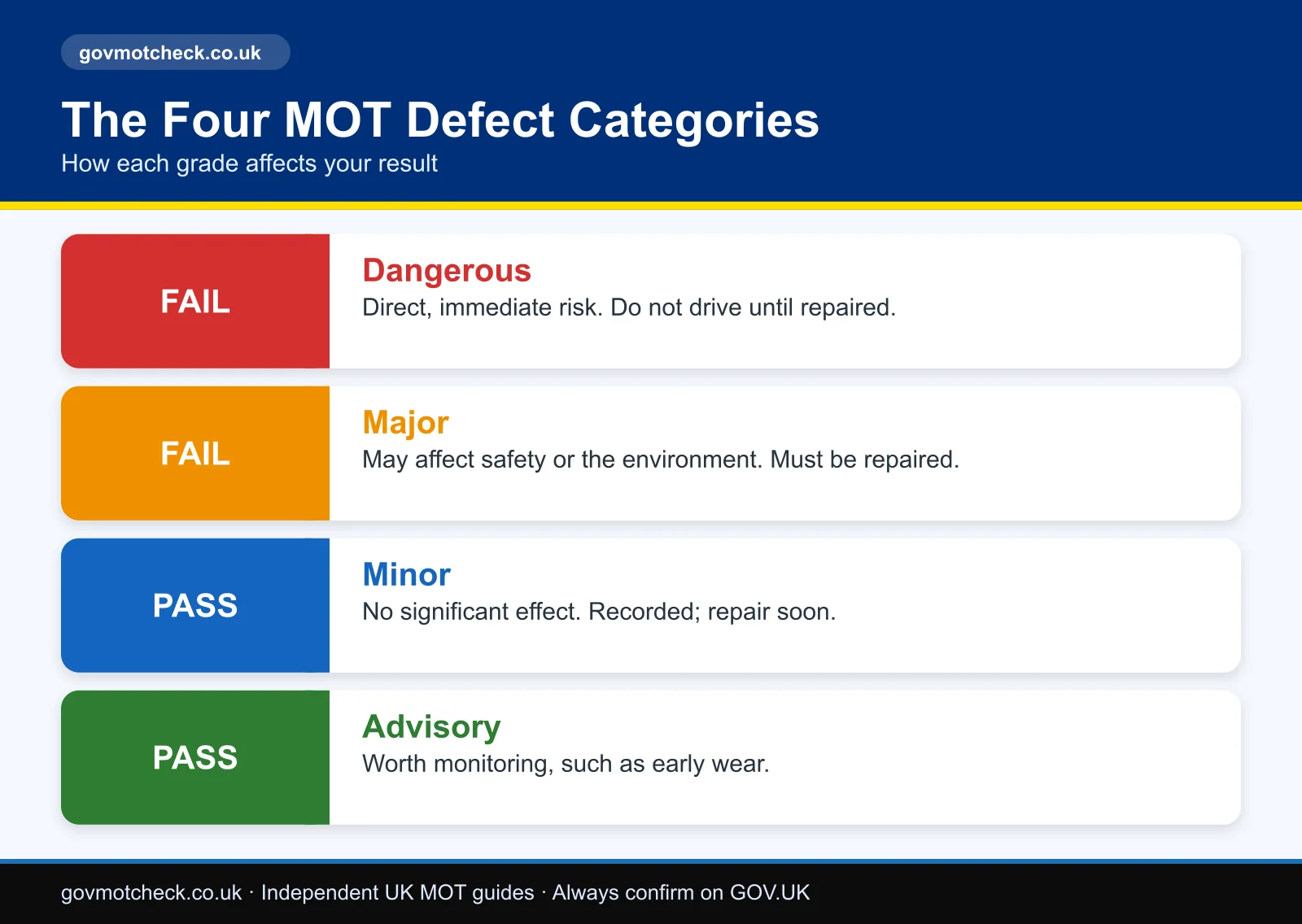
The Four Categories In One Table
| Category | Effect on result | What it means for you |
|---|---|---|
| Dangerous | Fail | Direct and immediate risk to road safety or the environment. Do not drive it |
| Major | Fail | May affect safety or the environment. Repair before it can pass |
| Minor | Pass (noted) | No significant effect, but worth repairing soon |
| Advisory | Pass (noted) | Something to monitor, such as early wear |
Pro Tip
Scan the table for the first two rows only. If your result lists neither a dangerous nor a major item, the car has passed.
Who Sets These Rules?
The MOT scheme is run by the DVSA (Driver and Vehicle Standards Agency) for Great Britain. The detailed rules testers follow are in the DVSA's MOT inspection manual, published on GOV.UK.
This page is independent and is not affiliated with DVSA, DVLA or GOV.UK, so use the official sources linked at the end to confirm anything that affects a decision. Northern Ireland has a separate scheme run by the DVA; see our Northern Ireland MOT guide.
What This Page Covers
It explains these topics, in roughly this order:
- Defect categories and what each one means.
- Whether you can drive after a fail.
- Retest rules and fees.
- How to read advisories.
- The most common failure areas by component.
- Emissions and warning lights.
- Pre-MOT checks.
- How to challenge a result.
Booking, prices and penalties for having no MOT sit on other pages.
What Happens If You Fail An MOT?
If your car fails its MOT (also searched as "what happens if my MOT fails" or "what happens if I fail my MOT"), the result is recorded on the national MOT database, you get a list of the dangerous and major defects, and the car needs those items repaired and retested before it can pass. You do not get a new certificate until it passes.
Here is what follows, in order:
- You get the failure details. The test centre can give you a refusal certificate (VT30), and the result also shows online in the vehicle's MOT history.
- Your old MOT, if any, is unchanged. A fail does not cancel a certificate that is still in date, and it does not extend one either.
- You decide whether you can drive it. You can drive the car away only if the current MOT is still valid and no dangerous defect was listed. Otherwise it must be repaired first, apart from driving to a repair or a pre-arranged test.
- You repair the dangerous and major items. At the same centre or anywhere else.
- You get a retest. A partial retest within 10 working days, or a full retest after that. See the retest section below.
- Or you challenge it. If you think the fail was wrong, you can appeal to DVSA within 14 working days.
Important
The fail itself carries no fine. The risk is driving a car that is unroadworthy, has a dangerous defect, or has no valid MOT. Those are covered in the driving section below.
What Counts As An MOT Failure?
An MOT failure is a test result where at least one defect is graded dangerous or major. The tester records the result in the national MOT database, and you can see it afterwards in the vehicle's MOT history.
Is A Fail The Same As "The Car Is Unsafe"?
Not always. A major defect means the vehicle does not meet the legal standard on the day, but it may still be usable for a short, sensible journey to a repair.
A dangerous defect is different: the vehicle presents an immediate risk and should not be driven.
Note
"Fail" is a legal result on the day of the test. It does not by itself tell you how risky each item is, so read the category next to every defect.
What Is The Difference Between A Refusal Certificate And A Fail?
They are the same event. When a vehicle fails, the test centre can issue a "refusal of an MOT test certificate", known as the VT30. GOV.UK says to ask the test centre for it, and the result also appears online. Our MOT certificate guide explains the paper forms.
Does A Fail Affect The Next Test Date?
A fail does not give you a new expiry date. Your old MOT, if still valid, keeps its expiry. A pass is what creates a new certificate. If you are unsure about timing, see MOT due date rules.
Warning
Do not assume a fail resets or extends anything. If the old certificate has expired, the car has no valid MOT until it passes.
The Four Defect Categories Explained
Since 2018 the MOT has graded faults in four tiers. GOV.UK's result page lists dangerous and major as fail items and minor and advisory as items to monitor or fix later. The inspection manual applies the grading to each component.
Dangerous defect
Direct and immediate risk. The result is a fail and the vehicle must not be driven until it is repaired.
Major defect
May affect safety or the environment. The result is a fail and it must be repaired before a pass.
What Is A Dangerous Defect?
A dangerous defect is a fault that is a direct and immediate risk to road safety or has a serious impact on the environment. The result is a fail and the vehicle must not be driven until it is repaired.
In the manual, examples include:
- A brake fluid level that cannot be seen at all.
- Insufficient tyre tread.
- A steering wheel likely to become detached.
Important
A dangerous defect means do not drive the car, even if the old MOT is still valid.
What Is A Major Defect?
A major defect is a fault that may affect safety, put other road users at risk or have an impact on the environment. It is a fail. Examples from the manual include:
- A registration plate that is illegible.
- A non-working wiper.
- A missing headlamp.
- An ABS warning lamp showing a malfunction.
What Is A Minor Defect?
A minor defect has no significant effect on safety or the environment. The vehicle passes, but the item is recorded and should be repaired soon. Examples in the manual include:
- Brake fluid slightly under the minimum mark.
- A damaged rack gaiter.
- A faulty hazard tell-tale.
What Is An Advisory?
An advisory is a note that something is worth watching, such as early corrosion or a tyre approaching the legal limit. It does not affect the result. Advisories are covered in detail in later sections.
Pro Tip
Treat advisories as a free early warning. A repair now is usually cheaper than a forced repair after a fail.
Can A Tester Pass Something They Would Rather Fail?
The tester must apply the manual's thresholds. Where the manual says to "pass and advise" in borderline cases, such as when a tester cannot tell whether what they feel in a tyre cut is the cords or a foreign object, they record an advisory instead of a fail.
That is why two cars with similar wear can get different notes.
Note
Borderline items are judged against the manual on the day, not against the tester's personal preference.
Dangerous Defects
Dangerous defects are the highest grade. The vehicle fails and there is no legal basis to treat it as a normal road vehicle until it is fixed.
What Is Classed As A Dangerous MOT Failure?
A dangerous failure is any defect that is a direct and immediate risk to road safety. Under the DVSA manual this includes:
- Insufficient tyre tread.
- A bulge or lump from tyre structural failure.
- All stop lamps missing.
- Smoke likely to obscure other road users' vision.
Which Common Faults Can Be Dangerous?
The manual grades several everyday faults as dangerous when they reach a threshold:
- Tyre tread below the legal minimum.
- Tyre separation, lifted tread or exposed cords.
- Brake fluid not visible at all in the reservoir.
- Stop lamps that stay on after the brake is released, or all stop lamps inoperative.
- A turning door likely to open inadvertently.
- Any defect in an LPG, CNG, LNG or hydrogen fuel system.
- Excessive corrosion that is likely to affect steering or braking.
Warning
Driving a vehicle that failed for a dangerous problem can bring a heavy fine, a driving ban and penalty points. The amounts are covered below.
Can The Same Fault Be Major Or Dangerous?
Yes. Severity depends on degree. Brake fluid slightly below the minimum mark is minor, significantly below is major, and not visible at all is dangerous.
A tester decides on the day, so a car can move up a grade between visits if the fault worsens.
Worked example
A 2014 hatchback has brake fluid just under the minimum mark at its test: minor, so it passes. A year later the fluid is not visible in the reservoir: dangerous, so it fails and must not be driven.
Major Defects
Major defects are the most common cause of a fail because they cover a wide range of items, from a blown bulb to a defective warning system.
Why Are Major Defects So Broad?
The manual assigns "major" to anything that could affect safety or the environment but is not an immediate danger. That includes:
- Missing mirrors.
- An inoperative horn.
- Seat belt buckles that do not work.
- Emissions above limits.
- A malfunction lamp showing a fault.
Pro Tip
Most majors are cheap to prevent. A quick walk-round for bulbs, wipers and the horn catches many of them before the test.
Do I Need To Fix Every Major Defect To Pass?
Yes. All dangerous and major items on the failure list must be resolved. Minor and advisory items do not need to be, though fixing them at the same time can save a second visit.
Fixes must be done before a retest, covered in the retest section below.
Can I Disagree With A Major Defect?
You can discuss it with the test centre immediately and, if you still think the failure was wrong, appeal to DVSA. Do not repair anything before the appeal ends, because the repair destroys the evidence. See the appeals section later on this page.
Warning
Repairing the item before the appeal process has finished can remove the evidence DVSA needs to review the result.
Minor Defects
A minor defect is recorded but the car passes. Minor items are often the early version of a future major.
Do Minor Defects Fail An MOT?
No. A minor defect does not fail the MOT. It is printed on the pass certificate as a defect for you to repair at your convenience, and it stays in the vehicle's online history.
Are Minor Defects The Same As Advisories?
They are separate categories, although both appear on a pass. A minor defect is a fault that exists and has been graded. An advisory is an observation, such as wear that has not yet reached a threshold. Used-car buyers should read both.
Note
On a pass, read the minor defects and advisories together. Between them they show what is likely to cost money soon.
Why Fix A Minor Defect At All?
Because many minors become majors at the next test. A slightly low power steering fluid level is minor today; an empty reservoir is major. Fixing it now is usually cheaper than an enforced repair plus retest.
Worked example
A 2016 estate passes with a minor note for a slightly low power steering fluid level. Left alone, the reservoir runs empty before the next test and becomes a major fail.
What Are MOT Advisories?
MOT advisories are notes added by the tester for things that are not yet a failure but may need attention. People searching "mot advisories", "check mot advisories" or "mot advisory meaning" are usually trying to decide if a car has hidden costs coming.
How Are Advisories Different From Failures?
An advisory has no effect on whether the car passes. It does not need repair for the MOT. Nobody can stop you driving because of an advisory alone, but it is a record that the tester saw something worth monitoring.
Are Advisories Legally Binding?
No. GOV.UK describes them as items to monitor or fix later. Still, if a car is later involved in a collision and an advisory covered the relevant component, an insurer or investigator could consider that you knew about the problem. This is general information, not legal advice.
Important
An advisory is not a legal requirement to repair, but it is a written record that you were told about the problem.
Where Do Advisories Appear?
They appear in two places:
- On the paper certificate given at the test centre.
- In the online MOT history for the vehicle.
Our MOT history checker guide shows how to view them by registration number.
Do Advisories Expire?
They are not removed after a set time. Each test has its own list, so a repair shows as an advisory missing from the next test. If the same advisory repeats year after year, the part has probably not been repaired.
Pro Tip
Compare this year's advisories with last year's. Any that has vanished was fixed; any that remains is still waiting.
Pass, Pass With Advisories Or Fail: Reading The Result
GOV.UK shows two official outcomes: pass and fail. The phrases "pass with advisories" and "pass with minor defects" are everyday shorthand. The detail is on the record.
Pass
No dangerous or major defects found.
- Minor defects and advisories may still be listed
- Treat them as a to-do list
Fail
At least one dangerous or major defect.
- Ask the centre for the refusal certificate (VT30)
- Check the result online
What Does A Plain Pass Look Like?
A pass means no dangerous or major defects were found. A pass can still list minor defects and advisories, and when it does, treat them as a to-do list rather than good news about every component.
What Does A Fail Look Like?
A fail lists at least one dangerous or major defect. It may also list minor and advisory items. GOV.UK says you can ask the test centre for the refusal certificate (VT30) and check the result online.
How Do I Tell Which Items Caused The Fail?
Look at the category label next to each item. Only those marked dangerous or major caused the fail. If an item has no label, check the printout or your online record, or ask the tester to point to the entry.
Pro Tip
Highlight the dangerous and major lines first. Those are the only items you must fix to pass the retest.
Can You Drive A Car That Has Failed Its MOT?
You can drive a failed car away only if its current MOT is still valid and no dangerous problems were listed, according to GOV.UK. Otherwise you must repair it before driving, apart from limited exceptions such as driving to a repair or to a pre-arranged MOT test.
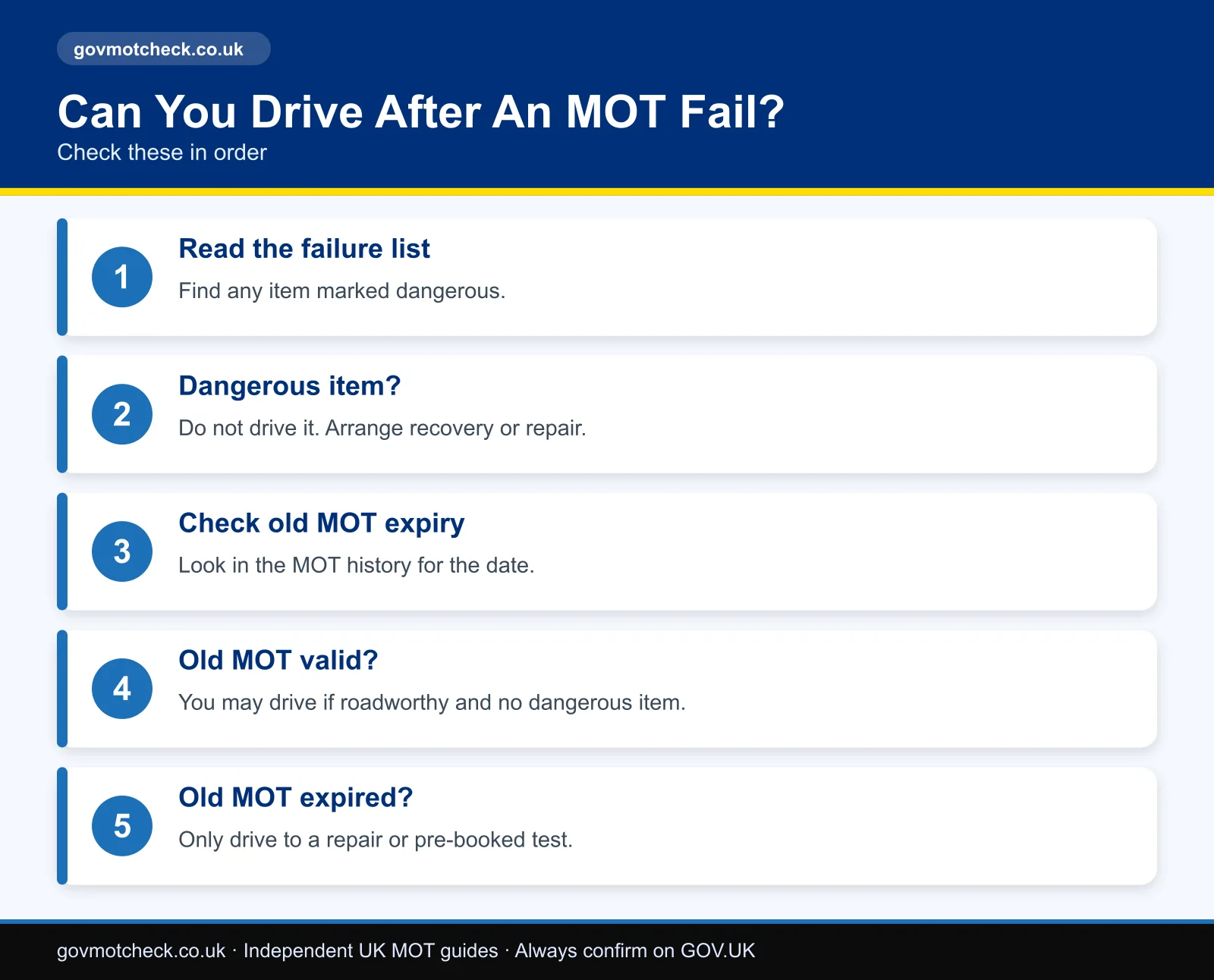
The decision runs in this order:
- Check for dangerous items. If any were listed, do not drive the car.
- Check the old MOT. If it is still valid and nothing is dangerous, you may drive it, provided it stays roadworthy.
- Check for expiry. If the old MOT has run out, drive only to a repair or a pre-booked test.
Important
Always start with the dangerous items. They override whatever the old MOT says.
Old MOT still valid
If nothing dangerous was listed, you may drive the car, provided it stays roadworthy.
Old MOT expired
Drive only to a repair or a pre-arranged MOT appointment. A casual detour is not covered.
Dangerous defect listed
Do not drive it, even if the old MOT is still valid. Arrange recovery or repair.
If The Old MOT Is Still Valid And The Fail Is Major
You may drive it, but the car must meet the minimum standards of roadworthiness at all times. If your old MOT is still valid, you can take it away for repairs, and GOV.UK stresses you could be fined if it is not roadworthy. In practice, a failed brake light or horn is not a reason to take a long journey.
If The Old MOT Has Expired
GOV.UK says that if the MOT has run out you cannot drive or park on the road, except to take the car to or from a repair, or to a pre-arranged MOT appointment. The fine for driving with no valid MOT can be up to £1,000. Details on penalties are in our rules and exemptions guide.
Warning
A casual detour, such as a shopping trip, is not covered by the exception for driving to a repair or test.
If A Dangerous Defect Was Listed
Do not drive it, even if the old MOT is still valid. GOV.UK says driving a vehicle that failed for a dangerous problem can bring a fine of up to £2,500, a driving ban and 3 penalty points. Arrange recovery or repair at the test centre if they offer it.
Does My Insurer Care?
Insurers can refuse claims where a vehicle is unroadworthy. Confirm your policy terms with the insurer and keep the failure sheet showing the defect.
Pro Tip
Photograph the failure sheet and keep it with your insurance papers in case a claim is questioned.
Driving Home After A Fail: Worked Examples
These examples use made-up vehicles to show how the rules apply. They are illustrations, not legal advice.
Example: Valid Old MOT, Major Tyre Defect
Worked example
a 2015 hatchback with an MOT expiring in three weeks fails on a major tyre defect and has no dangerous items. Because the current MOT is valid and nothing is dangerous, it may be driven home, provided it remains roadworthy. The owner should replace the tyre first, not wait.
Example: Expired MOT, Minor Lamp Failure
Worked example
a 2012 estate with an expired MOT fails because a rear fog lamp does not work, a major defect. The owner may drive it to a repair appointment or a pre-booked retest, not on errands. A casual detour is not covered.
Example: Dangerous Brake Fluid Defect
Worked example
a 2010 saloon fails with brake fluid not visible in the reservoir, a dangerous defect. It should not be driven, whatever the old MOT says. The owner arranges recovery or has the garage repair it on site.
Example: What If There Are Several Failures?
The most serious one decides the rule. One dangerous item among five majors means the whole vehicle falls under the dangerous rule.
What Happens Straight After A Fail
Immediately after a fail the tester gives you the failure details and the refusal certificate. You then have to choose one of three routes:
- Repair at the same centre.
- Repair elsewhere.
- Challenge the result.
What Do I Do In The First Hour?
Work through these steps:
- Read the list. Note every dangerous and major item.
- Ask which items are dangerous. This decides whether you can drive.
- Ask for a written estimate. Ask whether the centre can repair the car.
- Check the old expiry. Look up your old certificate's expiry date in the MOT history so you know if you can legally drive it.
Should I Authorise Repairs On The Spot?
Only if you are comfortable with the price. You can decline, take the list elsewhere and get other quotes. Our booking and cost guide covers comparing garages and spotting upselling.
Pro Tip
Ask the garage to mark which repairs are needed for the MOT and which are optional extras.
Where Does The Result Go?
Into the national database. Anyone can look up the history of a plate, so the fail remains visible even after a pass. Used-car buyers often look at past fails, which is why a clean repair record matters.
Selling Or Scrapping A Car That Failed
You can sell a car with a failed MOT, but you must be honest about it. Buyers who search "sell mot failure car" are often dealers or scrap yards.
Can I Sell A Car That Failed Its MOT?
Yes. GOV.UK does not prohibit selling a failed car. State clearly that it failed and list the defects. Selling it as roadworthy when you know it is not could create legal problems, so seek advice if unsure.
Warning
Describing a car as roadworthy when you know it failed for a safety defect could create legal problems for you as the seller.
Who Buys Failed Cars?
Several kinds of buyer:
- Private buyers who want a project.
- Dealers.
- Salvage buyers.
- Scrap buyers.
Offers reflect repair cost. Compare several, because quotes vary widely.
Should I Repair Before Selling?
It depends on repair cost versus the price difference between a car with and without a fresh MOT. Get a quote for the fail items and compare it against the likely uplift.
What About Scrapping?
If the car is beyond economic repair, an authorised treatment facility can scrap it. Tax and SORN rules apply; see the MOT and tax guide.
Note
Check the tax position before you scrap or sell, so you do not pay for a car you no longer use.
MOT Retest Rules
An MOT retest is a second inspection after a fail. As of November 2026, GOV.UK's "Retest after a repair" page sets three routes:
- Leave the vehicle at the test centre.
- Return it by the end of the next working day.
- Take it away and come back within 10 working days.
Anything else is a full retest at the full fee.
Important
Only the routes above qualify for a partial retest. Miss the window and you pay for a full test again.
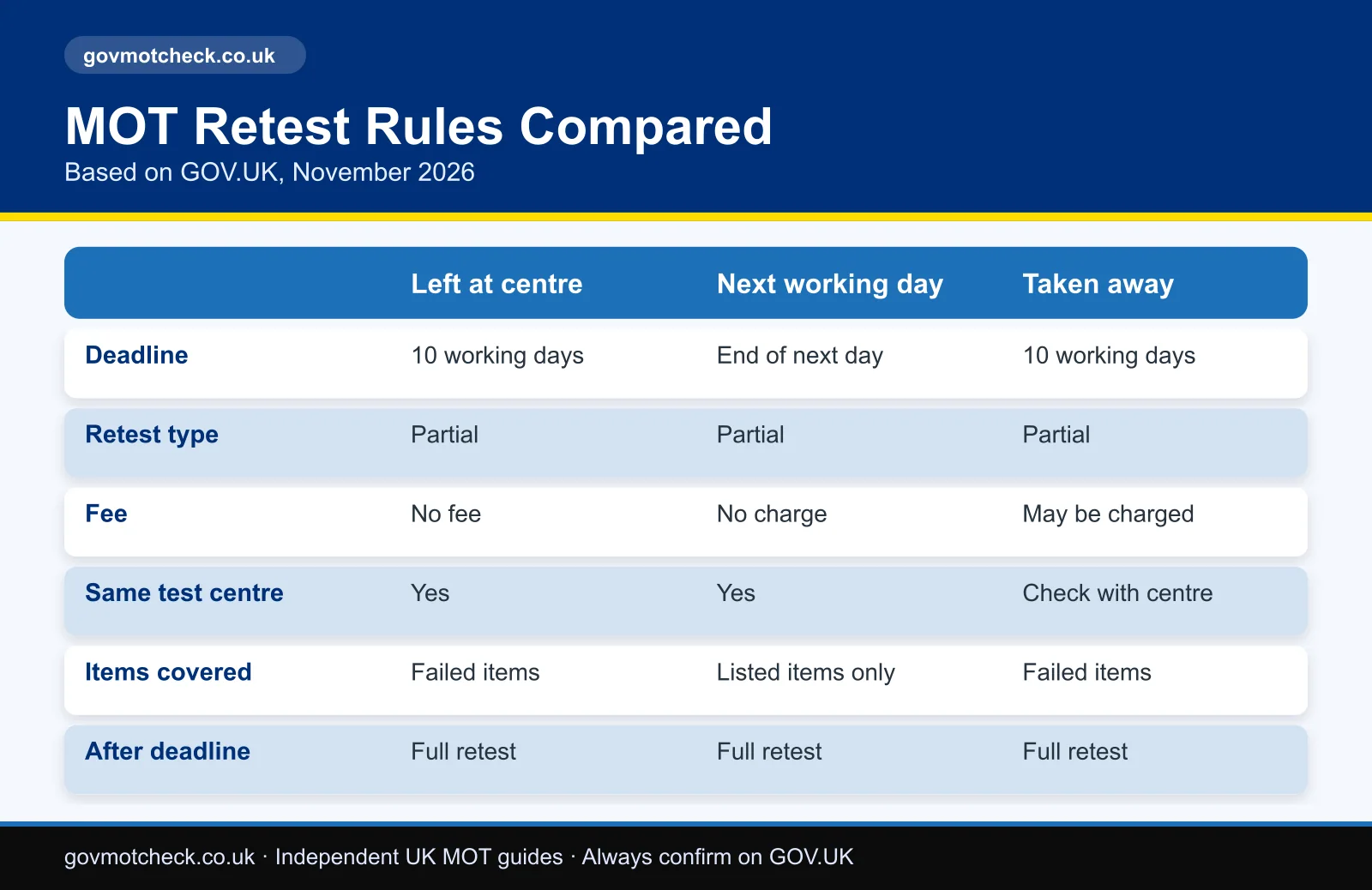
What Are The Retest Rules At A Glance?
| Situation | Retest type | Fee according to GOV.UK |
|---|---|---|
| Left at the test centre for repair, retested within 10 working days | Partial | No fee |
| Taken away, returned to the same centre by the end of the next working day (listed items only) | Partial | No charge |
| Taken away, returned within 10 working days | Partial | A partial retest fee may be charged |
| Any other case, including after 10 working days | Full | Full MOT test fee again |
Free partial retest
- Left at the test centre and retested within 10 working days
- Returned to the same centre by the end of the next working day (listed items only)
May be charged
- Taken away and returned within 10 working days: a partial retest fee may be charged
- Ask for the price before you leave
Which Retest Rules Do People Mix Up?
Most confusion comes from "free retest". It is only free in the first two rows above. If you take the car away and come back later in the 10 working days, the centre may charge a partial fee. Always ask for the price before you leave.
Pro Tip
Ask the centre to confirm in writing which retest route applies and what, if anything, you will be charged.
Does The Retest Rule Depend On The Test Station?
GOV.UK's wording refers to "the same test centre" for the free next-working-day route. A different centre treats it as a new test. The 10 working day partial route is described for repairs generally, but check with the centre you plan to use.
Partial Retest Fees
A partial retest only re-inspects the items that failed. GOV.UK does not publish a fixed price for it on the retest page, so do not trust any figure you have not been quoted.
How Much Is A Partial Retest?
GOV.UK says you "may be charged a partial retest fee" if you take the car away and return within 10 working days. The retest page does not state an amount, so ask the test centre for the exact price. For the maximum full fee for a car, see our booking and cost guide.
Note
There is no official partial-fee figure on the GOV.UK retest page, so the only reliable number is the one the centre quotes you.
Is A Partial Retest Ever More Than The Full Fee?
The full test fee is a maximum set in law. GOV.UK says test stations cannot charge more than the maximum, and for most Class 4 vehicles including cars that figure is £54.85 as of November 2026. A partial fee should not exceed it; if a quote seems high, compare centres.
Warning
If a quote for a partial retest is close to or above the full maximum fee, question it before you agree.
Do Centres Advertise Free Retests?
Many do, in line with the left-at-centre or next-working-day rules. Read the small print about:
- Which items are covered.
- What happens if you take the car elsewhere for repairs.
- Whether any time limit applies.
The Free Retest Next Working Day
The next-working-day route is the narrowest free retest. GOV.UK says you will not pay again if you return the vehicle to the same test centre before the end of the next working day, but only for a partial retest of listed items.
Which Items Qualify?
GOV.UK lists items such as:
- Mirrors and horn.
- Lamps and seat belts.
- Seats.
- Windscreen and wipers.
- Wheels and tyres.
Some items, like stairs and emergency exits, apply only to class 5 vehicles. If your failure was brakes or emissions, it does not qualify for this route.
Important
Brake and emissions failures are not on the next-working-day list, so plan for a different retest route.
What Counts As The Next Working Day?
A working day excludes weekends and bank holidays. A car failing on a Friday afternoon would need to be back by the end of Monday, unless Monday is a bank holiday, in which case the next working day is Tuesday. Always confirm the centre's opening times.
Worked example
A car fails on Friday afternoon. The next working day is Monday, so it must be back at the same centre by the end of Monday. If Monday is a bank holiday, the deadline moves to Tuesday.
What If I Only Fix Part Of The Failure?
The centre re-inspects the listed items. Anything still failing means another fail result. Fix everything on the list before returning, to avoid wasting your free slot.
How Long Do You Get For An MOT Retest?
You get 10 working days for a partial retest if you take the car away or leave it at the centre. After that, GOV.UK treats the retest as a full test with a full fee.
How Is 10 Working Days Counted?
Count Monday to Friday, skipping bank holidays, starting the day after the fail. A bank holiday in between pushes the deadline back by a day.
Worked example
A car failing on Tuesday 3rd has until the end of Tuesday 17th, unless a bank holiday sits in between, which would push the deadline back by a day.
What If Parts Are Delayed?
The deadline does not extend for slow parts. If you cannot make it, you will need a full retest. Order parts promptly and tell the centre if you are close to the limit.
Pro Tip
Order parts the same day as the fail so a supplier delay does not use up your 10 working days.
Does The Retest Window Apply If I Change Garages?
GOV.UK's description of the 10 working day route says the vehicle is taken away for repairs and brought back; it refers to the original test result. Ask any new centre whether they will treat it as a partial retest. They may insist on a full test.
Retest In A Different Place
You can repair a failed car anywhere and then book a full test elsewhere. The partial concession mostly benefits those returning to the same centre.
Return to the same centre
GOV.UK describes partial retests in relation to the original test centre.
Use a different centre
Expect a full test and a full fee. Add the full retest fee to your sums.
Can I Use A Different Test Centre For The Retest?
Yes, but expect a full test and a full fee. GOV.UK only describes partial retests in relation to returning to the original test centre.
Is There Any Advantage To Repairing Elsewhere?
Often price. Dealers and independent garages differ greatly, so getting three quotes can offset a lost partial concession. Our guide to booking an MOT discusses comparing centres.
Note
A cheaper repair elsewhere can outweigh the lost partial concession, but add the full retest fee to your sums.
Do Chain Names Change The Rules?
Rules are the same, but chains publish their own retest policies. Searches like "halfords mot retest" or "kwik fit retest mot" are about each firm's wording. Treat it as an offer on top of the law and check it before you pay.
How Long Does An MOT Retest Take?
A partial retest checks only the failed items, so it is usually quicker than a full test. GOV.UK does not publish an official duration for either, so ask the centre when you book.
Why Does A Partial Retest Vary In Time?
Because it depends on the items:
- Re-checking a lamp takes minutes.
- Re-checking brakes or emissions needs equipment set-up and a run-up.
Ask when booking.
Should I Wait Or Drop Off?
If the centre needs the car for repairs too, drop it off. If it is a simple retest, many centres will do it while you wait.
Pro Tip
Ask at booking whether waiting is possible. It saves a second trip for a simple lamp or wiper retest.
Getting Repairs Done After A Fail
You choose who repairs your car. The test centre does not have to be the garage that fixes it.
Should I Use The Test Centre For Repairs?
It is convenient and guarantees the free partial retest in most cases. But you should compare prices. A quote and a clear list of the work should be provided in writing.
What Should A Repair Quote Include?
A good quote lists:
- Parts and labour.
- VAT.
- A time estimate.
- The warranty period.
- Whether the retest fee is included.
Photographing the failed part helps if you need to compare.
What If The Repair Is Too Expensive?
Consider selling the car as a non-runner, scrapping it, or fixing only what is needed. See "Selling or scrapping a car that failed" earlier on this page.
Note
Fixing only what is needed means every dangerous and major item. Minor and advisory items are optional for the retest.
How To Check MOT Advisories Online
Checking advisories is done through the official GOV.UK MOT history service using the vehicle's registration number. You can search "check mot advisories" and land on GOV.UK, which is free.
What Do I Need To Check Advisories?
The registration number of the vehicle. For ownership checks you may also use the V5C logbook details, but advisories are public for any plate. The page shows:
- Test date and result.
- Mileage.
- Advisories and minor defects.
- Reasons for failure.
Our home page guide walks through each field.
Can I Check Advisories On A Car I Do Not Own?
Yes. The MOT history is public for the registration number. Used-car buyers often do this before viewing a vehicle.
Pro Tip
Check the history before you travel to see a car. It can save a wasted journey.
How Far Back Does The History Go?
The online record does not cover every year equally, and older paper-era tests may be missing or less detailed. Our MOT history guide explains what the record includes and how to interpret gaps.
How To Read An MOT Advisory
Advisory text is free-form written by the tester, so wording varies. Learn the key patterns to translate them.
What Do Common Phrases Mean?
Common wording translates like this:
- "Slightly" means mild.
- "Corroded" is surface or structural depending on the item.
- "Insecure" means loose.
- "Worn" means approaching limits.
- "Play" means looseness.
Extra words like "nearside" or "offside" tell you the side: nearside is the kerb side in the UK (left), offside is the driver's side (right).
How Do I Tell If An Advisory Is Urgent?
Look at the component and the verb. An advisory on brake pipes or steering is more urgent than one on a bumper scuff. If unclear, take the car to a garage with the advisory list.
Important
Treat brake and steering advisories as the priority, whatever the wording sounds like.
What About The "Funny" Advisory Notes People Share?
Social media posts about odd tester comments are common, but they are anecdotal. Because the field is free text, wording can be informal. Judge by content, not by humour, and never assume an odd phrase means the issue is trivial.
Which Advisories Should You Fix First?
Prioritise by these two tests:
- Safety first.
- What is most likely to cause a fail next year.
A simple ranking works well.
Fix These First
Fix these first
- Brake components, especially pipes, hoses and pad or disc wear.
- Tyres close to the tread limit, cuts or sidewall damage.
- Steering and suspension components with play or leaks.
- Lamps and electrical faults that might blow before the next test.
Fix these when convenient
- Cosmetic body panel notes.
- Surface corrosion away from structural areas.
- Minor fluid weeping that is not on a brake or fuel line.
Warning
Brake, tyre and steering advisories left unrepaired are the ones most likely to become a dangerous or major fail.
How Should I Record Advisories?
Make a short list with date, component and quote. Cross off items as you repair them. A tidy service record helps resale.
Pro Tip
Keep the list in your phone notes and update it after each service so the history is easy to show a buyer.
Advisories When Buying A Used Car
For used-car buyers, advisories are negotiation tools and risk signals. The history may show a pattern across several years.
What Should I Look For In The History?
Four warning signs:
- Repeated advisories on the same component.
- A jump in failed items.
- Long gaps between tests.
- Mileage anomalies.
Our home page guide explains reading mileage in the history.
Does An Advisory Mean I Should Not Buy?
No. Many cars have advisories. The question is whether the repair cost is realistic and priced into the deal.
Can I Use Advisories To Negotiate?
Yes, with evidence. Get a quote for the advisory items and ask the seller to reduce the price or fix before sale.
Worked example
A used saloon shows a worn front tyre advisory. You get a quote for two tyres and ask the seller to take that amount off the price.
Do Minor Defects And Advisories Affect Insurance Or Tax?
They do not affect the MOT result, and tax depends on having a valid MOT, not on a clean sheet. Check your insurer's terms.
Will A Minor Defect Raise My Premium?
We have no verified evidence that insurers price from MOT history, but policy terms commonly require the vehicle to be roadworthy. Ask your insurer if unsure.
Note
If you are unsure how your insurer treats known defects, ask before you need to make a claim.
Does An MOT Pass With Defects Allow Tax Renewal?
Yes. A pass is a pass. See our MOT and tax guide for the dependency between the two.
Common MOT Failure Reasons By System
The DVSA manual is organised into numbered sections, and failures fall into these areas. This page does not publish failure-rate figures because we cannot verify current ones here; DVSA and GOV.UK publish official statistics if you need them.
Which Systems Does The MOT Check?
The manual covers:
- Identification of the vehicle (plates and VIN).
- Brakes and steering.
- Visibility.
- Lamps and electrical equipment.
- Axles, wheels, tyres and suspension.
- Body structure.
- Other equipment such as seat belts and airbags.
- Nuisance (noise and emissions).
GOV.UK also says the test does not cover the condition of the engine, clutch or gearbox.
Note
The MOT checks emissions and leaks, but not the general health of the engine, clutch or gearbox.
What Are The Most Common Things That Will Fail An MOT?
In general terms, lamps, tyres, brakes, suspension, visibility items and emissions are the areas drivers meet most often, because they involve wear parts and bulbs. For exact numbers, search DVSA's published MOT statistics rather than relying on forum lists.
Which Fault Types Are Easiest To Prevent?
The easy ones:
- Bulbs.
- Wiper blades and washer fluid.
- Tyre pressures.
- Horn.
- Number plates.
A quick walk-round can find most of these in under ten minutes.
Pro Tip
Do the walk-round the day before the test, so there is time to buy a bulb or blade if you find a fault.
MOT Tyre Rules
Tyre rules are among the most searched topics for this page ("mot tyre rules", "tyre rules for mot"). The DVSA manual is explicit, which makes tyres one of the easiest areas to self-check.
What Is The Legal Tyre Tread Depth For An MOT?
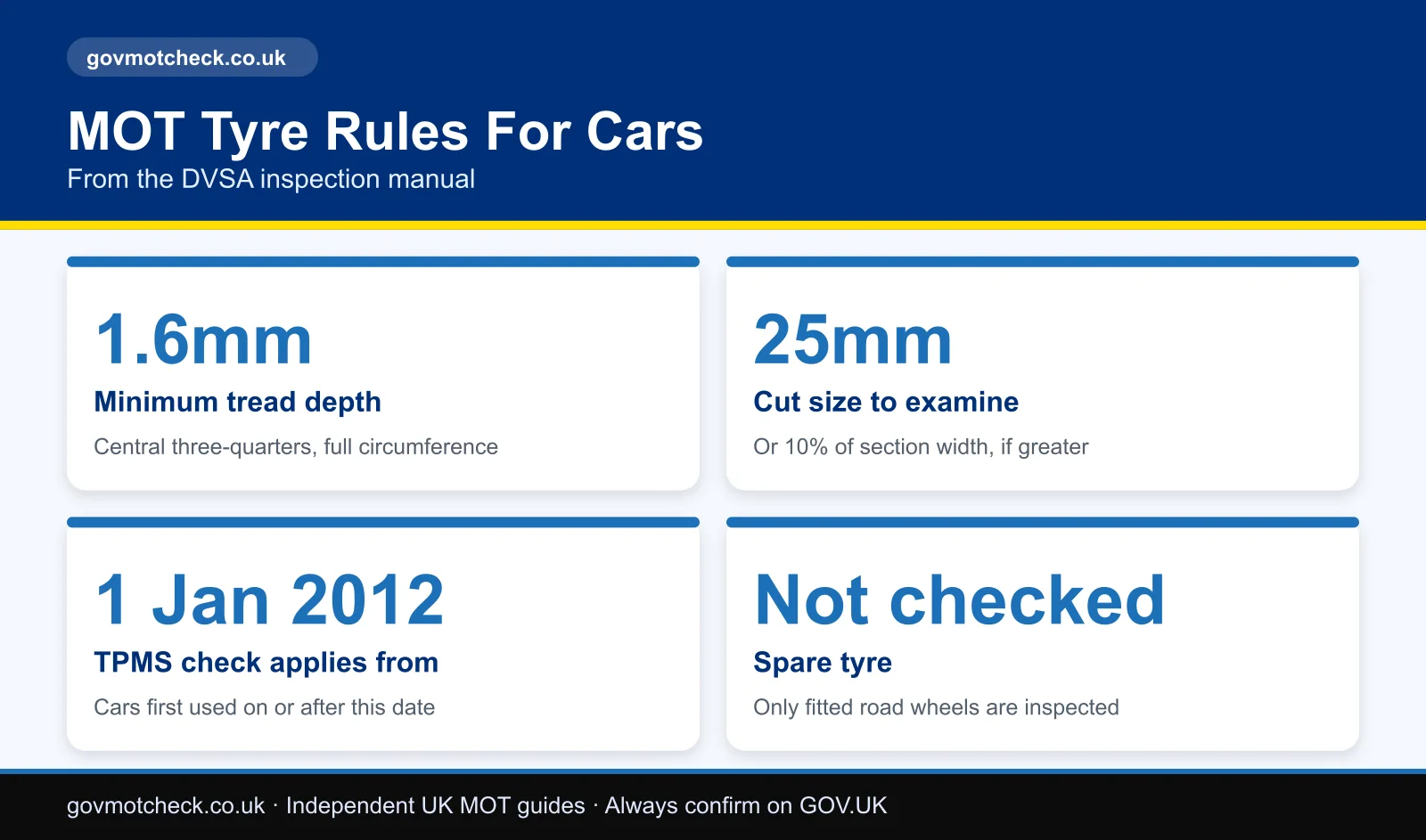
For a typical car, the primary grooves must be at least 1.6mm deep across the central three-quarters of the tread and around the full circumference. Insufficient tread is graded as a dangerous defect in the DVSA manual.
Important
The 1.6mm minimum applies to ordinary cars, and below it the tyre is a dangerous fail.
What Vehicles Use A Different Tread Limit?
The manual sets 1.0mm for some vehicles, and 1.6mm for ordinary cars.
Ordinary cars: 1.6mm
Primary grooves must be at least 1.6mm deep across the central three-quarters of the tread and around the full circumference.
1.0mm vehicles
- Vehicles first used before 3 January 1933
- Passenger vehicles with more than 8 seats (excluding the driver)
- Certain tricycles
For motorcycles and vans see our motorcycles, vans and EVs guide.
Do Secondary Grooves Count?
No. The manual says secondary grooves and sipes are ignored when measuring, and grooves containing wear indicators count as primary. That is why a tyre can look fine but fail where the main grooves are worn.
Pro Tip
Measure the main grooves with a tread gauge in several places, not just where the tyre looks newest.
Read the motorcycle and van guide
Tyre Damage: Cuts, Bulges And Lumps
Tyre damage is judged on whether it exposes the internal structure. Cosmetic scuffs are treated differently from structural damage.
Is A Cut In A Tyre An MOT Failure?
It is if the ply or cord can be seen without touching the tyre, whatever the size of the cut. A cut that reaches the ply or cords is a major defect. If the cords can only be felt, not seen, it still fails when the cut is longer than 25mm or 10% of the section width (whichever is greater).
Is A Bulge Or Lump A Failure?
Yes. A lump, bulge or tear caused by separation or partial structural failure, including lifted tread rubber or exposed or damaged cords, is a dangerous defect. A bulge on the sidewall usually means internal damage after a kerb strike or pothole.
Warning
A bulge can mean the tyre structure has failed inside. Do not drive on it, even if the tread looks fine.
Is A Nail In A Tyre An MOT Failure?
Not automatically. The manual tells testers that before failing a cut, they must make sure what they can feel is the tyre cords and not a foreign object (such as a stone or a nail head lodged in the cut). If the tester is not sure, they should pass and advise. A nail or screw that has not caused a cut reaching the ply is usually not a fail by itself, but it can lose air, so repair it.
What About Tyre Cracking?
Cracking in the sidewall is a general wear pattern. Deep cracking exposing cords would be assessed as a cut or structural failure. Light surface cracking is more likely to be an advisory.
Other Tyre Defects That Cause A Fail
Beyond tread and damage, the manual lists categories that surprise owners.
| Tyre defect | Category in the DVSA manual |
|---|---|
| Insufficient tread | Dangerous |
| Lump, bulge or tear from structural failure | Dangerous |
| Load capacity insufficient for axle weight | Dangerous |
| Valve seriously damaged or misaligned | Dangerous |
| Cut reaching ply or cords | Major |
| Load or speed rating below minimum | Major |
| Different sizes on the same axle | Major |
| Different structures (radial and cross-ply) on one axle | Major |
| Tyre fouling part of the vehicle | Major |
| Incorrectly seated on the rim | Major |
| Obviously under-inflated | Minor |
Can Mixed Tyres Fail An MOT?
Yes. Different sizes on the same axle, or different structures such as radial and cross-ply on the same axle, are major. Run-flat and conventional tyres may share an axle, though this is not recommended.
Note
Matching tyres across each axle is the safest way to avoid this fail.
Can Under-Inflation Fail?
An obviously under-inflated tyre is a minor defect, so it should not fail by itself. But low pressure often goes with other damage, so inflate and check.
How Old Can A Tyre Be?
The tyre-age rules we found in the manual (tyres over 10 years old, identified by the date code) apply to buses, coaches and minibuses, not ordinary cars. Check the manufacturer's guidance for age advice on your tyres. Keyword searches such as "mot tyre age limit cars" return mixed claims, so rely on the manual.
Worked example
A 12-year-old tyre on a family hatchback is not failed on age alone under the rules we found in the manual. The same age on a minibus would be a problem.
Spare Tyre And The MOT
People often ask "do you need a spare tyre for an MOT". The answer is straightforward and it appears in the manual.
Myth
You need a spare tyre to pass an MOT.
Fact
Only road wheels fitted at the time of inspection are checked. A missing spare is not a failure.
Do You Need A Spare Tyre To Pass An MOT?
No. The manual states that only road wheels fitted at the time of inspection are checked. A missing spare is not a failure.
Is The Spare Tyre Checked In An MOT?
No. If a spare tyre is defective, the tester advises the presenter, but it is not a test failure. Many modern cars carry a repair kit instead.
Should I Keep A Spare Anyway?
For safety, yes, if your car has space. That is separate from the legal test.
Pro Tip
If your car has a repair kit instead of a spare, check the sealant has not passed its date.
Tyre Pressure Warning Lights (TPMS)
TPMS (tyre pressure monitoring system) checks apply to some newer cars. The test covers the system, not the pressure itself.
Is A TPMS Light An MOT Failure?
It can be. The manual says the check applies to M1 vehicles first used on or after 1 January 2012, and a malfunctioning or obviously non-working TPMS is a major defect. If the lamp is on simply because a tyre is low, the tester may add advisory information rather than fail.
Can You Fail An MOT On Tyre Pressure?
Not for pressure alone, as the manual treats "obviously under-inflated" as minor. But a faulty TPMS system is major. Fixing a flat or refilling usually clears the lamp.
Pro Tip
Check all four tyre pressures before the test. A low tyre is the most common reason for the lamp to light.
Which Vehicles Are Excluded From The TPMS Check?
The manual excludes:
- Motor caravans.
- Ambulances.
- Hearses approved as M1 with a gross vehicle weight over 2,500kg.
Brakes And The MOT
Brakes are checked in every MOT. Searches such as "are brakes checked on mot" and "does mot check brakes" have a clear answer: yes.
What Does The MOT Check On The Brakes?
The manual covers:
- Pedal or lever condition and travel.
- Pads and linings.
- Discs and drums.
- Pipes and hoses.
- Master cylinder and servo.
- Cables and linkages.
- Brake fluid.
- The performance of service, secondary and parking brakes.
Performance is measured on a roller brake tester, plate tester or decelerometer.
What Brake Efficiency Is Required?
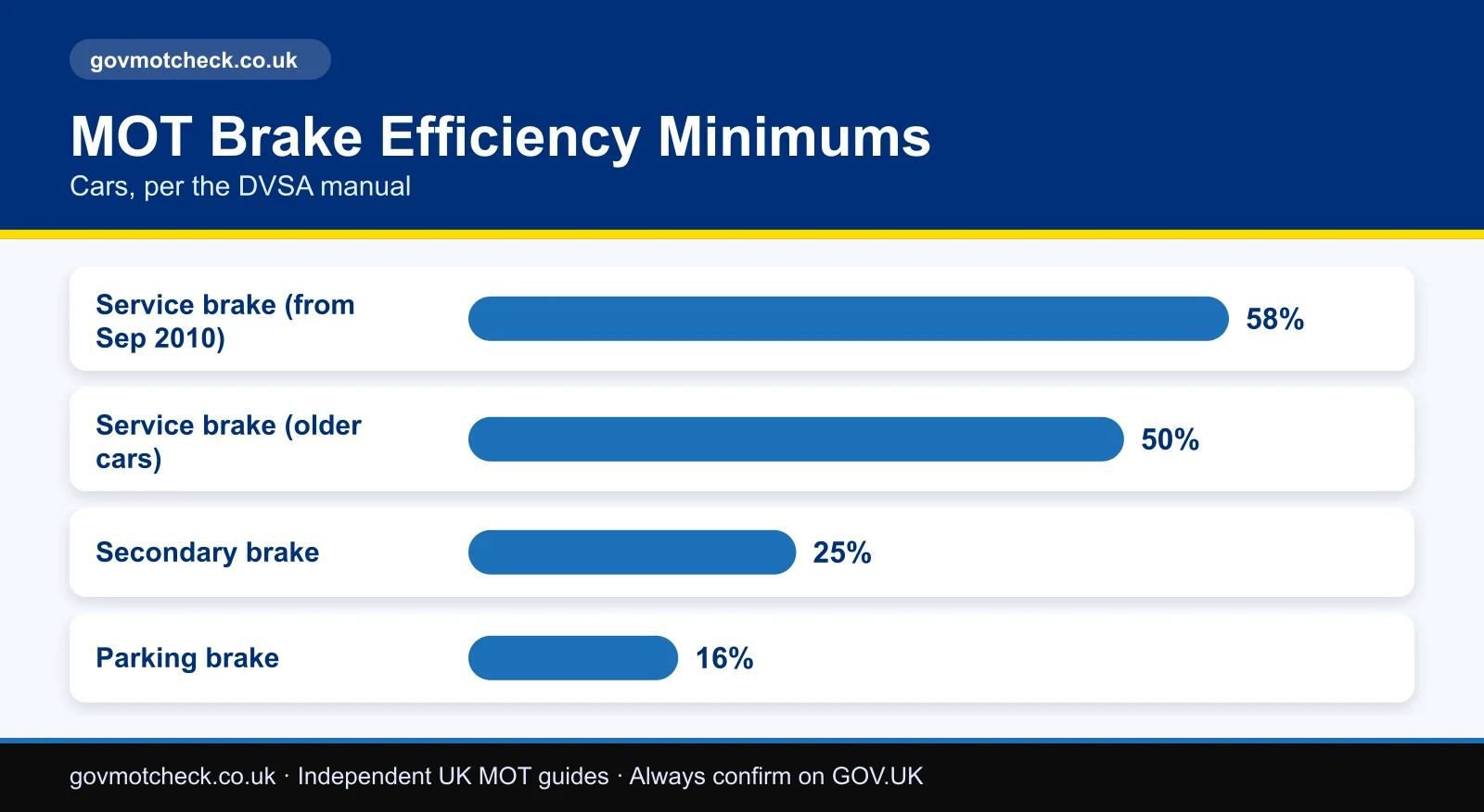
For a car first used on or after 1 September 2010, the service brake must reach 58% efficiency. For cars first used before that date it is 50%. The secondary brake needs 25% and the parking brake 16% for most vehicles, according to the manual.
Important
The brake efficiency figure depends on when the car was first used, so check your car's registration date.
Which Brake Faults Are Major Or Dangerous?
Examples from the manual:
Dangerous
- Brake pads worn below 1.5mm and leaking hydraulic pipes
- Brake fluid not visible at all
Major
- Contaminated fluid that is clearly visible
- A missing master cylinder cap
Warning
Worn pads and leaking brake pipes are dangerous fails. Do not drive the car until they are repaired.
Is A Brake Fluid Warning Lamp A Failure?
If illuminated or defective, it is minor. Fluid significantly below the minimum mark is major.
ABS And Brake Warning Lights
ABS (anti-lock braking system) lamps are a frequent search ("abs light mot failure").
Is An ABS Light An MOT Failure?
Yes. The manual grades a non-working ABS warning device, or one showing a malfunction, as major. An ABS system that has been obviously removed is also major, and ABS cannot legally be removed from vehicles first used on or after 1 January 2010.
Will The ABS Light Come On And Go Off?
On most cars it lights at ignition and then goes out. If it stays on, the system has a fault such as a wheel speed sensor problem. Have it diagnosed before the test.
Pro Tip
Watch the dashboard as you start the car. A lamp that stays lit after the check cycle needs diagnosis before the MOT.
Does The Handbrake Light Matter?
The manual separately covers the parking brake performance. A brake fluid warning lamp that is illuminated is minor. If the parking brake does not meet its efficiency threshold, that is a performance failure.
Lights And The MOT
Light failures are cheap to fix and easy to spot. Lamps get a long section of the manual.
Why Do So Many Cars Fail On Lights?
Three common reasons:
- Bulbs fail without warning.
- Lenses crack.
- Aim drifts over time.
The manual grades many lamp faults as major when the lamp is missing, inoperative or more than half the light sources are out.
What Are The Headlamp Rules?
The key points:
- A matched pair of main beam and a matched pair of dipped beam are required.
- Light sources out up to half on an LED lamp is minor.
- Missing, inoperative or over half out is major.
- Wrong colour, incompatible light source, or an aim that is out of limits is major.
What Are The Stop Lamp Rules?
The grades run as follows:
Dangerous
- All stop lamps missing or inoperative
- A stop lamp that stays on after the brake is released
Minor or major
- One out of several light sources is minor
- More than half out, or a missing lamp, is major
Warning
If all stop lamps are out, the car is a dangerous fail, so do not drive it.
What About Indicators And Hazards?
The key points:
- Indicators must be amber.
- A multi-source lamp up to half out is minor.
- Missing, inoperative or over half out is major.
- Flash rate must be 60 to 120 per minute.
- An indicator tell-tale missing or inoperative is minor.
Pro Tip
Have a helper stand behind the car while you test the indicators, hazards and stop lamps in turn.
Daytime Running Lights, Fog Lamps And Reversing Lamps
These are often misunderstood. The manual sets rules depending on the date the vehicle was first used.
Is A Reversing Light An MOT Failure?
Yes, on vehicles first used on or after 1 September 2009 (excluding quadricycles and Class 3), a reversing lamp that is inoperative is a major defect. It must come on automatically when reverse is selected. Older vehicles are not required to have one.
Can Daytime Running Lights Fail An MOT?
DRLs (daytime running lamps) where fitted as original equipment on M1 vehicles first used on or after 1 March 2018 must be white and no more than two. Inspectors check them as position lamps under the manual. A faulty DRL on a covered vehicle can be a defect.
Are Fog Lamps Required?
One rear fog lamp, red, on the centre or offside is required for vehicles first used on or after 1 April 1980. An obligatory rear fog lamp missing, or any fog lamp inoperative, is major.
Are Side Lights An MOT Failure?
Position lamps (sidelights): missing, inoperative or over half out is major. Up to half out on a multi-source lamp is minor.
What About Number Plate Lamps?
If the only lamp or all lamps are not working, that is major. One of several lamps out is minor.
Note
A single working number plate lamp out of several is minor, but fix it before the next test.
Number Plates And The MOT
Number plates are a frequent cause of failure that is entirely avoidable. Search interest includes "mot test number plates" and "number plate mot failure".
What Are The MOT Rules For Number Plates?
Both plates must be:
- Fitted and showing the same registration.
- Clean enough to read.
- Free from being obscured, excessively damaged or delaminated.
- Of the correct size, stroke width, spacing and font.
Rear plates need black on yellow and front plates black on white, for vehicles made from 1 January 1980.
What Number Plate Defects Fail?
Every registration plate defect in the manual is major:
- Plate missing or likely to fall off.
- Inscription missing or illegible.
- Incorrect registration.
- Plate not conforming to the requirements.
A plate with a tint, film or honeycomb background on newer vehicles counts under that last point.
Warning
A plate with a tint, film or honeycomb background can be a major fail on newer vehicles.
Do I Have To Measure The Characters?
No. The manual says inspectors judge by eye and "do not have to physically measure the characters or their spacing". Obviously wrong spacing or italic fonts will still be noticed.
What About The VIN?
The VIN (Vehicle Identification Number) must be present, complete and legible on vehicles first used on or after 1 August 1980. A missing, illegible or obviously falsified VIN is major, and so is more than one different VIN.
Visibility: Windscreen, Wipers And Mirrors
Visibility items are in section 3 of the manual. They include damage to the screen, wipers, washers and mirrors.
How Big Can Windscreen Damage Be?
The limits depend on the zone:
- Directly ahead of the driver: a swept area 290mm wide, centred on the steering wheel, where damage over 10mm in diameter is a problem.
- Rest of the swept area: the limit is 40mm.
Damage only fails if it significantly affects the driver's view.
Pro Tip
Fix a small stone chip early. A chip in the driver's zone can grow past 10mm, especially in cold weather.
Do Wipers And Washers Matter?
Yes:
- A wiper that does not operate or is missing is major.
- A defective blade is minor.
- A missing blade or one that clearly fails to clear the screen is major.
- Washers that do not work or do not supply enough fluid are major.
What Mirror Faults Fail?
The grades are:
- A missing obligatory mirror is major.
- Slightly damaged or loose is minor.
- Inoperative, excessively damaged, insecure, or not giving an adequate view to the rear is major.
Can A Repaired Windscreen Pass?
The manual says repaired windscreens are judged solely on whether the repair interferes with vision.
Steering And Suspension
Steering and suspension wear slowly, so advisories often precede a fail. These systems are in sections 2 and 5.
What Steering Faults Can Fail?
The grades are:
- Excessive play is major.
- Excessive ball joint wear is major.
- An electric power steering warning lamp indicating a fault is major.
- A steering wheel likely to become detached is dangerous.
- Steering rack gaiter damage and slight fluid weeping are minor.
How Much Steering Play Is Allowed?
Free play at the rim of a 380mm wheel is limited to:
- 13mm for rack and pinion steering.
- 48mm with several joints between wheel and rack.
- 75mm for other types.
Limits are adjusted for different wheel sizes.
Note
These limits are for a 380mm wheel. The garage adjusts them for other wheel sizes.
Can Power Steering Fluid Fail The Car?
Level below minimum is minor, and an empty reservoir is major. Testers check through a sight glass without removing the cap.
What About Suspension?
The manual covers springs, shock absorbers, bushes and joints. Leaking dampers and worn bushes are typical advisories or majors depending on the degree.
Body Structure And Corrosion
Corrosion is judged by how it affects the structure, not by how it looks. Appendix A of the manual covers the criteria.
When Does Rust Fail An MOT?
Corrosion is major if vehicle rigidity is significantly reduced, and dangerous if steering or braking is likely to be affected. Body panels corroded or damaged to the point of likely injury when grazed are major.
Important
Rust is judged on structure, not looks. Surface rust on a panel is not the same as rust on a load-bearing area.
What Are The Rules On Doors, Boot And Bonnet?
The grades are:
- A door that will not open with its control or close properly is major.
- A turning door likely to open by itself is dangerous.
- A boot lid or tailgate that cannot be secured closed is major.
Do Towbars Get Tested?
Yes:
- A towball or coupling with excessive wear, damage or corrosion is major.
- One likely to fail is dangerous.
- A towbar that obstructs the number plate or a lamp is minor, or major if the plate is unreadable.
What About Fuel And Exhaust Leaks?
The grades are:
- A leaking or missing filler cap is major.
- Excessive leaking or a fire risk is dangerous.
- An exhaust fume leak into the cabin is major.
- One that endangers occupants' health is dangerous.
Seat Belts, Airbags And Other Equipment
Section 7 of the manual covers seat belts, airbags, horn, speedometer and electronic stability control.
What Seat Belt Faults Fail?
A missing statutory belt, loose anchorage, damaged webbing, faulty buckle or retractor are all major. A belt that is damaged near a load-bearing structure likely to detach in a collision is dangerous.
Pro Tip
Pull each belt fully out and let it retract, and click every buckle, as part of your pre-MOT check.
Is The Airbag Light A Failure?
Yes. The SRS (supplementary restraint system) malfunction indicator lamp showing a malfunction is major. A switched-off passenger airbag, or a lamp showing it is disabled, is not a defect.
Do Horn And Speedometer Matter?
Yes:
- An audible warning that does not work is major.
- A speedometer that does not work or is not illuminated is major.
Is ESC Checked?
Yes. An ESC (electronic stability control) warning lamp that clearly indicates a malfunction is major, as are damaged wheel speed sensors or a damaged ESC switch.
The MOT Emissions Test
The exhaust emissions check is part of the MOT because the test covers environmental standards as well as safety. GOV.UK describes the MOT as checking that a vehicle meets "road safety and environmental standards". Section 8 of the DVSA manual covers noise, exhaust emissions, fluid leaks and the engine malfunction indicator lamp.
Why Do MOT Tests Include An Exhaust Emission Test?
Because vehicles must meet environmental standards as well as safety standards. Testers measure what comes out of the exhaust, and check that emission control equipment is present and unmodified, so that cars do not pollute more than they were designed to.
What Does The Tester Actually Measure?
The measurements depend on fuel type:
Petrol cars
Carbon monoxide (CO), hydrocarbons (HC) and lambda, a measure of air to fuel balance.
Diesels
Smoke opacity, measured by accelerating the engine several times.
They also look for visible smoke, leaks in the induction or exhaust and any missing or tampered emission control equipment.
Note
The tester checks the equipment as well as the readings, so a missing or modified component can fail even if the numbers look fine.
Is The Emissions Test The Same For Every Car?
No. Limits depend on:
- Fuel type.
- Age of the vehicle.
- For catalyst petrol cars, vehicle-specific figures from the in-service exhaust emission standards.
The manual says default limits apply if there is no exact match.
Petrol Emissions Limits And Failures
Petrol cars are tested at idle and a raised fast idle. The manual sets basic test figures for vehicles without vehicle-specific data.
What Are The Petrol Limits?
The basic test figures are:
- At fast idle (2,500 to 3,000 rpm): CO up to 0.2%.
- At fast idle: HC up to 200 ppm.
- At fast idle: lambda between 0.97 and 1.03.
- At idle: CO up to 0.3%.
Full catalyst tests use vehicle-specific limits, so these are guide values only. Ask the garage for your car's own limit.
Important
These petrol figures are guide values only. Your car may be tested against its own vehicle-specific limit.
Why Does A Petrol Car Fail On Emissions?
Typical causes are:
- A failing catalytic converter.
- A faulty lambda or oxygen sensor.
- A rich fuel mixture.
- An induction or exhaust leak.
- An engine that has not reached operating temperature.
The manual treats emissions above the limit, a lambda outside range, or a test that cannot be completed as major.
What Can I Do Before The Test?
Three practical steps:
- Service the car if it is due.
- Check for warning lights and fix the cause of any that are lit.
- Drive it for a good run so the engine and catalyst are hot.
Clear fault codes only after fixing the cause, not to hide it.
Pro Tip
Drive straight to the test centre if you can, so the engine and catalyst are at full operating temperature when the test starts.
Can I Reduce CO And HC With An Additive?
Additives are sold for this purpose but results vary and we cannot verify claims. Fixing the root cause, such as a worn sensor or misfire, is the dependable route.
Diesel Smoke Limits And The MOT
Diesel cars are tested for smoke density by accelerating the engine several times and measuring opacity.
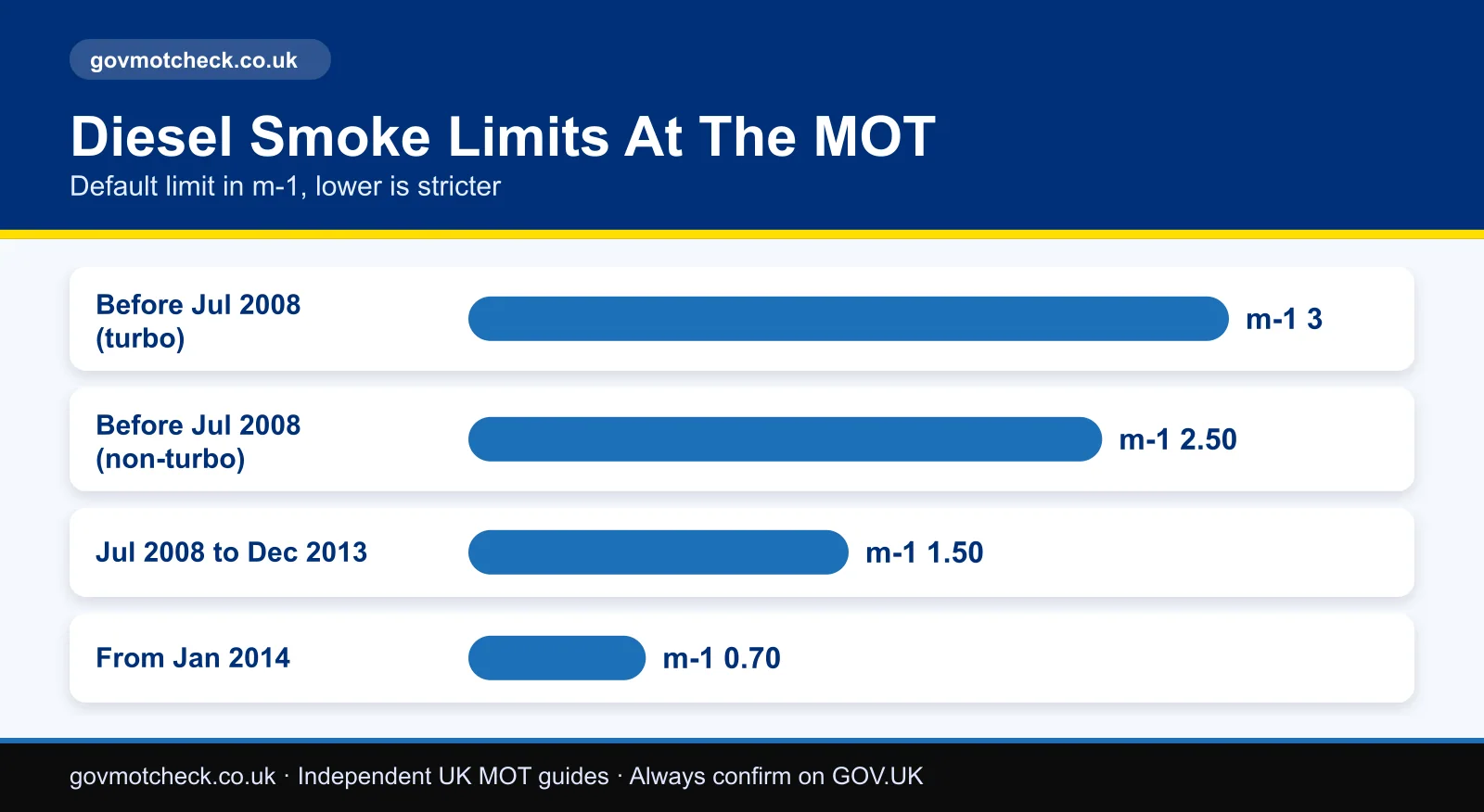
| Diesel first used | Maximum smoke if no plate value |
|---|---|
| Before 1 July 2008 | 2.5 m⁻¹ (non-turbo) or 3.0 m⁻¹ (turbo) |
| 1 July 2008 to 31 December 2013 | 1.5 m⁻¹ |
| On or after 1 January 2014 | 0.7 m⁻¹ |
How Is The Diesel Smoke Test Carried Out?
The sequence runs like this:
- Warm the engine. It must be at least 80°C, or normal operating temperature if lower.
- Purge. The tester holds the engine at about 2,500 rpm for 30 seconds.
- Accelerate. The tester carries out up to 6 accelerations.
- Read the result. It passes if the first reading is 60% or less of the limit, or the mean of the first three, or any three consecutive readings, is at or below the limit.
Note
The test allows several attempts, so a single high reading does not automatically fail a diesel.
What If The Plate Shows A Lower Limit?
Cars that carry a manufacturer's plate value are tested against that value, with 0.05 added by the tester. So the plate figure matters for newer cars.
What Smoke Is Dangerous?
Smoke of any colour likely to obscure other road users' vision is graded dangerous. Smoke above the limit is major.
Warning
A diesel pouring out smoke that hides other drivers is a dangerous defect. Do not drive it away.
Diesel Particulate Filters (DPF) And The MOT
A DPF (diesel particulate filter) traps soot. The MOT checks it by looking for smoke and signs of tampering.
Does The MOT Check The DPF?
Yes. During the smoke test the tester checks for visible smoke of any colour. Visible smoke from a vehicle with a DPF is a major defect. A DPF with evidence of tampering is also major.
Can I Remove My DPF?
Removing or modifying emission control equipment is a major defect in the manual, and the manual says to reject a filter that has been cut open and rewelded unless the presenter can show a valid reason such as cleaning. Beyond the MOT, check the law with DVSA or a legal adviser before modifying anything.
Warning
Removing or tampering with a DPF is a major defect, and there may be legal consequences beyond the MOT.
How Do I Stop A DPF Causing A Fail?
Good habits:
- Take regular longer runs so the filter can regenerate.
- Keep to the service schedule.
- Do not ignore a DPF warning lamp.
If the lamp is lit and the car is in limp mode, get it diagnosed. A blocked DPF often reflects short journeys.
Can A Regeneration Run Before The Test Help?
A sustained motorway run may help if the filter is partly loaded. It cannot fix a failed or removed filter, so treat it as a preparation step only.
Worked example
A diesel hatchback used only for short school runs has a partly loaded DPF. A long motorway drive the weekend before the test may help, but it will not repair a damaged filter.
What To Do If Your Car Failed The MOT On Emissions
Searches such as "car failed mot on emissions what can i do" show how common worry is. The answer depends on the fuel type and the fault.
What Are The First Steps?
Start here:
- Read the failure sheet. See whether the fail was a reading above limit, a test that could not be completed, or a lamp or equipment fault.
- Get the cause diagnosed. Do this rather than guessing.
- Repair, then retest.
The fail gives you the results; a garage can find the reason.
What Are Typical Fixes?
| Problem | Typical repair area |
|---|---|
| Petrol CO or HC too high | Catalytic converter, lambda sensor, spark plugs, misfire |
| Lambda out of range | Oxygen sensor, fuel system, air leaks |
| Diesel smoke too high | Injectors, air filter, EGR, turbo, DPF |
| Visible DPF smoke | DPF condition or tampering |
| Malfunction lamp on | Fault code diagnosis |
Pro Tip
Show the garage the failure sheet, not just a description. The exact reading helps them find the cause faster.
Can I Drive It Away?
GOV.UK's rule applies: if the current MOT is valid and no dangerous defect was listed, you may drive it, though it must remain roadworthy. A diesel producing smoke that obscures other drivers is dangerous, so do not drive that.
Does A CO2 Fail Exist?
The manual sets limits for CO and HC on petrol cars and smoke opacity on diesel. We could not verify a separate CO2 pass or fail limit in the manual, so check with the garage if your sheet mentions CO2.
Warning Lights And The MOT
Warning lights, also called tell-tales, are checked on the dashboard against the lamp rules in the DVSA manual.
Which Warning Lights Fail An MOT?
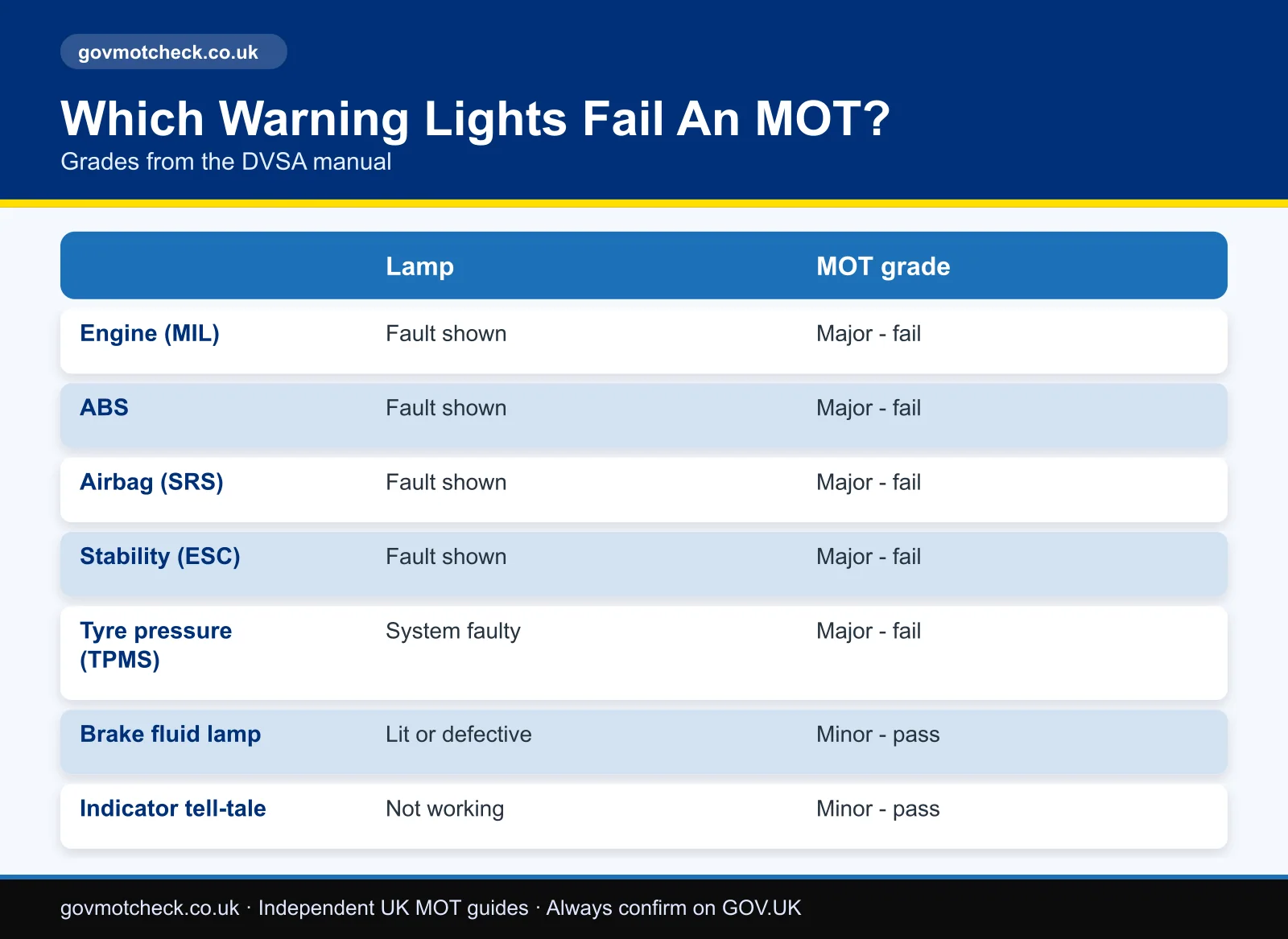
| Warning lamp | Grade in the DVSA manual |
|---|---|
| Engine malfunction indicator lamp (MIL) inoperative or showing a fault | Major |
| ABS warning lamp showing a malfunction | Major |
| SRS (airbag) lamp showing a malfunction | Major |
| ESC lamp clearly indicating a malfunction | Major |
| Electric power steering lamp showing a malfunction | Major |
| TPMS malfunction | Major |
| Brake fluid warning lamp illuminated | Minor |
| Indicator tell-tale missing or inoperative | Minor |
Important
Most dashboard warning lamps that show a fault are major fails, so do not ignore a lit lamp before the test.
Is An Engine Management Light An MOT Failure?
Yes, on the vehicles covered. The manual grades a MIL that is inoperative or showing a fault as major. It applies to:
- Petrol and gas or bi-fuel vehicles with four or more wheels (hybrids included).
- Diesel vehicles with four or more wheels, subject to first-use dates.
Kit cars, amateur-built vehicles and American pickups are exempt.
Can A Car Pass With The Engine Light On?
Not if the lamp is showing a fault on a covered vehicle. Fix the fault, then confirm the lamp goes out after starting. Clearing codes just before the test does not help if the fault returns.
Warning
Clearing fault codes just before the test can leave the car unable to complete the check, and the fault will return.
Is A Service Light An MOT Failure?
A service reminder is not listed among the warning lamps we found in the manual, so it is not graded as a defect there. Treat it as a maintenance prompt.
Is The Tyre Pressure Light A Failure?
A TPMS system that is malfunctioning is major. If it lit because a tyre is low, the tester may add advisory information. Check pressures first.
Pre-MOT Checks You Can Do Yourself
A pre-MOT check is a walk-round and dashboard check before the real test. Searches like "pre mot checklist" and "pre mot checks" are among the highest on this page.
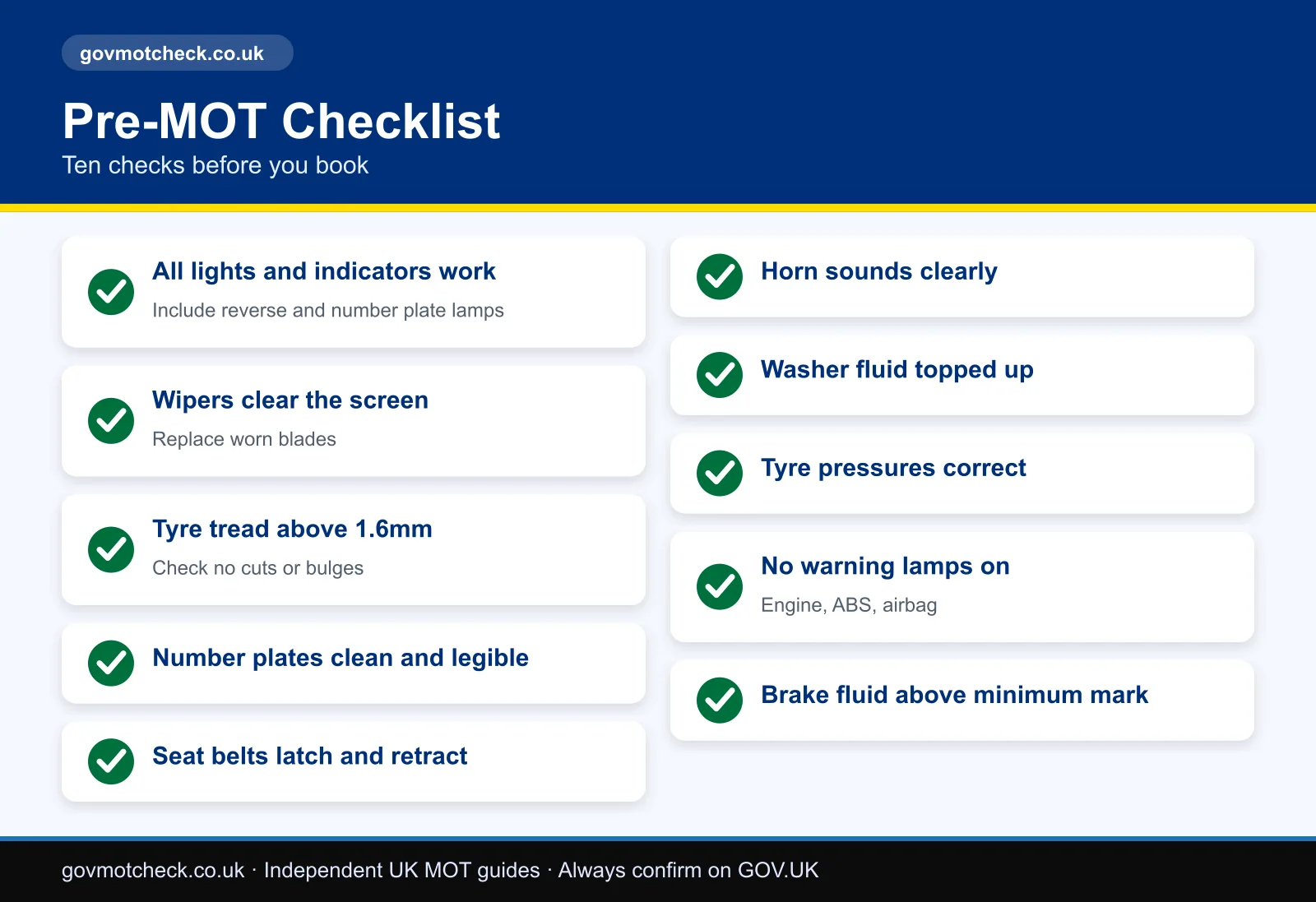
What Should Be On A Pre-MOT Checklist?
Work through these items, where the manual gives clear thresholds:
- Lights, indicators and horn.
- Wipers and washer fluid.
- Tyre condition and pressures.
- Number plates.
- Mirrors and seat belts.
- Windscreen damage.
- Dashboard warning lamps.
- Brake fluid level.
- A look underneath for leaks.
Pro Tip
Print or save this list and tick it off the day before the test, so you have time to fix what you find.
How Long Does A DIY Check Take?
A basic walk-round can be done in a few minutes with a helper to watch the lights. Allow longer if you check tread depth and fluids.
How Do I Check Lights Alone?
Reverse up to a wall or a reflective surface, or use a helper. Test these in turn:
- Dipped and main beam.
- Sidelights and fog lamps.
- Indicators and hazards.
- Stop lamps and reversing lamps.
Remember number plate lamps.
How Do I Check Tread Depth?
Use a tread gauge across the central three-quarters of the tread, in the main grooves, at several points around the tyre. The 1.6mm minimum applies to ordinary cars.
Worked example
On a four-tyre car, you measure each tyre in three places across the tread and around the circumference. The lowest reading on any tyre is the one that counts against the 1.6mm limit.
What Should I Look For Underneath?
Look for:
- Fluid drips.
- Damaged brake pipes.
- Split rubber boots.
- Loose exhaust sections.
- Obvious corrosion.
If you cannot safely get underneath, ask a garage.
Getting A Professional Pre-MOT Inspection
You can ask a garage for a pre-MOT check or a health check before the test. Searches include "pre mot inspection" and "can you get a pre mot check".
What a garage can do
Raise a ramp, check wear and quote repairs before the official test. Often it can repair the car too.
What it cannot do
A garage doing a pre-check is not the DVSA tester and cannot guarantee the result.
Is A Pre-MOT Check Worth Paying For?
Yes, in any of these cases:
- The car is older.
- It has unexplained noises or warning lights.
- The last MOT listed several advisories.
A garage can raise a ramp, check wear and quote repairs before the official test. Price comparison is covered in the booking guide.
Can The Garage Also Repair It?
Often, and that avoids a second trip. But remember that a garage doing a pre-check is not the DVSA tester and cannot guarantee the result.
Note
A clean pre-check is a good sign, not a promise. The official tester applies the manual on the day.
Should I Book The Real Test Straight After?
Some centres combine them. Check the retest policy of the centre, because failing in front of the same tester usually gives you the strongest retest terms.
Appeals And Disputes About A Result
GOV.UK explains how to challenge a result. It is not a substitute for a retest if you simply want the work done.
Before you appeal
Discuss the result with the test centre first. Note the 14 working day deadline the day you receive the fail.
While the appeal runs
Do not have any repairs made until the appeal process has finished, because it can destroy the evidence.
Can I Appeal An MOT Failure?
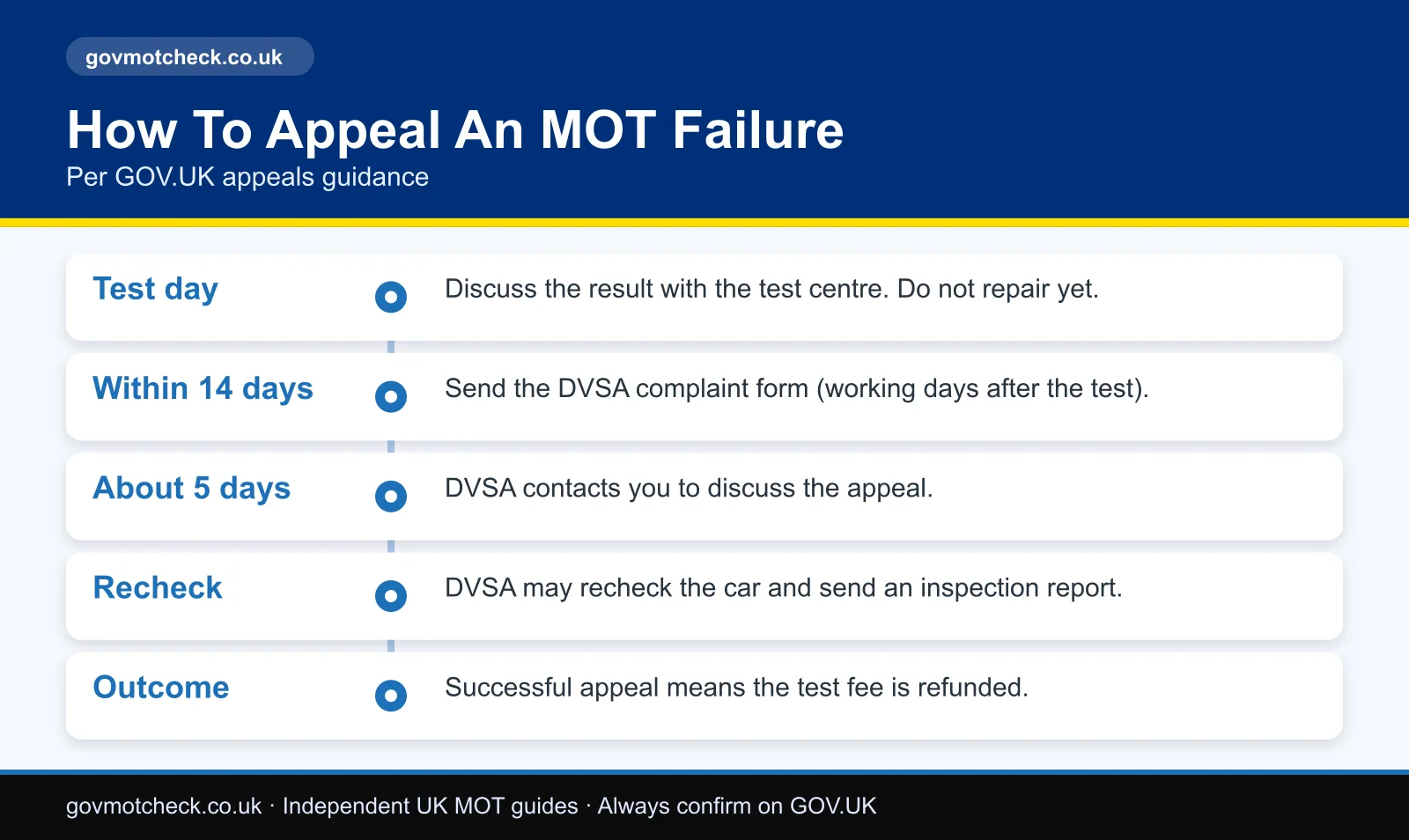
Yes. You can appeal to DVSA if your vehicle failed and you think the failure was wrong, or if it passed and you think it should have failed. Discuss the result with the test centre first. GOV.UK says you should not have any repairs made until the appeal process has finished.
Warning
Repairing the car before the appeal ends can destroy the evidence. Wait until the process has finished.
What Is The Deadline?
Send the complaint form to DVSA within 14 working days of the test for a failed MOT you dispute. For a pass you think should have failed, GOV.UK gives 3 months if the problem is corrosion-related; confirm other deadlines on the GOV.UK page, because the wording is easy to misread.
Important
Note the 14 working day deadline the day you receive the fail, and confirm the exact wording on GOV.UK.
What Happens After I Appeal?
The process runs like this:
- DVSA contacts you. It says it will do so within 5 days to discuss the appeal.
- Possible recheck. It may recheck the vehicle and send an inspection report listing defects.
- Fee. If a recheck is ordered after a failed-test appeal you must arrange a date and pay the full test fee again; if the appeal succeeds, the fee is refunded.
Can DVSA Get Me Compensation?
GOV.UK says DVSA cannot help you get a refund or compensation from the MOT centre. For action against a centre, GOV.UK points to Trading Standards, personal legal proceedings or the police.
What If The Record Is Wrong Rather Than The Test?
Mistakes on the record are a separate process. See our MOT certificate guide for corrections.
MOT Failure Myths
Myths cost people money and cause unsafe driving. Each one below is checked against GOV.UK or the DVSA manual.
Myth: A Failed Car Can Never Be Driven
It can, if the current MOT is still valid and no dangerous defect was listed, per GOV.UK. It must still be roadworthy.
Myth: Advisories Mean A Fail Next Year
Not necessarily. They signal a watch-list. Many advisories remain for years without becoming a fail, but ignoring brake or steering ones is risky.
Pro Tip
Judge each advisory by the component, not by the word "advisory". Brakes and steering come first.
Myth: You Need A Spare Tyre To Pass
You do not. The spare is not checked as a road wheel.
Myth: A Retest Is Always Free
Only in defined cases. Taking the car away and returning within 10 working days may attract a partial retest fee.
Myth: The Engine Light Is Just A Warning
On covered vehicles a MIL showing a fault is a major failure.
Myth
The engine light is just a warning.
Fact
A MIL showing a fault is a major failure on covered vehicles. Fix the fault, then confirm the lamp goes out.
Myth: The MOT Checks The Engine And Gearbox
GOV.UK says the test does not cover the condition of the engine, clutch or gearbox. Emissions and leaks are checked.
Buying A Car That Failed Its MOT
Searches such as "mot failure cars for sale" and "buy mot failure cars" show people hunt for bargains. Risk is higher, so be systematic.
How Do I Check The Failure Reasons?
Look up the registration in the online history and read the fail items and the categories. A dangerous brake defect and a blown bulb are very different purchases. Our history checker guide walks through the steps.
Worked example
Two failed cars are listed at the same price. One failed on a blown bulb, the other on a dangerous brake defect. The first is a cheap fix; the second needs a proper repair quote before you buy.
What Should I Price In?
Add up these costs:
- Parts and labour.
- The retest fee.
- Tax status.
- Delivery.
Do not count on a free partial retest unless you have confirmed terms with a centre.
Can I Drive It Home?
Only under GOV.UK's limits: valid MOT with no dangerous items, or travel to a repair or pre-booked test. Dangerous items mean transport on a trailer. The MOT and tax guide covers tax and insurance questions when buying.
Warning
Do not drive a car home if any dangerous item was listed, however short the journey.
Fleet And Business Angles
Fleet owners deal with many vehicles and can lose revenue when one fails.
How Should A Fleet Handle Failures?
Three habits:
- Keep a list of defects by vehicle.
- Repair them before retest windows close.
- Track repeat advisories, which often indicate driver or maintenance issues.
Should Fleets Use Pre-MOT Checks?
Daily walk-round checks catch bulbs, tyres and leaks. Combine with scheduled servicing so test day is a formality.
Where Can I Find Official Failure Statistics?
DVSA publishes MOT testing statistics on GOV.UK. We do not quote failure rates here because we have not verified current figures; use the official release for exact numbers.
Where To Check The Rules Yourself
Official sources override this page. The most useful are:
- GOV.UK's "Getting an MOT" pages.
- The "Retest after a repair" page.
- The "Test result appeals and problems" page.
- The DVSA MOT inspection manual.
As of November 2026 the manual page showed an update dated 14 October 2026; check it for changes before relying on any threshold above.
Important
If anything on this page differs from GOV.UK or the DVSA manual, follow the official source.
What If The Rules Change?
Thresholds and fees can change. Where this page quotes a figure, it records the source and the date it was checked. Treat anything else as general guidance.
What If I Am In Northern Ireland?
The DVA runs a separate scheme. Retest and failure details may differ, so use the Northern Ireland MOT guide and NI Direct.
Read the Northern Ireland guide
How To View MOT Advisories Online
To view MOT advisories, use the official GOV.UK Check MOT history service and enter the vehicle's number plate. Each recorded test lists what failed and what had minor problems, and advisories are shown against the test they were recorded on.
How Do You View MOT Advisories Step By Step?
- Go to the Check MOT history service from GOV.UK.
- Enter the registration number of the vehicle.
- Open the latest test and read the failure, minor defect and advisory lists.
- Open earlier tests to compare, so you can see which items were repaired and which keep coming back.
Pro Tip
Check the history before you travel to see a used car, and compare the last two or three tests side by side.
What Extra Detail Do You Need?
GOV.UK says you need the number plate. For tests in England, Scotland and Wales you also need the 11-digit number from the V5C log book if you want to see where each test was done. History for cars, motorcycles and vans goes back to 2005, as of November 2026.
Can You See Advisories From The Paper Certificate Instead?
Yes, if the test centre printed them, but the online record is easier to keep and compare. If an advisory is missing from the paper copy and the online record, ask the test centre to check the result.
How Long After An MOT Fail Do You Have To Fix It?
You have 10 working days if you want a partial retest. After that you need a full retest and the full fee. Separately, there is no deadline for fixing a failed car if you do not need it on the road, but you cannot drive it if it is unroadworthy or has no valid MOT.
What Are The Two Different Deadlines?
- Retest deadline: 10 working days for a partial retest, or the end of the next working day for the free listed-items route at the same centre.
- Driving deadline: your old MOT's expiry date. If it is still valid and nothing dangerous was listed, you can keep driving until it runs out, but you cannot pass that date without a new pass.
Warning
A fail never extends an old certificate. Check the expiry date in the MOT history on the day you fail.
What If You Cannot Fix It In Time?
You can still repair the car later and book a full MOT. Nothing stops you doing that, but you pay the full fee and the car must not be driven on the road without a valid MOT except to a repair or pre-arranged test. The retest rules above explain how working days are counted.
What Are MOT Tyre Rules In The Test?
In the MOT tyres are checked for tread depth, damage, size, rating and fitment. For an ordinary car the minimum is 1.6mm in the main grooves across the central three-quarters of the tread and around the full circumference.
What Do Testers Look At On A Tyre?
- Tread depth in the primary grooves.
- Cuts, bulges, lumps and tears, including exposed cords.
- Speed and load ratings against the minimum for the vehicle.
- Matching sizes and structures on each axle.
- Valves and seating on the rim.
- Whether the tyre fouls a part of the vehicle.
Only the wheels fitted at the time of inspection are checked; the spare is not. The full table of tyre defects and their grades is in the tyre sections above.
Pro Tip
The cheapest tyre check is a tread gauge. Tyres close to 1.6mm are worth replacing before the test, not after a dangerous fail.
Why Do New Cars Fail MOTs?
A car's first MOT is due three years after registration, and cars that fail at that age usually fail on ordinary wear and tear items rather than age. The DVSA does not rank causes on this page's verified sources, so we do not quote percentages.
What New-Car Fail Topics Are Worth Checking?
- Bulbs and lamps, including reversing lamps and number plate lamps.
- Tyres, which wear faster on cars that cover high mileage.
- Wipers, washer fluid and windscreen chips.
- Number plates, especially tinted, film-covered or non-standard ones.
- Warning lamps such as ABS, airbag, ESC, engine and tyre pressure monitoring.
- Brake wear on cars driven mainly in towns or on motorways.
Note
A young car with a warning lamp on is a fail for the same reason as an old one. Manufacturer warranty is a separate matter from the MOT, so ask the dealer if the fault might be covered.
For when the first test is due, see MOT due date rules.
How To Lower Emissions For The MOT
To lower emissions before an MOT, make sure the car is serviced, has no warning lamps lit, and is fully warmed up when the test starts. If the readings are still high, the cause is usually a worn component, so the reliable fix is a proper diagnosis rather than an additive.
What Helps Petrol Cars?
- A service with fresh spark plugs, air filter and oil if due.
- Fixing any misfire or lit engine lamp first.
- A good warm-up run so the catalyst is hot.
- Checking for exhaust or induction leaks.
What Helps Diesel Cars?
- A longer, steady run before the test so a partly loaded DPF can regenerate.
- Replacing a clogged air filter.
- Having injectors, EGR or turbo problems diagnosed if smoke is visible.
Warning
Do not remove or modify emission equipment to pass. That is itself a major defect in the DVSA manual.
Should You Fix An MOT Advisory?
You do not have to fix an advisory to pass, but you should fix any that affect brakes, steering, suspension or tyres, and watch the rest. An advisory is the tester telling you the part is not yet a fail, which makes it the cheapest moment to repair it.
How Do You Decide?
- Safety part, getting worse: fix soon.
- Wear item near its limit: budget for it before the next test.
- Cosmetic or surface note: monitor it.
Which MOT Failures Are The Most Common?
The most common failure areas are lights, tyres, brakes, suspension, visibility and emissions, and most are cheap to prevent. DVSA publishes official MOT statistics on GOV.UK if you need exact rankings.
Pro Tip
Use the pre-MOT checklist on this page the day before your test.
Frequently Asked Questions
What are MOT advisories?
MOT advisories are notes a tester adds for items that are not yet failures but may need attention soon. They appear on the certificate and in the online MOT history, and they do not affect the pass or fail result. Typical examples include early corrosion, tyres nearing the limit or slight leaks.
Do MOT advisories mean my car will fail next year?
Not necessarily. An advisory is a watch-list item, and many stay unchanged for years. However, advisories on brakes, steering, suspension or tyres can become major defects as wear continues, so it is sensible to get them checked and priced well before your next test.
How do I check MOT advisories online?
Use the official GOV.UK MOT history service and enter the vehicle's registration number. The record lists each test with its result, mileage, advisories, minor defects and failure reasons. It is free, and you can check a car you do not own, which is useful when buying used.
Can I drive my car if it fails its MOT?
You can drive it only if its current MOT is still valid and no dangerous problems were listed, according to GOV.UK. The car must still meet roadworthiness standards at all times. If the MOT has expired, you may only drive it to a repair or to a pre-arranged test.
Can you drive a car with a dangerous MOT defect?
No. A dangerous defect means a direct and immediate risk, and you should not drive the vehicle until it is repaired. GOV.UK says driving a vehicle that failed for a dangerous problem can lead to a fine of up to £2,500, a driving ban and 3 penalty points.
What is the difference between a major and a dangerous defect?
A major defect may affect safety or the environment and causes a fail, while a dangerous defect is a direct and immediate risk and also causes a fail. The practical difference is driving: a major fail with a valid old MOT can be driven carefully, but a dangerous one should not.
Do minor defects fail an MOT?
No. Minor defects are recorded but the vehicle can still pass. They are listed on the certificate and online history so you can repair them later. Fixing them promptly is wise, because many minor faults, such as low fluid levels, become major failures if left to worsen.
Is an MOT retest free?
Sometimes. GOV.UK says there is no fee for a partial retest if you leave the vehicle at the test centre and it is retested within 10 working days. A partial retest is also free if you return to the same centre by the end of the next working day, for listed items only.
How long do I have for an MOT retest?
You have 10 working days for a partial retest. GOV.UK says that if you take the vehicle away for repairs and bring it back within 10 working days, only a partial retest is needed. After that period you will need a full retest and must pay the full test fee again.
How much is a partial MOT retest?
GOV.UK does not state a fixed price on its retest page. It says you may be charged a partial retest fee if you take the car away and return within 10 working days. Ask the test centre for the exact price, and remember the full test fee is capped by law.
What is the maximum MOT fee for a car?
As of November 2026, GOV.UK lists £54.85 as the maximum fee for most Class 4 vehicles, including cars with up to 8 passenger seats. Test stations cannot charge more than the maximum, and no VAT is added. Always check the GOV.UK fees table for the current figure.
Do I need to go back to the same garage for a retest?
Not legally, but the free and partial retest rules described by GOV.UK apply to the same test centre. If you use a different centre you should expect a full test and the full fee. Compare repair quotes against the value of the retest concession.
What counts as a working day for a retest?
A working day is a normal weekday, excluding weekends and bank holidays. When counting 10 working days, start from the day after the fail and skip weekends and bank holidays. If you are close to the deadline, confirm the date with the test centre before you rely on it.
Which items are covered by the next working day free retest?
GOV.UK lists items such as mirrors, horn, lamps, seat belts, seats, windscreen and wipers, and wheels and tyres. Some items, such as stairs and emergency exits, apply only to class 5 vehicles. Brake and emissions failures are not on that list, so those need a different retest route.
Is a tyre with 1.6mm tread legal for an MOT?
Yes, for an ordinary car 1.6mm in the primary grooves across the central three-quarters of the tread and around the full circumference is the minimum in the DVSA manual. Insufficient tread is a dangerous defect, so replacing tyres before they reach the limit is sensible.
Can tyres fail an MOT?
Yes. Tyres can fail for insufficient tread, cuts that reach the ply or cord, bulges or lumps, a speed or load rating below the minimum, mixed sizes or structures on one axle, a tyre fouling the vehicle or a badly seated tyre. Some of these are dangerous and some major.
Do you need a spare tyre to pass an MOT?
No. The DVSA manual says only road wheels fitted at the time of inspection are checked. If a spare is defective the tester advises you, but it is not a test failure. A car without a spare, using a repair kit instead, can still pass.
Is a nail in a tyre an MOT failure?
Not automatically. The manual focuses on cuts that expose ply or cord and on structural damage. A nail without such damage may be passed, with advice to repair it. A leaking tyre that cannot hold pressure is likely to cause other problems, so have it repaired quickly.
Is a tyre pressure warning light an MOT failure?
It can be. The check applies to cars first used on or after 1 January 2012, and a malfunctioning or obviously non-working TPMS is a major defect. If the light is on only because a tyre is low, the tester may add advisory information instead of failing it.
Is an engine management light an MOT failure?
Yes, on covered vehicles. The DVSA manual grades an engine malfunction indicator lamp that is inoperative or showing a fault as major. Kit cars, amateur-built vehicles and American pickups are exempt. Have the fault diagnosed and repaired before the test rather than simply clearing the code.
Is an ABS light an MOT failure?
Yes. An ABS warning lamp that does not work, or shows a malfunction, is graded major in the DVSA manual. An ABS system that has been obviously removed is also major, and ABS cannot legally be removed from vehicles first used on or after 1 January 2010.
Is an airbag warning light an MOT failure?
Yes. The SRS lamp showing a system malfunction is a major defect. A passenger airbag that is switched off, or a lamp showing that it is disabled, is not a defect. Get the airbag system diagnosed by a competent garage because it affects occupant safety.
Is a service light an MOT failure?
We could not find a service reminder listed as a defect in the DVSA manual, so it is not graded as one there. It is still a maintenance prompt, and a car overdue a service may have underlying faults that do cause failures. Check your handbook for what the lamp means.
Is a reversing light an MOT failure?
Yes, on vehicles first used on or after 1 September 2009, excluding quadricycles and Class 3. An inoperative reversing lamp or defective lens is a major defect. The lamp must come on automatically when reverse is selected and go off when it is deselected.
Are side lights an MOT failure?
They can be. A missing, inoperative or more than half-out position lamp is major, while a multi-source lamp with up to half out is minor. Position lamps must show steady red at the rear and white or yellow at the front in line with the manual.
Do daytime running lights fail an MOT?
They can on vehicles where they are fitted as original equipment. The manual says DRLs on M1 vehicles first used on or after 1 March 2018 must be white and no more than two. A missing or inoperative required lamp counts under the position lamp defects.
Can a number plate fail an MOT?
Yes. Every registration plate defect in the DVSA manual is major, including a missing or insecure plate, an illegible inscription, an incorrect registration or a plate that does not meet the specified requirements. Both front and rear plates must be fitted on most vehicles.
Does the MOT check the brakes?
Yes. The test inspects pedal or lever condition, pads, discs, pipes, hoses, fluid and brake performance on a roller tester, plate tester or decelerometer. For a car first used on or after 1 September 2010, the service brake must reach 58% efficiency.
Does the MOT check the engine oil?
The MOT does not assess the condition of the engine, clutch or gearbox, according to GOV.UK. The tester does check for fluid leaks and emissions. A car with low oil may still pass if it has no leaks and meets emission rules, but running low is risky.
Is the exhaust emissions test part of the MOT?
Yes. GOV.UK says the MOT checks road safety and environmental standards, and section 8 of the DVSA manual covers exhaust emissions. Petrol cars are tested for CO, HC and lambda, while diesel cars are tested for smoke opacity and the presence of a particulate filter.
Why did my diesel car fail the MOT on emissions?
The most common reasons are smoke above the limit, visible smoke from a vehicle fitted with a DPF, evidence of DPF tampering, missing or modified emission equipment or an induction or exhaust leak. A garage can diagnose injectors, EGR, turbo, air filter or DPF problems.
What are the diesel smoke limits for an MOT?
Where there is no plate value, the manual sets 2.5 m⁻¹ for non-turbo or 3.0 m⁻¹ for turbo diesels first used before 1 July 2008, 1.5 m⁻¹ for 1 July 2008 to 31 December 2013, and 0.7 m⁻¹ from 1 January 2014. A manufacturer's plate value takes priority.
What are the petrol emissions limits for an MOT?
For the basic test the manual gives CO up to 0.2% and HC up to 200 ppm at fast idle, lambda between 0.97 and 1.03, and CO up to 0.3% at idle. Catalyst cars use vehicle-specific limits from a database, so ask the garage for the figures for your car.
Does the MOT check the DPF?
Yes, indirectly. The tester looks for visible smoke of any colour during the metered check and rejects a filter that appears to have been tampered with, such as one cut open and rewelded without a valid reason. Visible smoke from a car with a DPF is a major defect.
How can I reduce emissions before the MOT?
Make sure the car is serviced, has no warning lights, and is fully warmed up before the test. A sustained run can help a diesel DPF regenerate. If readings are still high, the cause is usually a worn sensor, catalyst, injector or leak that needs proper diagnosis and repair.
Can I sell a car that failed its MOT?
Yes, GOV.UK does not stop you selling a failed car, but you should be honest about the failure and the defects. Buyers include private purchasers wanting a project, dealers and scrap buyers. Compare offers against the cost of repairing and retesting it yourself.
Can I scrap a car that failed its MOT?
Yes. If repairs cost more than the car is worth, an authorised treatment facility can scrap it. You should tell DVLA and sort out vehicle tax or SORN as needed, and keep the paperwork. Our tax guide explains the status steps.
Can I tax a car that failed its MOT?
Not unless it has a valid MOT. GOV.UK says that if your MOT has expired you cannot renew vehicle tax until the vehicle passes. If you will not use the car on the road, you can declare it off the road with a SORN instead.
Does a failed MOT affect my insurance?
It may. Policies commonly require a roadworthy vehicle, and driving one with a known dangerous defect could cause problems if you make a claim. We cannot give legal advice, so read your policy wording and ask your insurer if you are unsure about your position.
Can I appeal an MOT fail?
Yes. If you think the failure was wrong, discuss it with the test centre and then send the DVSA complaint form within 14 working days of the test. GOV.UK says not to have repairs made until the appeal process has finished, because the evidence could be lost.
How long does a DVSA appeal take?
GOV.UK says DVSA will contact you within 5 days to discuss the appeal. It may then recheck the vehicle and send an inspection report listing any defects. There is no stated overall completion time on that page, so ask DVSA when they contact you.
Will I be refunded if my appeal succeeds?
If you appeal a failure and win, GOV.UK says you get the test fee refunded. If a recheck is ordered you must arrange a date and pay the full test fee again first. DVSA cannot help you get compensation from the test centre.
Can I complain about a test centre?
Yes. If you are unhappy with the MOT service, GOV.UK points you to contact DVSA. For action against a centre, it suggests Trading Standards, legal proceedings or the police. DVSA says it cannot help you take action against a centre or obtain a refund from it.
What if the MOT record has a mistake?
Mistakes on your MOT record use a separate process from an appeal. GOV.UK has a page called Report a mistake on your MOT record. Use it for errors such as wrong details, not to disagree with a tester's judgement about whether a defect existed.
Does the MOT check windscreen damage?
Yes. In the zone directly ahead of the driver, damage over 10mm in diameter matters, and in the rest of the swept area the limit is 40mm. Damage only fails when it significantly affects the driver's view. Repaired screens are judged on whether the repair interferes with vision.
Do wipers and washers affect the MOT?
Yes. A wiper that does not operate or is missing is a major defect, and so are washers that do not work or lack enough fluid. A defective blade is minor, but a blade that clearly fails to clear the screen counts as major.
Does rust fail an MOT?
It can. Corrosion is major if it significantly reduces vehicle rigidity and dangerous if steering or braking is likely to be affected. Body panels corroded to the point of likely injury when grazed are major. Surface rust away from structural areas is more likely to be an advisory.
Are seat belts checked in the MOT?
Yes. A missing statutory belt, loose anchorage, damaged webbing or a faulty buckle or retractor is a major defect. Original-equipment pre-tensioners or airbags that are obviously missing or deployed are also major. Check every belt fully extends, latches and retracts before your test.
Does the MOT check the horn?
Yes. An audible warning that does not work is a major defect, an insecure control is minor, and a horn that does not comply with requirements is major. Test it before the MOT, because it is a quick and cheap thing to fix.
Does a car with a tow bar need extra checks?
Yes. Towbars are inspected for wear, damage, corrosion and security. A coupling with excessive wear is major, and one likely to fail or detach is dangerous. A towbar that blocks the number plate or a lamp is minor, or major if the plate is unreadable.
Can I check if a car passed its MOT?
Yes. Enter the registration number into the GOV.UK MOT history service to see the result of each test, along with advisories and failure reasons. Our home page guide explains how to read the record, including mileage and dates, and how to spot gaps.
How often should I do a pre-MOT check?
A quick check before every MOT is sensible, and many drivers also check lights, tyres and fluids monthly. Most cheap failures, such as bulbs, wipers, washer fluid and number plates, are easy to catch with a few minutes of attention.
Is a pre-MOT inspection worth it?
It can be if the car is older, has warning lights, or the last test listed several advisories. A garage can lift the car, assess wear and quote repairs in advance. It cannot guarantee the result, because the official tester makes the final judgement on the day.
What should I do first if my car fails the MOT?
Read the failure list and note which items are dangerous or major, then check whether your old MOT is still valid. Ask for a written repair quote, decide whether to repair at the same centre, and work out your retest deadline from the date of the failure.
Can I get a free MOT retest at a chain like Halfords or Kwik Fit?
Chains publish their own retest policies, and these may offer more than the legal minimum. Rules in GOV.UK still describe the standard partial and full retest arrangement. Check the chain's current terms in writing and ask about the time limit and which items are included.
Does a failed MOT show in the online history?
Yes. Failed tests are recorded in the national MOT database, and the fail, with its dangerous and major items, appears in the public history for the registration. A later pass does not delete the earlier fail, so buyers can see the pattern.
Do funny MOT advisory notes mean anything?
They are free-text comments written by testers, so wording varies and occasionally sounds odd. Treat the content seriously even if the phrasing is blunt. Judge urgency by the component involved and the verb used, and ask a garage if the meaning is unclear.
Are the MOT rules different in Northern Ireland?
Yes. Northern Ireland runs a separate scheme operated by the DVA, and its details can differ from GB rules. This page covers Great Britain. See our Northern Ireland guide and NI Direct for local rules, retest arrangements and any applicable fees.
Where can I find official failure statistics?
DVSA publishes MOT testing statistics on GOV.UK. We do not quote failure rates here because we have not verified current figures, and unverified numbers circulate widely online. Use the official release if you need an exact pass rate or a ranking of common failure reasons.
What happens if you fail an MOT?
The failure is recorded on the national MOT database and you get a list of dangerous and major defects. The car needs those repaired and retested before it can pass. You can drive it away only if the old MOT is still valid and nothing dangerous was listed. A fail itself carries no fine.
What happens if my MOT fails and the old one has expired?
You cannot drive or park the car on the road, except to take it to or from a repair, or to a pre-arranged MOT appointment. Driving without a valid MOT can bring a fine of up to £1,000. Arrange repairs, recovery or a booked retest rather than using the car normally.
How long after an MOT fail do you have to fix it?
For a partial retest you have 10 working days, according to GOV.UK, or until the end of the next working day for the free listed-items route at the same centre. After that you need a full retest and full fee. There is no deadline if you leave the car off the road.
How can I view MOT advisories online?
Use the GOV.UK Check MOT history service and enter the vehicle's number plate. Open a test to see its failures, minor defects and advisories. For tests in England, Scotland and Wales, GOV.UK says you also need the 11-digit V5C number to see where each test was done.
Should I fix MOT advisories?
You do not have to for the MOT, but you should fix any on brakes, steering, suspension or tyres promptly, because they can become major or dangerous defects. Budget for wear items near their limit, and simply monitor cosmetic or surface notes. Repairing early is usually cheaper than a forced repair after a fail.
Which MOT problems fail a car and which do not?
Dangerous and major defects fail a car. Minor defects and advisories do not. Typical majors are non-working lamps, wipers or horn, illegible number plates, and ABS, airbag, ESC or engine warning lamps showing a fault. Typical dangerous items are insufficient tyre tread, a tyre bulge or brake fluid not visible.
How do I lower emissions for the MOT?
Service the car, fix any warning lamps, and drive it far enough that the engine and catalyst are fully warm before the test. Diesels may benefit from a longer run to help the DPF regenerate. If readings stay high, have the cause diagnosed, as additives are unreliable and removing emission equipment is a major defect.
Why do new cars fail their first MOT?
At three years old, failures are usually ordinary wear items rather than age: bulbs, tyres, wipers, windscreen chips, number plates, brake wear and warning lamps. We do not quote failure percentages because we cannot verify current figures. DVSA publishes official MOT statistics on GOV.UK if you need rankings.
What do MOT tester tyre checks include?
Testers check tread depth in the main grooves, cuts, bulges and lumps, exposed cords, speed and load ratings, matching sizes and structures on each axle, valve damage, seating on the rim and whether the tyre fouls the vehicle. The spare is not checked. Ordinary cars need at least 1.6mm of tread.
Does a tyre cut with cords felt but not seen fail an MOT?
It can. If the cords can be seen, it fails whatever the cut size. If they can only be felt, it fails when the cut is longer than 25mm or 10% of the section width, whichever is greater. The tester must first make sure it is cords and not a foreign object, and passes with an advisory if unsure.
Can I get an MOT retest at a different garage?
Yes, but expect a full test and full fee, because GOV.UK describes the partial retest rules in relation to the original test centre. Ask the new centre for its terms before booking. A cheaper repair elsewhere can still outweigh the lost partial concession, so compare total cost.